

A reader recently asked Diventures Magazine:
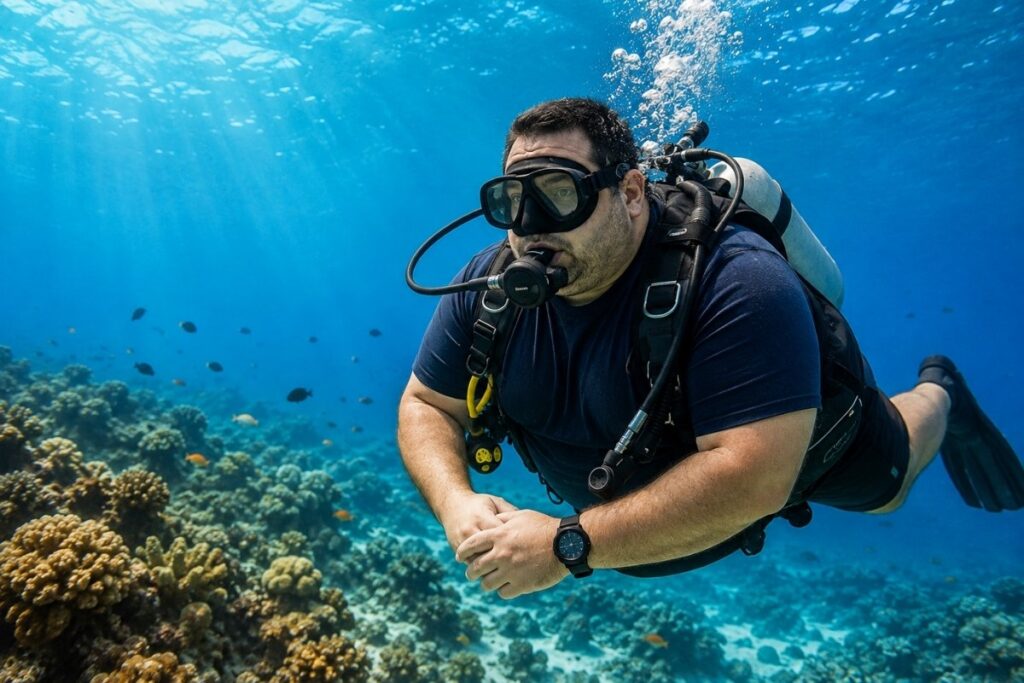
“I weigh about 110 kg and I am around 175 cm tall. Can I practice scuba diving and freediving normally, or do I need to lose weight?”
The short answer is that being overweight does not automatically mean you cannot scuba dive or freedive.
However, body weight is only one part of the picture. Cardiovascular fitness, exercise capacity, mobility, medical history and the demands of the planned dive are much more important when deciding whether someone is fit to dive.
For someone who is significantly overweight, a medical assessment may also be advisable before beginning or returning to diving, particularly when other cardiovascular or metabolic risk factors are present.
Weight Alone Does Not Decide Whether You Can Dive
At 110 kg and 175 cm, the standard Body Mass Index calculation produces a BMI of approximately 35.9.
That number should not, however, be treated as a diving clearance or disqualification.
The Undersea and Hyperbaric Medical Society explains that BMI is not included as a specific criterion in the recreational Diver Medical screening questionnaire because it is simply a relationship between height and weight. It does not directly measure body composition and can sometimes be misleading.
Healthy body composition and cardiovascular fitness remain important, but they cannot be determined from BMI alone.
In other words, two people of the same height and weight may have very different levels of physical fitness and potentially very different diving risk profiles.
The More Important Question: Are You Fit Enough to Dive?
Scuba diving can sometimes feel physically effortless, particularly in warm, calm water with good buoyancy control.
The problem is that conditions do not always remain easy.
A diver may suddenly need to swim against a current, complete a long surface swim, climb a boat ladder while wearing equipment, deal with waves or assist another diver.
Divers Alert Network therefore emphasizes the importance of both strength and cardiovascular capacity.
A useful question is not simply:
“How much do I weigh?”
It is:
“Can my body comfortably handle the physical demands of the dive, including an unexpected emergency?”
Someone who is overweight but exercises regularly, swims comfortably and has good cardiovascular capacity may be better prepared for those demands than someone with a lower body weight but poor physical conditioning.
Why Excess Weight Still Matters
Although weight alone does not determine fitness to dive, significant excess body fat should not simply be ignored.
DAN notes that overweight divers can have greater cardiovascular risk. Excess body fat may also be associated with conditions such as hypertension, cardiovascular disease and reduced exercise tolerance.
Diving itself places additional demands on the cardiovascular system. Immersion, exertion, cold, breathing gases under pressure and stress can all affect the body’s workload.
This makes underlying cardiovascular health particularly important.
Current diving medical guidance therefore focuses on the diver as a whole rather than establishing a universal maximum body weight for recreational diving.
What About Decompression Sickness?
It is tempting to assume that being overweight automatically means a diver will develop decompression sickness more easily because nitrogen dissolves in fatty tissues.
The real world relationship is more complicated.
DAN states that there is not a clear correlation between obesity and increased decompression illness risk. This means body weight alone should not be used to predict whether an individual diver will experience decompression illness.
That does not mean excess weight has no relevance to diving health. Cardiovascular fitness, physical conditioning, dive exposure and individual medical factors still matter.
Divers should therefore follow conservative diving practices regardless of body size.
What About Freediving?
The same basic principle applies to recreational freediving: excess weight by itself does not automatically prevent participation.
The current Diver Medical Participant Questionnaire explicitly applies to both recreational scuba diving and freediving.
Freediving, however, places different physiological demands on the body. Breath holding, swimming underwater, equalization, recovery breathing and repeated dives require appropriate physical conditioning and training.
A heavier freediver may also need to pay particular attention to weighting and buoyancy.
Weight should never be configured simply to make descent easier. Proper weighting should allow the freediver to maintain appropriate positive buoyancy near the surface according to the training system and conditions being used.
Most importantly, freediving should always follow recognized safety procedures, including trained buddy supervision. A freediver should never practice breath hold diving alone.
You Do Not Have to Become Thin Before You Become Active
For many people, swimming, scuba diving and freediving can become part of a broader effort to improve physical fitness.
There is therefore little value in creating an arbitrary rule that someone must reach a particular body weight before entering the water.
The better objective is to progressively improve cardiovascular endurance, strength, mobility and swimming ability.
DAN recommends that divers maintain regular physical activity rather than considering scuba diving itself sufficient exercise.
Weight reduction may improve general health and make some aspects of diving easier, including moving in equipment, climbing ladders and managing strenuous conditions. But the appropriate target should be based on the individual’s health and body composition rather than an arbitrary diving weight limit.
When Should You See a Doctor?
Anyone uncertain about their fitness should complete the current Diver Medical Participant Questionnaire.
The questionnaire is designed to identify medical history or conditions that require assessment by a physician before participating in recreational scuba diving or freediving.
Medical evaluation becomes particularly important when excess weight is accompanied by other potential risk factors or symptoms, such as cardiovascular or respiratory problems, reduced exercise tolerance or relevant metabolic conditions.
Where an evaluation is necessary, consulting a physician familiar with diving medicine is preferable when available.
So, Can a 110 kg Diver Go Diving?
Potentially, yes.
There is no simple recreational diving rule saying that a person weighing 110 kg cannot scuba dive or freedive.
But at 110 kg and 175 cm, it would be sensible to look beyond the number on the scale and assess overall health and physical conditioning.
Can you swim comfortably?
Can you handle moderate sustained exercise without unusual breathlessness?
Can you climb a dive boat ladder safely?
Could you manage a surface swim or assist your buddy if something went wrong?
And are there medical conditions that might increase your risk underwater?
If those questions raise concerns, obtaining a diving medical evaluation before participating is a sensible precaution.
Losing excess body fat and improving fitness can certainly benefit both diving performance and long term health. But fitness to dive should be assessed individually rather than decided by body weight alone.
Sources
Divers Alert Network, Fitness for Diving
DAN Fitness for Diving
Divers Alert Network, Physical Fitness for Diving
DAN Physical Fitness for Diving
Undersea and Hyperbaric Medical Society, Recreational Diving Medical Screening System
UHMS Diving Medical Screening System
PADI, Diver Medical Participant Questionnaire, 2026 edition
Current Diver Medical Participant Questionnaire
Editorial Note
This article provides general diving health information and is not a medical clearance to dive. Individual fitness to scuba dive or freedive should be assessed according to personal health, medical history, physical capacity and the conditions of the planned activity.

Mohsen Nabil is the Founder and Editor-in-Chief of Diventures Magazine. A mechanical engineer and scuba diving instructor based in the Red Sea, he writes about diving safety, marine conservation, underwater exploration, and developments in the global dive industry. Through Diventures Magazine, he works to connect divers, scientists, and ocean advocates while promoting responsible diving and protection of the oceans.