
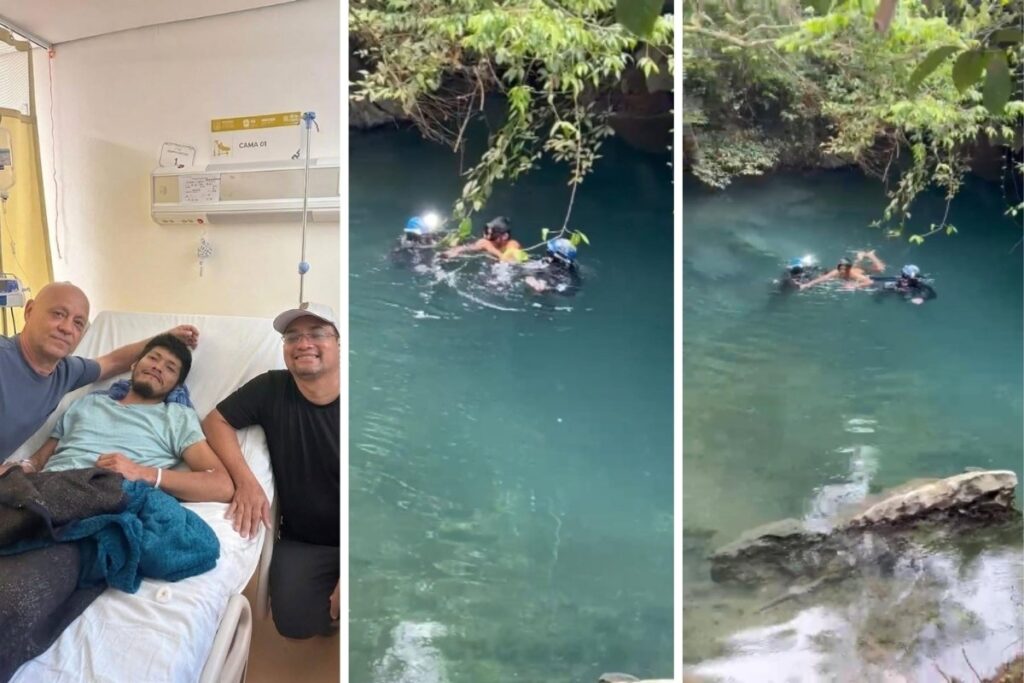

A 31 year old spearfisher has been rescued alive after spending 15 days trapped inside a remote underwater cave system in Mexico, surviving in darkness until specialist cave divers reached the chamber where he had taken shelter.
Erasto Crisanto Valdez disappeared on July 23 while fishing with his father near San Francisco La Paz in the Uxpanapa region, close to the border between the Mexican states of Veracruz and Oaxaca.
According to reports following the rescue, Valdez entered the water carrying a small breathing cylinder and a spear. He reportedly followed a robalo, commonly known as a common snook, into the cave system but was unable to find his way back out.
His father initially attempted to locate him before alerting others. Local residents, relatives, civil protection personnel and Mexican Navy divers subsequently became involved in the search.
Despite the extensive effort, Valdez remained missing.
Search Becomes a Recovery Mission
As the days passed without finding him, expectations that Valdez could still be alive diminished.
Experienced cave divers were eventually brought into the operation, including American cave diving instructor Harry Gust and Rosalino “Rosso” Rivera.
Gust later published his own account of the operation, saying that by the time he became involved, the mission had been presented to him as a body recovery rather than a rescue.
The cave presented significant challenges. According to Gust, visibility was less than one metre in places, while sharp rock formations created additional hazards for divers and their guidelines. The system was also unexplored and apparently unmapped.
During his first search, Gust conducted several search patterns before discovering a small Spare Air cylinder approximately 100 metres inside the cave.
The discovery provided an indication of the route Valdez might have followed.
Gust then ended the dive and returned the following day to continue searching.
A Voice from Inside the Cave
During the second search, Gust reached a large dry section connected to the flooded cave passage.
He called out to determine whether anyone was inside.
Someone answered.
Valdez was alive.
He had been sheltering inside the air filled section of the cave for 15 days, only around 10 metres from where Gust had emerged from the flooded passage.
Gust returned to the surface to inform the rescue team and prepare an extraction plan with Rivera.
The operation remained dangerous. Valdez had spent more than two weeks underground and was reportedly severely dehydrated and malnourished. The rescuers also had to bring him through approximately 100 metres of flooded cave with extremely poor visibility.
One factor worked in their favour. Valdez already had experience breathing through a diving regulator and using a mask.
Gust and Rivera returned to the chamber, where Rivera crossed the dry section to reach Valdez and helped him to the water.
The three then began the journey out of the cave, with Valdez breathing from Rivera’s cylinder.
They successfully reached the entrance, where the surface rescue team took over.
The extraction was completed on August 7.
Valdez was carried by stretcher to an ambulance and transported to hospital. Reports described him as dehydrated and malnourished, but he was later reported to be recovering with his family.
How Did He Survive for 15 Days?
Valdez’s survival appears to have depended on reaching a substantial air filled section beyond the submerged passage.
Gust described finding a dry cave containing a small river with flowing water. This potentially provided Valdez with access to water during his time underground.
Valdez later said that he spent his time sleeping, praying and drinking water.
With no daylight or external reference to measure the passing days, he reportedly believed that he had been trapped for only around three days.
On the day he was discovered, Valdez said he heard bubbles and saw a light before hearing Gust calling into the chamber.
Conflicting Reports About the Rescue
Some early reports contained conflicting information about who located Valdez and how deep inside the cave he had been found.
Gust later published his account partly to clarify those discrepancies.
Reports variously described the location as being 65, 80, 100 or even 120 metres deep. However, Gust’s description indicates that the approximately 100 metre figure referred to penetration distance inside the cave rather than vertical depth below the surface.
His account also indicates that Gust located Valdez and that he and Rivera carried out the underwater extraction, while other divers, local authorities, government agencies and surface personnel contributed to the wider search and rescue operation.
The precise configuration and dimensions of the unexplored cave system have not been independently documented.
What is clear from the available accounts is that Valdez entered an overhead underwater environment without apparent cave diving training, became unable to locate the exit and survived for more than two weeks after reaching an air filled chamber.
His eventual discovery transformed what rescuers had expected to be a recovery operation into an extraordinary successful rescue.
Source: Cave Diver Harry Gust