
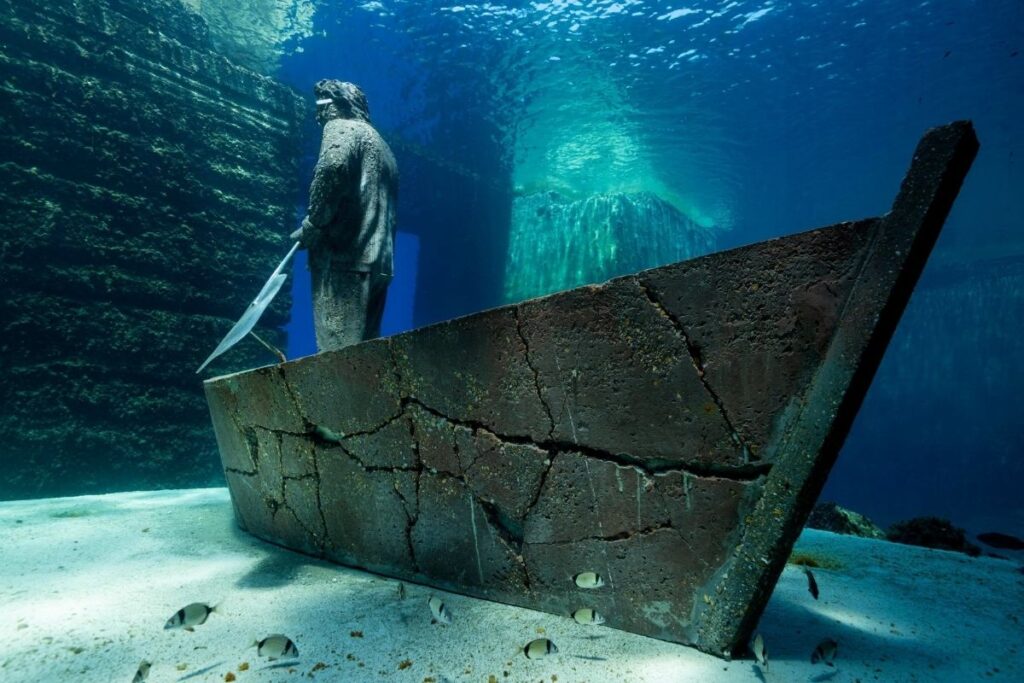

British underwater sculptor Jason deCaires Taylor has installed his first work in Italian waters, a piece titled “Journey Man,” created for the sixth edition of the EOLIÈ festival on the volcanic island of Lipari in Sicily’s Aeolian archipelago.
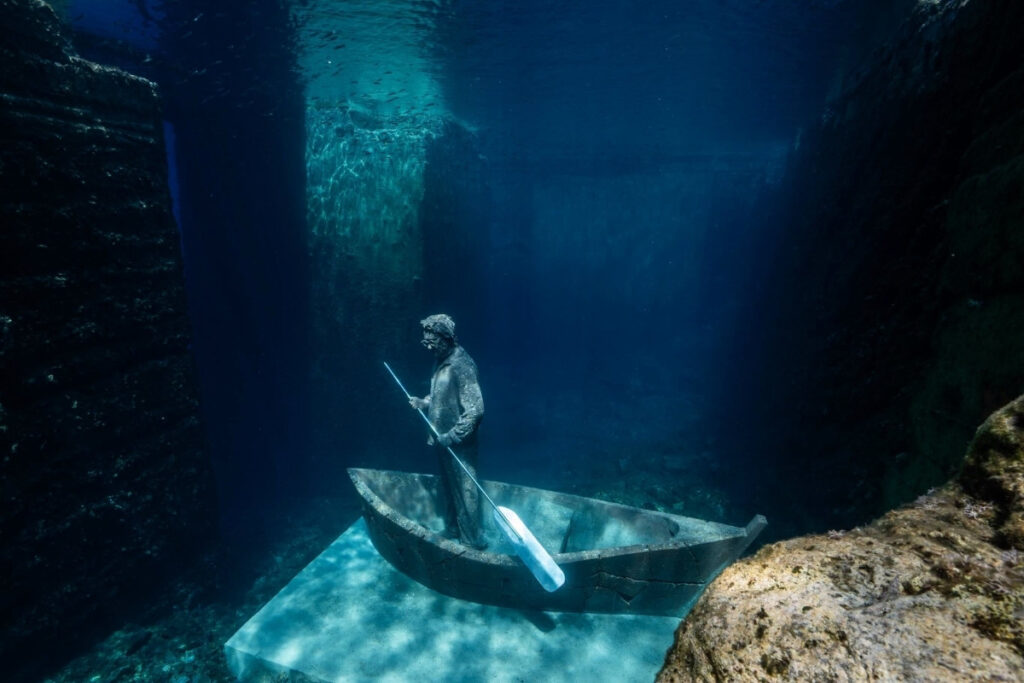
The sculpture sits a few metres below the surface in the sheltered natural pool of Sottomonastero, at the foot of Lipari’s Acropolis, an area known locally as “La Piscina.” It depicts a lone mariner aboard a fragmented vessel, navigating toward the depths.
A tribute to Sebastiano Tusa
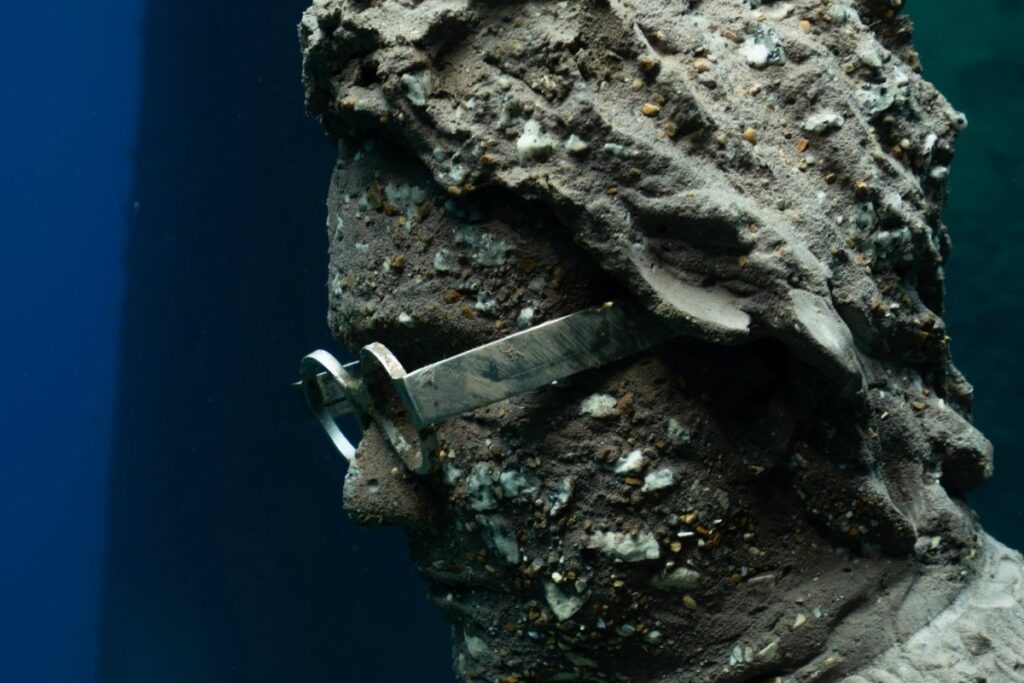
The work is dedicated to Sebastiano Tusa, an Italian marine archaeologist who spent his career researching and protecting submerged cultural heritage across the Mediterranean, from ancient shipwrecks to naval battlefields around Sicily and the Aeolian Islands. Tusa served as Sicily’s regional Councillor for Cultural Heritage and was widely regarded as a leading figure in underwater archaeology before his death on March 10, 2019, when he was among the 157 people killed in the crash of Ethiopian Airlines Flight 302 near Addis Ababa. He had been travelling to a UNESCO conference on underwater cultural heritage.
Taylor’s sculpture reimagines Tusa’s lifelong search for lost history through a figure who continues searching the seabed for stories that time has buried. The vessel is built from fragmented pieces, a visual echo of both an archaeologist piecing together the past and the timeless image of the ark as a refuge for life and memory.
Built to become a living reef
Constructed from pH neutral marine materials, “Journey Man” is designed to function as a long term artificial habitat, allowing coral and marine organisms to colonise its layered stone and aggregate surface over time. Taylor is known internationally for large scale underwater installations, including submerged museums off Cancún, Mexico, and Lanzarote in the Canary Islands, both intended to combine public art with reef regeneration.
According to Taylor, the entire process, from sculpting the portrait and vessel to transporting and installing the work underwater, was completed in roughly three months. He credited the wider team involved in the project and singled out Malfitano’s support as central to bringing the installation to life.
Part of the EOLIÈ festival programme
The sculpture was commissioned for EOLIÈ, Art, Literature and Society, a cultural festival held in Lipari from July 3 to 6, 2026, under the theme “Abyss and Mystery.” The event was organised by the cultural association Un Sanpietrino under the direction of Francesco Malfitano. Alongside Taylor’s installation, this year’s programme featured contemporary sculptor Giuseppe Agnello, urban artist Marco Tamburro, photographer Carlos Solito, and emerging artist Giuditta Sin, with panel discussions on marine conservation running throughout the festival. A follow up programme, “EOLIÈ-off,” is planned for August and September at other Sicilian locations, including Patti and Tindari.
“Journey Man” adds Lipari to the small but growing list of Mediterranean sites hosting permanent underwater art, joining a broader trend of using submerged sculpture to draw divers and snorkellers toward reef restoration sites while commemorating figures tied to the sea.
A destination in the making
For travellers, the appeal lies in what the piece is designed to become over time rather than only what it looks like today. Built from pH neutral marine materials, “Journey Man” is engineered to encourage coral growth and marine colonisation, the same approach behind Taylor’s Cancún and Lanzarote installations, both of which have become established dive and snorkel destinations in their own right. If “Journey Man” follows a similar trajectory, Lipari’s sheltered cove could develop into a comparable draw for underwater art tourism in the Mediterranean.
Prospective visitors should treat the sculpture as a newly unveiled installation rather than a fully established dive site for now. Reporting on the debut has not specified an exact depth, confirmed formal dive permits or marked entry points, or named local operators currently running trips to the site. Travellers interested in visiting should check directly with dive centres and tourism authorities on Lipari for up to date access information, site conditions, and any restrictions tied to the surrounding marine area before planning a trip.
Beyond Lipari, the wider EOLIÈ festival programme, including work from sculptor Giuseppe Agnello, urban artist Marco Tamburro, and photographer Carlos Solito, continues through a follow up series of events, “EOLIÈ-off,” planned for August and September at other Sicilian locations, including Patti and Tindari, giving travellers extending their trip further reason to explore the region beyond the islands themselves.

Mohsen Nabil is the Founder and Editor-in-Chief of Diventures Magazine. A mechanical engineer and scuba diving instructor based in the Red Sea, he writes about diving safety, marine conservation, underwater exploration, and developments in the global dive industry. Through Diventures Magazine, he works to connect divers, scientists, and ocean advocates while promoting responsible diving and protection of the oceans.