

Editorial Introduction
In an exclusive interview with Diventures Magazine, Captain Ahmed Abo Gabal, the technical manager of the dive center responsible for the trip, recounts the final hours leading up to the death of Captain Adam Jacoub during a deep technical dive in the Red Sea.
Abo Gabal, who served as the support diver during the dive, describes what he witnessed personally, as well as what he was later told by the diver who accompanied Adam underwater.
Editorial note: This interview is based on Ahmed Abo Gabal’s account. It does not represent the final outcome of any official investigation, nor does it make any legal determination regarding the cause of death or responsibility. The names of the dive center and the Adam’s buddy diver have been withheld out of respect for the ongoing investigation and the privacy of those involved.
Background to the Incident
The dive took place on 18 July 2026 at the Shaab Al-Maallag dive site.
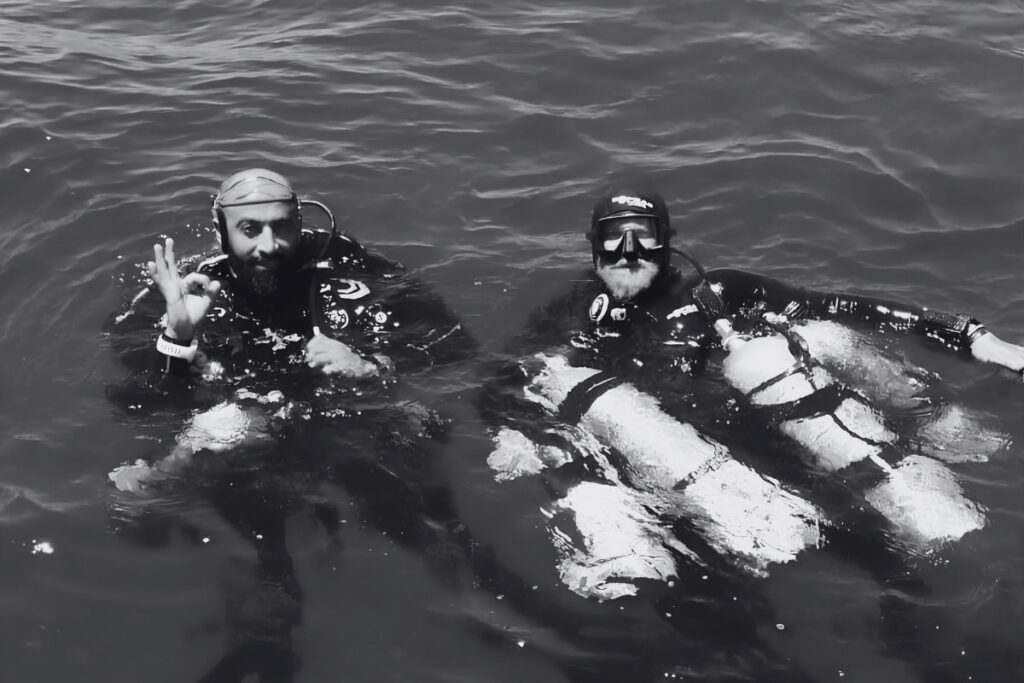
Adam Jacoub was conducting a deep technical dive with a qualified technical diver who held a PADI Trimix Diver certification. Ahmed Abo Gabal was assigned as the support diver, with a planned position at approximately 45 metres.
Preparations began that morning. The team entered the water at approximately 2:23 p.m., while the final diver exited the water at around 5:30 p.m.
The Original Dive Plan
The planned maximum depth was 130 metres.
According to Abo Gabal, the original plan included:
- Reaching the target depth in approximately seven minutes.
- Remaining at the target depth for around seven minutes.
- Beginning a gradual ascent through pre-calculated stops.
- Meeting the support diver at 45 metres, approximately 25 minutes after the start of the dive.
- Completing the ascent and decompression stops within a total runtime of approximately two and a half hours.
Abo Gabal waited at the agreed depth, monitoring the bubbles rising from below as the only available indication of the divers’ movement at greater depth.
According to the report, however, the descent to 130 metres took approximately 24 minutes rather than the planned seven minutes. Abo Gabal considers this delay a significant point in the sequence of events that followed.
The Possible Reason for the Delayed Descent
Abo Gabal believes that the gradual slope of the dive site, rather than a direct vertical drop, may have contributed to the slower descent.
However, he stresses that this remains his personal assessment. It is not something he witnessed directly or can confirm conclusively.
The Moments at 45 Metres
Abo Gabal said he continued monitoring the bubbles, but the agreed time passed without Adam and the accompanying diver reaching him.
He could not remain at that depth indefinitely because doing so would increase his own decompression obligation and place him at risk. He therefore began a gradual ascent.
During his ascent, he was surprised to see the accompanying diver appearing alone and requesting assistance at a depth of approximately 37 metres.
Abo Gabal asked him twice where Adam was. The diver replied that he did not know.
The diver’s available gas had either been exhausted or had become insufficient to complete the remaining decompression stops.
What Happened Between Adam and His Buddy Before They Separated?
Abo Gabal emphasises that he did not personally witness this part of the incident. It was described to him by the accompanying diver after they had exited the water.
According to the diver’s account, the problem began during the ascent at a depth of approximately 90 metres.
The diver saw Adam handling his cylinders and equipment, although he could not determine at that moment what kind of problem Adam was experiencing. At the same time, the accompanying diver’s own gas supply was approaching depletion.
Adam then instructed him to continue the ascent alone.
Moments later, according solely to the accompanying diver’s account, he saw Adam without a regulator in his mouth, approaching him and apparently attempting to reach the regulator he was using.
The diver said that he believed Adam was conducting an unexpected exercise to test his response to an emergency or stressful situation.
He moved away and continued ascending alone from approximately 90 metres towards 60 metres, separating from Adam at that point.
Given that his own gas supply was close to depletion, continuing the ascent was, in principle, the appropriate immediate safety response to the risk of running out of gas. This observation relates only to the immediate decision to preserve his own gas supply and does not assess the complete ascent profile or replace the findings of the technical investigation.
These details remain an account relayed to Abo Gabal and were not personally witnessed by him.
Assisting the Diver After Finding Him
Abo Gabal had one cylinder filled to approximately 200 bar, in addition to around 70 bar remaining in the cylinder he was using.
This amount was not sufficient for him to remain with the diver throughout all the remaining decompression stops.
Abo Gabal said that he first confirmed that the diver was conscious and able to communicate. He secured him to the line connected to the boat and explained that he would ascend to obtain additional cylinders before returning.
Abo Gabal completed his required ascent stops.
When he reached the surface, Adam had already been recovered from the water, CPR was being performed by the instructor who had remained on the boat.
Adam was not responding to the CPR attempts.
The relevant authorities were immediately notified, and Abo Gabal personally contacted an inspector from the Chamber of Diving and Watersports and informed him of the situation.
Returning to the Water
Abo Gabal returned to the water within less than five minutes after being supplied with two full cylinders.
He reached the accompanying diver, who was then at a depth of approximately 20 metres.
The diver was experiencing dizziness and loss of balance and asked Abo Gabal to remain beside him and physically support him.
He also needed additional weight to maintain his position, so Abo Gabal provided him with four kilograms of weight from his spare pocket.
After completing this stop, the two divers ascended together to a stop between ten and twelve metres.
At that point, Abo Gabal felt numbness in his toes. He believed it was caused by tightness in the lower section of his diving suit rather than decompression sickness.
As their gas supplies began to fall again, he confirmed that the diver remained conscious, then ascended to collect more cylinders and change his suit before returning to the water.
The decompression schedule was completed, including approximately 40 minutes at ten metres and 43 minutes at five metres.
The accompanying diver remained conscious and able to communicate until his final exit from the water.
After Leaving the Water
After reaching the surface, the accompanying diver was suffering from dizziness and poor balance. He also vomited whenever he attempted to eat.
Abo Gabal immediately contacted the ambulance service, the relevant authorities and a hyperbaric chamber doctor in Makadi.
The diver was transferred to the hyperbaric chamber, where he underwent a treatment session lasting approximately six hours on the first day, followed by two additional sessions.
According to the information later received by Abo Gabal, the diver’s condition improved and he was reported to be doing well.
Initial Indications from the Gases and Equipment, Including the Missing Cylinder
According to Abo Gabal’s initial observations, which do not constitute the results of an official technical examination, the bottom-gas cylinders belonging to Adam that were available for inspection were empty.
Regarding the decompression gases, only a limited amount had been used from the decompression cylinder containing 50% oxygen, while the cylinder containing an 80% oxygen mixture remained almost full.
Abo Gabal also stated that one of Adam’s cylinders was still missing when he prepared his report.
For this reason, it is not yet possible to establish a complete picture of the gas distribution and actual consumption before the missing cylinder is recovered and examined, together with the remaining equipment and dive computers.
The dive computers and the equipment that were secured are now in the possession of the investigating authorities, while one of Adam’s cylinders remained missing at the time Abo Gabal prepared his report.
Analysing the depth data, descent and ascent times, gas-consumption rates and the condition of all the cylinders, including the missing cylinder once recovered, will be essential to producing a more accurate technical reconstruction of the incident.
Did the Dive Centre Violate Technical Diving Regulations Because It Was Not Registered as a Specialised Technical Centre?
The attached regulatory material issued by the Chamber of Diving and Watersports, titled Recreational Diving Operator Technical Manager Basic Training, indicates that a recreational diving facility may host occasional technical diving activities, provided that a qualified technical instructor is present and that the requirements relating to qualifications, dive planning, gases, support personnel, emergency procedures and insurance are met.
The material requires the instructor to be certified by a recognised training organisation, such as TDI, PADI, IANTD, SSI or NAUI Tec, and to hold a professional card issued by the Chamber.
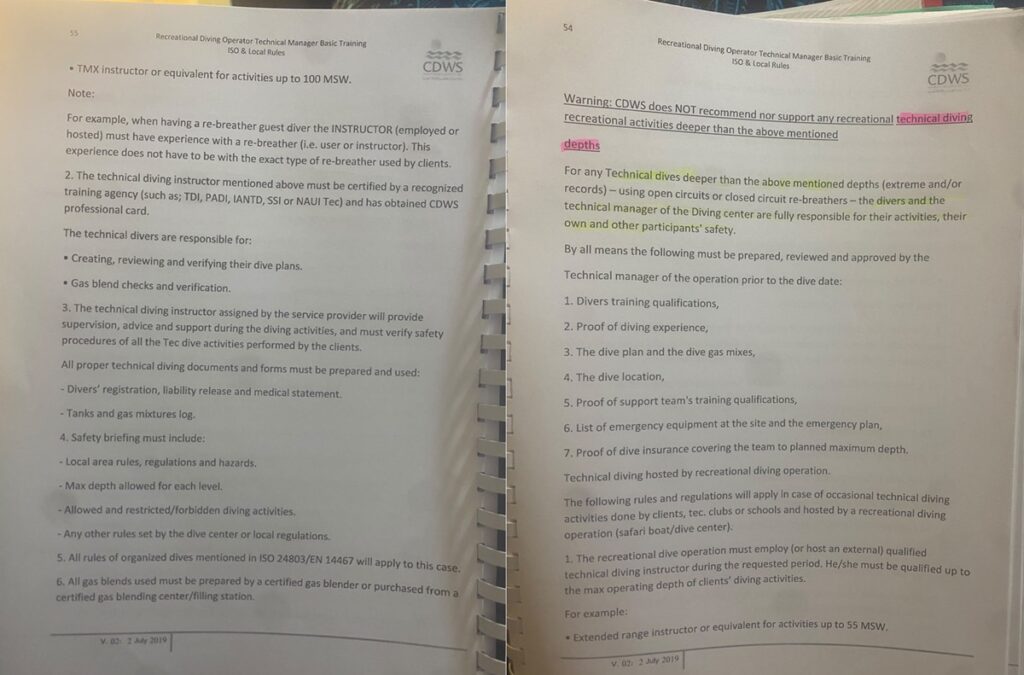
It also assigns direct responsibilities to the technical divers themselves, including preparing, reviewing and verifying the dive plans and checking the gas mixtures.
The technical instructor appointed by the service provider is required to offer supervision, advice and support, verify safety procedures, prepare the necessary documentation and records, and conduct a safety briefing before the dive.
Therefore, the fact that the centre was not registered as a specialist technical-diving facility does not, by itself, constitute evidence of a violation.
However, determining whether all applicable requirements were fully met requires a review of all the documents and procedures associated with the dive. That determination rests with the Chamber of Diving and Watersports and the investigating authorities.
The material also states that a TMX Instructor qualification, or its equivalent, covers activities to a depth of 100 metres of seawater.
This does not mean that the Chamber approves or authorises dives to 130 metres. Rather, the attached guidance states that it neither recommends nor supports dives exceeding the specified limits and that responsibility for such activities lies with the participants and the technical manager, according to the wording presented.
The Importance of the Support Diver’s Role
Abo Gabal said that Adam initially did not want a support diver to be involved, but that he insisted on participating.
In his personal assessment of the importance of the support-diver role, Abo Gabal said he believes his intervention was critical in helping the accompanying diver complete his decompression stops.
He added:
“If I had not been there, we could have been looking at two deaths instead of one.”
This is Abo Gabal’s personal assessment and not a conclusion issued by the investigating authorities.
He also said that the relevant authorities were informed immediately after the incident and that the available safety, rescue and evacuation procedures were implemented.
Abo Gabal’s Initial Assessment of the Incident
Abo Gabal believes that the substantial delay in reaching the target depth was a significant factor in what followed.
The descent took 24 minutes rather than the planned seven minutes, which, in his view, could have affected the gas plan, timing and decompression schedule.
However, he acknowledges that this remains a preliminary personal assessment and cannot be treated as the final cause of death before the dive computers and secured equipment are fully analysed, the missing cylinder is recovered and examined, all parties are interviewed, and the official medical and technical reports are issued.
What Remains Unknown?
Several important questions remain unanswered pending the outcome of the investigation:
- The direct medical cause of Adam’s death.
- The complete sequence of events between 130 and 90 metres.
- The condition of Adam’s cylinders and gas supplies during the ascent, how they were consumed, and why some decompression mixtures remained unused according to the initial observations.
- The location of the missing cylinder, the mixture it contained, its pressure and condition when recovered, and its possible relevance to reconstructing the incident.
- The data from the dive computers and the descent and ascent rates.
- The exact quantities of gas before and after the dive.
- The effect, if any, of losing the backup dive computer on the original descent plan.
- Whether all documentation and procedures required for this type of dive had been completed.
Until the technical and medical investigations are concluded, Ahmed Abo Gabal’s account remains the testimony of a person who directly participated in the support and rescue plan. It is not the final explanation of the incident.
Diventures Magazine will update this report when verified official information or confirmed findings become available.
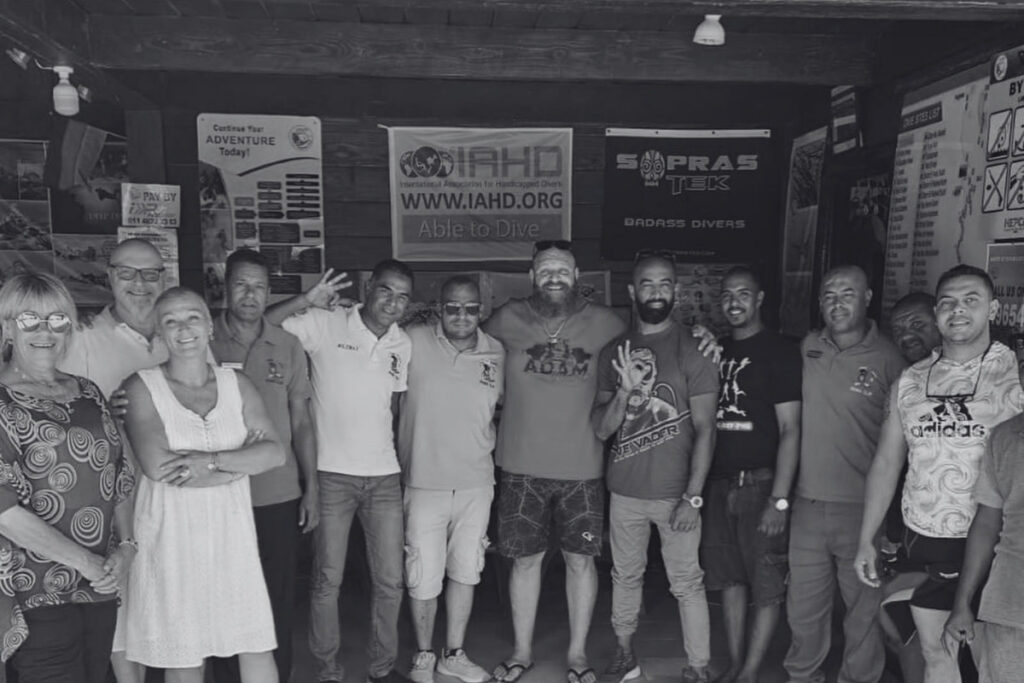
May Adam Jacoub rest in peace. We also wish the diver who accompanied him a full recovery, and Diventures Magazine extends its deepest condolences to Adam’s family and friends around the world.

Mohsen Nabil is the Founder and Editor-in-Chief of Diventures Magazine. A mechanical engineer and scuba diving instructor based in the Red Sea, he writes about diving safety, marine conservation, underwater exploration, and developments in the global dive industry. Through Diventures Magazine, he works to connect divers, scientists, and ocean advocates while promoting responsible diving and protection of the oceans.