
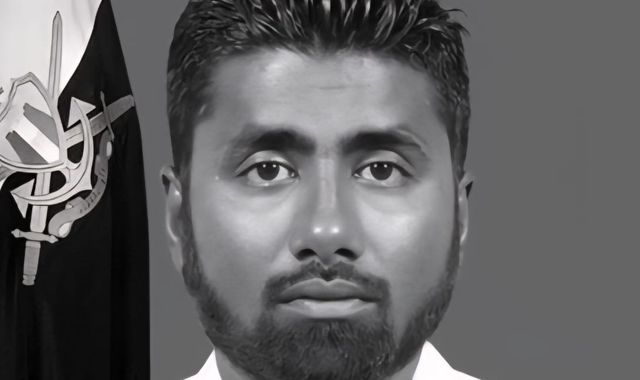

The family of Sergeant First Class Mohamed Mahudhee, the Maldives Coast Guard diver who died during the recovery operation for four Italian divers trapped inside the Devana Kandu cave system in May, has publicly disputed the government’s account of how he died.
Mahudhee’s family says evidence shown to them indicates that he became separated from his dive team, remained alone inside the cave and was later found motionless at depth with his regulator out of his mouth and his cylinder empty.
They argue that he may already have been dead before the recovery ascent began, raising questions over the sequence of events and the cause of death recorded on his death certificate.
The Maldives Police Service investigation into the incident remains open.
Mahudhee, 43, died on 16 May, two days after five Italian divers went missing during a deep cave dive near Alimatha in Vaavu Atoll.
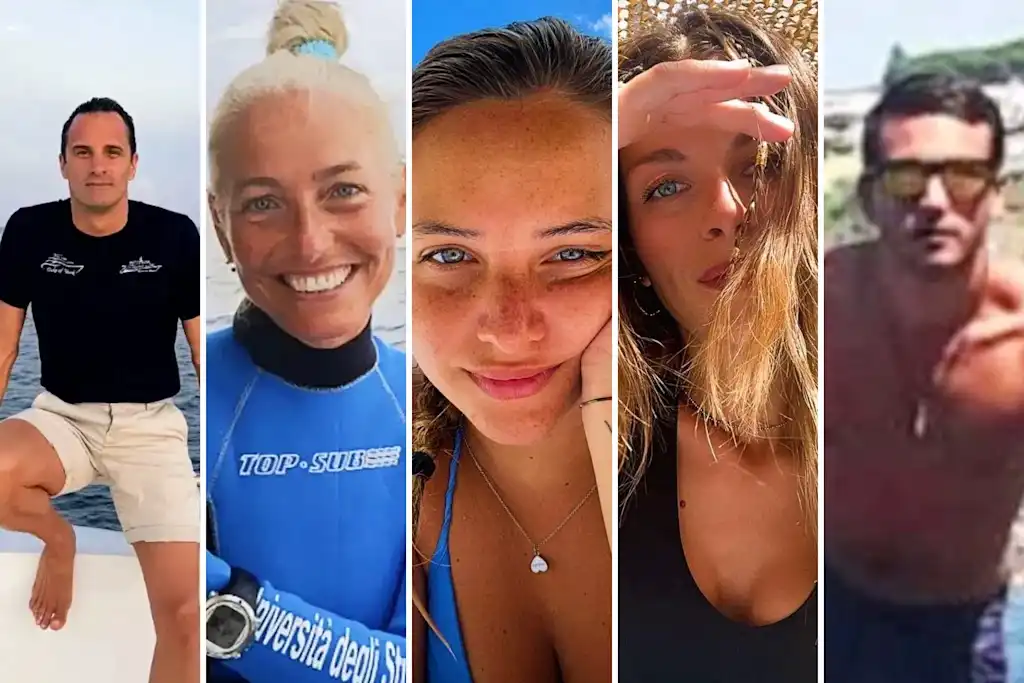
Diving instructor Gianluca Benedetti was recovered on the evening of 14 May. The remaining four divers were subsequently located deep inside the cave system before international cave-diving specialists took over the highly complex recovery.
Diventures Magazine has followed the incident since the first reports and later published an expanded investigation into the cave, dive profiles, equipment and circumstances surrounding the deaths.
Mahudhee was taking part in the recovery operation when he died.
Initial Official Account
In the immediate aftermath of Mahudhee’s death, government spokesperson Mohamed Hussain Shareef told international media that Mahudhee had been diving with a partner, in accordance with protocol.
According to accounts given to outlets including the BBC, CNN and Associated Press, the team was returning toward the surface when Mahudhee’s partner realised something was wrong. Other divers reportedly re-entered the water and found him unconscious.
Officials initially linked his death to decompression-related complications.
At the time, Diventures reported that the recovery operation itself had turned fatal following Mahudhee’s death, adding another casualty to an operation already facing extreme depth, confined passages, poor visibility and difficult surface conditions.
Mahudhee’s death certificate, issued by ADK Hospital and reviewed by the Maldives Independent, recorded the cause of death as cerebral arterial gas embolism resulting from a “rapid ascent from a scuba dive,” with “diver removed from depth” listed in the causal sequence.
The family now says the underwater events were substantially different from that initial public account.
Family Reconstructs the Dive
Mahudhee’s brother, Faris Ibrahim, has reconstructed the operation using dive footage shown to the family by the Maldives National Defence Force, conversations with military and police divers who participated in the recovery, and records later made available to the family.
According to Faris, Mahudhee was leading a team into the cave when a pocket carrying his guide line became detached without him noticing.
The second diver in the team was filming and, according to the family’s account, did not immediately realise that Mahudhee had continued farther into the cave alone.
A third diver later entered the second chamber.
Faris said the diver encountered a motionless body on the cave floor in heavily silted water, at a reported depth of approximately 69 metres.
The diver reportedly attempted to pull the body but received no response. With his own gas supply running low and uncertain of both his remaining breathing gas and the identity of the diver in the poor visibility, he returned toward the surface.
The extreme environment is significant. Previous reporting by Diventures found that the Devana Kandu system extends well beyond recreational depths and includes deep chambers, restrictions and a fully overhead environment where direct ascent to the surface is impossible.
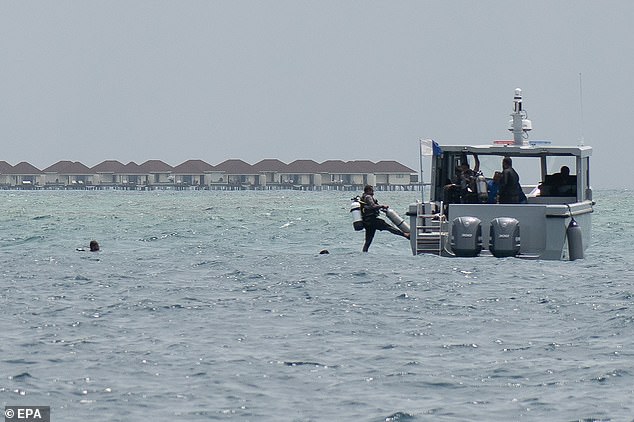
It was subsequently a Maldives Police Service dive team, rather than the original MNDF team, that recovered Mahudhee.
Records shown to the family indicate that the police team was alerted to the missing diver at around 12:22pm and entered the water at approximately 12:50pm.
Mahudhee was reportedly brought to the surface at around 1:10pm.
The family says the police divers found him in the same second chamber described by the earlier diver, with his regulator out of his mouth and his cylinder empty.
If that timeline is accurate, it raises an important question over how long Mahudhee remained alone inside the cave before the recovery team reached him.
Hospital Records Raise Further Questions
Medical records reviewed by the Maldives Independent appear to support important parts of the family’s reconstruction.
According to the ADK Hospital report, Mahudhee was brought to the surface unresponsive, with no spontaneous breathing and no detectable pulse.
CPR began shortly afterwards and continued during his transfer to Malé.
The hospital recorded a non-shockable cardiac rhythm, with asystole continuing throughout the resuscitation attempt.
Mahudhee was formally declared dead at 3:11pm.
Crucially, the hospital report states that this was the time at which death was declared and not an estimate of when death had actually occurred.
The medical history provided to ADK also reportedly stated that Mahudhee had been found unresponsive inside the underwater cave and brought rapidly to the surface.
That description differs materially from the earliest public statements suggesting that Mahudhee became critically ill during the team’s return or ascent.
The discrepancy does not establish how Mahudhee died, but it makes the exact underwater timeline increasingly important.
Cause of Death Remains Disputed
A CT scan performed after Mahudhee’s recovery identified extensive gas within the brain, heart, lungs and blood vessels.
The family questions whether those findings alone can establish the initiating cause of death.
A diving physician with experience in the Maldives, interviewed anonymously by the Maldives Independent, said gas bubbles would not be unexpected in a body recovered from significant depth after an extended period underwater.
The physician did not endorse a single cause of death and said the precise distribution of the gas would be important when distinguishing between possible arterial gas embolism, decompression-related injury and post-mortem changes.
The ADK Hospital report itself states that Mahudhee’s full dive profile, the precise depth at which he was found and the duration of his submersion and ascent could not be determined when the hospital certified the death.
ADK recommended a forensic post-mortem examination to establish the cause more precisely.
No such examination has been conducted.
In a letter sent to the Maldives Police Service in late June, Mahudhee’s parents formally requested that the recorded cause of death be reviewed and listed as undetermined while the investigation continues.
They argued that attributing the death specifically to a rapid ascent could imply that the recovery ascent itself caused his death when the initiating event may have occurred earlier inside the cave.
Without a complete forensic examination and the full dive profile, the family argues that factors such as breathing-gas depletion, equipment problems, hypoxia, nitrogen narcosis or another event at depth cannot yet be conclusively ruled in or out.
Questions over breathing gases have been central to the wider Devana Kandu investigation. In the days immediately following the deaths of the Italian divers, diving and medical specialists raised oxygen toxicity, gas selection, panic and disorientation as possible factors. Those theories concerned the Italian divers and have not been established as the cause of Mahudhee’s death.
Questions Over Breathing Gas and Equipment
The family has also raised questions about the breathing gas and equipment used during Mahudhee’s recovery dive.
According to Faris, Mahudhee was diving on compressed air rather than a helium-based breathing mixture despite the operation extending significantly beyond 50 metres.
At a reported depth of approximately 69 metres, the choice of breathing gas raises important questions about gas planning, nitrogen narcosis exposure, breathing-gas reserves and the technical-diving capability available to the recovery team.
Breathing compressed air at such depths substantially increases nitrogen exposure and gas density, while consumption also rises dramatically with ambient pressure. In an overhead environment, where a diver cannot ascend directly to the surface, adequate reserve gas and team procedures become even more critical.
Two days before Mahudhee’s death, MNDF officers speaking on state broadcaster PSM reportedly acknowledged that Coast Guard divers were certified to a maximum depth of 50 metres and that deeper operations required specialised equipment and advanced training.
Faris has also raised concerns about the regulator used by his brother, saying he had previously advised Mahudhee against using the same type of regulator for deeper commercial dives.
Those concerns do not establish that the regulator contributed to the accident, and no confirmed equipment failure has been publicly identified.
However, the family says it has requested access to Mahudhee’s diving equipment and has not received it.
The equipment may be important to investigators when determining whether the breathing system was functioning normally at the time of the incident.
The wider tragedy has already forced a national discussion about how advanced diving should be managed in the country. Shortly after the accident, the Maldives government confirmed plans to develop a regulatory framework for technical diving, prompting Diventures to examine what future Maldives technical-diving legislation would need to address, including qualifications, operator responsibility and emergency-response capability.
Mahudhee’s death makes the emergency-response element of that debate particularly significant.
The Dive Computer May Provide Critical Evidence
One of the most significant unresolved issues is Mahudhee’s dive computer.
According to his brother, the computer remains in the possession of the authorities.
Its data could potentially provide investigators with an objective record of significant parts of the dive, including maximum depth, bottom time and ascent profile.
Depending on the model and recorded information, it could help establish when Mahudhee reached the reported 69-metre area, how long he remained at depth and the profile followed when his body was recovered.
Those records would be particularly important because the hospital stated that Mahudhee’s dive profile was not known when his cause of death was certified.
The family says police have requested the computer but does not know whether it has been transferred to investigators.
Until those data are examined as part of the investigation, one of the most important pieces of technical evidence remains unavailable publicly.
Family Stops Short of Alleging a Cover-Up
Despite challenging the government’s account, Faris has stopped short of accusing authorities of deliberately concealing the circumstances of his brother’s death.
He has described the contradictions as potentially resulting from miscommunication and said the family’s position will depend on whether the ongoing investigation establishes the full sequence of events and whether the death certificate is corrected if necessary.
The family has also said it does not want the case used for political purposes.
The President’s Office, Maldives National Defence Force and Maldives Police Service did not respond to detailed questions submitted by the Maldives Independent.
Shareef previously acknowledged, during a briefing approximately one week after Mahudhee’s death, that Mahudhee had been recovered from inside the cave.
He said government information was updated as additional details became available.
International Specialists Complete the Recovery
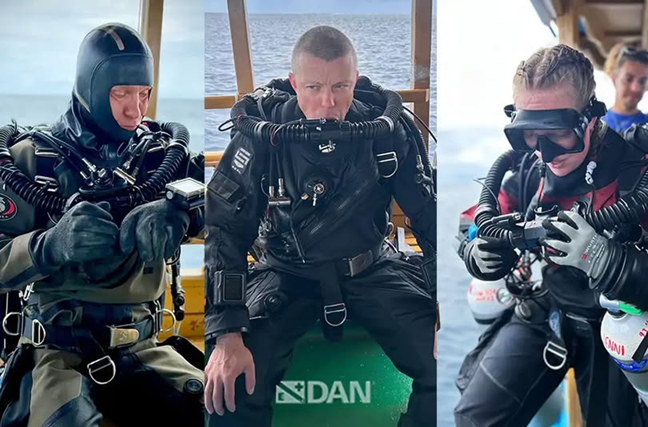
Following Mahudhee’s death, international cave-diving specialists were brought into the Maldives to continue the operation.
Finnish divers Sami Paakkarinen, Jenni Westerlund and Patrik Grönqvist, working with assistance from DAN Europe, later recovered the remaining Italian victims from the cave.
Their work highlighted the specialised skills required for a recovery in a deep, restricted overhead environment.
The operation later received international recognition when Italian President Sergio Mattarella honoured the three Finnish divers for their role in recovering the victims.
The contrast between the highly specialised international recovery team and the circumstances surrounding Mahudhee’s earlier dive is now likely to receive further scrutiny as investigators examine the procedures, equipment, gases and capabilities available during the initial operation.
Questions the Investigation Still Needs to Answer
Several technical and factual questions remain unresolved.
Investigators must establish precisely when Mahudhee became separated from the team, how long he remained inside the cave before he was located, and what breathing gas and equipment he was carrying.
They must determine what his dive computer shows about his depth, exposure and ascent profile.
They must also establish the condition and remaining gas pressure of his cylinder when he was recovered, whether his regulator and other equipment were subsequently examined, and what procedures governed the decision to send Coast Guard divers into the cave.
Most importantly, investigators must establish whether the medical cause listed on Mahudhee’s death certificate describes the event that initiated his death or a physiological consequence associated with the later recovery from depth.
The available evidence does not yet establish a definitive cause.
What it does establish is that significant differences remain between the earliest public description of Mahudhee’s death and the account now presented by his family, supported in part by hospital records and information from divers involved in the operation.
The Maldives Police Service investigation remains open.
For Mahudhee’s family .. and for the wider diving community following the Devana Kandu tragedy .. the dive computer data, recovery timeline and final investigative findings may ultimately provide the clearest answers about what happened inside the cave on 16 May.

Mohsen Nabil is the Founder and Editor-in-Chief of Diventures Magazine. A mechanical engineer and scuba diving instructor based in the Red Sea, he writes about diving safety, marine conservation, underwater exploration, and developments in the global dive industry. Through Diventures Magazine, he works to connect divers, scientists, and ocean advocates while promoting responsible diving and protection of the oceans.