
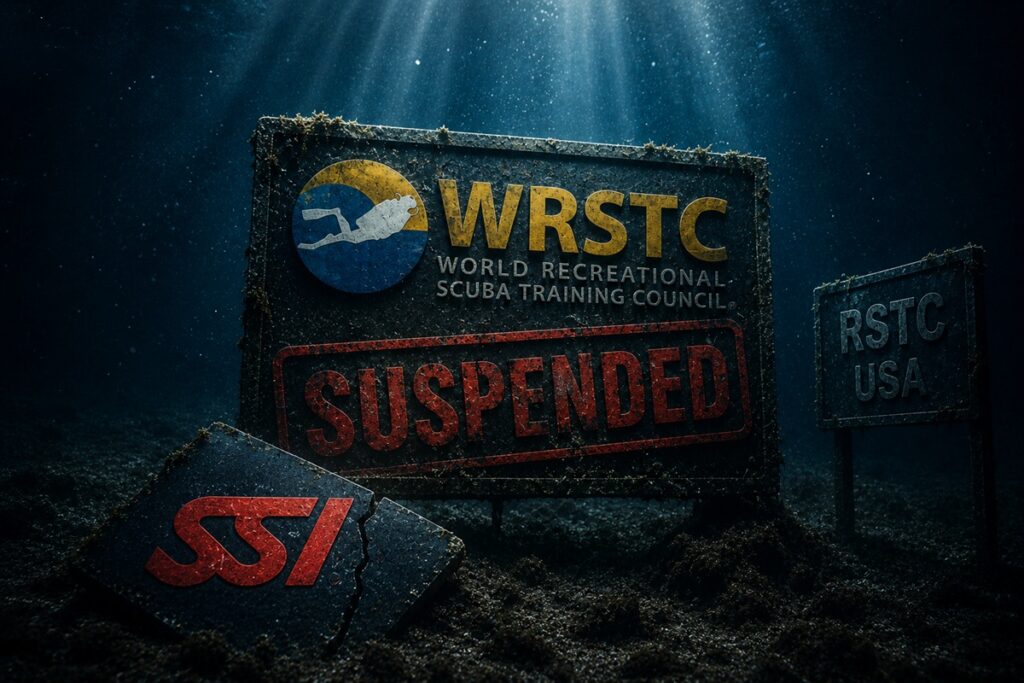

The Recreational Scuba Training Council United States (RSTC US) has issued its first official public statement on the removal of Scuba Schools International (SSI) from its membership, published on the WRSTC website. The statement introduces a significant new detail that changes the nature of the story: SSI was not simply removed — it was suspended.
The statement, issued by the RSTC US Board of Directors, comes in response to SSI’s internal communication to its professionals and training centers worldwide, which Diventures Magazine reported on earlier this week.
SSI Was Suspended
The RSTC US states clearly that SSI’s information was removed from the US Council page as a result of suspension — a word that carries procedural and legal weight beyond a simple membership removal. The council adds that no separate public announcement was made because the action was taken in compliance with its established procedures.
This directly contradicts the framing in SSI’s own statement, which described the removal as having been carried out without notice and without explanation.
ISO Is Not a Substitute for RSTC Compliance
Perhaps the most significant element of the RSTC US response is its direct rebuttal of SSI’s central argument. SSI had framed the dispute as a conflict between an outdated RSTC standard from 2002 and the more current ISO 24802-1 standard from 2014, arguing that its ISO compliance should be recognised as meeting or exceeding the RSTC benchmark.
The RSTC US has rejected that argument explicitly. According to their statement, ISO standards and WRSTC standards serve different purposes and should not be considered interchangeable. WRSTC member organisations are expected to uphold WRSTC training standards globally, and WRSTC Councils do not administer or enforce ISO certification requirements. The council adds that ISO certification is voluntary and is not a requirement for WRSTC membership — noting that many WRSTC members also hold ISO certification and maintain compliance with both frameworks simultaneously.
In other words, the RSTC US position is that SSI cannot use ISO compliance as a reason to deviate from RSTC standards. Both must be met independently.
The Door Remains Open
Despite the firm tone on standards compliance, the RSTC US statement stops short of closing the door on SSI’s membership. The council acknowledges having worked collaboratively with SSI on standards alignment and states it remains committed to constructive engagement going forward. It also affirms its belief that diverse perspectives and contributions strengthen the organisation and the industry as a whole.
The statement closes with a reminder that all member organisations — regardless of tenure or historical role — share an ongoing responsibility to maintain compliance with established WRSTC standards and contribute positively to the council’s mission. The reference to tenure is widely understood as an acknowledgement of SSI’s founding membership status, while making clear that history does not exempt any agency from compliance obligations.
Where Things Stand
The RSTC US statement reframes this dispute in important ways. What SSI presented as a standards advocacy effort — pushing for more current ISO-aligned requirements — the RSTC US characterises as a compliance failure. SSI remains suspended from the US council pending further developments.
SSI has not yet responded to the RSTC US statement. Diventures Magazine has contacted both Karim Salah, International Training Director at SSI Middle East, and SSI CEO Guido Wätzig for comment.
SSI certifications remain valid and SSI professionals and training centers worldwide continue to operate normally under current SSI standards, as confirmed in SSI’s earlier statement.
For the full background on this story, read our previous report … SSI No Longer Listed as Member of the US RSTC

Mohsen Nabil is the Founder and Editor-in-Chief of Diventures Magazine. A mechanical engineer and scuba diving instructor based in the Red Sea, he writes about diving safety, marine conservation, underwater exploration, and developments in the global dive industry. Through Diventures Magazine, he works to connect divers, scientists, and ocean advocates while promoting responsible diving and protection of the oceans.