

Training Agency or Dive Instructor: Which Matters More When Choosing a Scuba Course?
PADI, SSI, SDI or another recognised training organisation? New divers often focus on the name that will appear on their certification card. But the more important question may be who will actually teach them to dive.
Ask a group of divers which scuba training agency is best and you may quickly find yourself in a debate.
Some will recommend PADI. Others will favour SSI, SDI, NAUI, CMAS or another organisation. Divers may point to course materials, teaching philosophy, digital systems, professional pathways or simply the agency through which they learned to dive.
For someone preparing to take their first scuba course, all of this can make the decision seem much more complicated than it needs to be.
The logo on the certification card does matter. Training agencies establish standards, create educational systems, define certification requirements and provide pathways for continuing education.
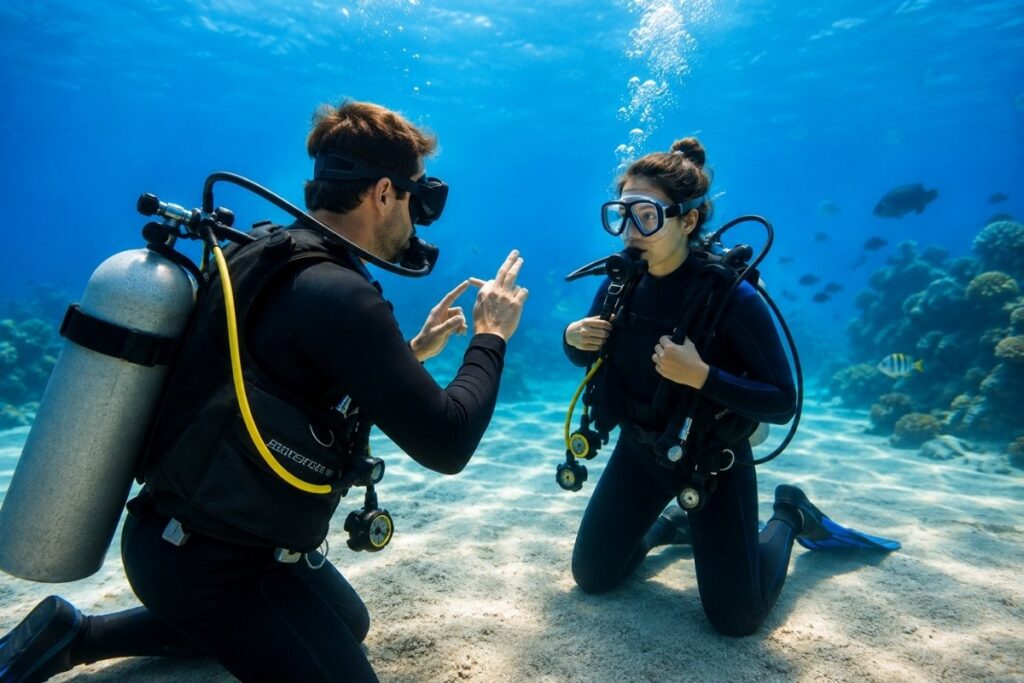
But the agency is not the person standing beside you in the water.
Your instructor is.
And for a new diver, choosing the right instructor may ultimately have a greater influence on the quality of the training experience than choosing between major recognised training agencies.
Start With What the Agencies Have in Common
Before comparing agency names, it helps to understand how recreational diving training is structured internationally.
The International Organization for Standardization has developed standards covering recreational scuba diver training, instructor training and recreational diving service providers.
For recreational scuba divers, ISO 24801 establishes three competency levels.
ISO 24801 Part 1: Supervised Diver
This defines the competencies expected of a diver who operates under appropriate supervision.
ISO 24801 Part 2: Autonomous Diver
This defines the competencies expected of a diver who can dive with another appropriately qualified diver in conditions comparable to those in which the diver was trained.
ISO 24801 Part 3: Dive Leader
This defines competencies associated with leading recreational divers.
Instructor qualifications are addressed separately through ISO 24802.
ISO 24802 Part 1: Instructor Level 1
ISO 24802 Part 2: Instructor Level 2
These standards provide an international framework against which recreational diving qualifications can be compared.
Major agencies including PADI, SSI and SDI have training systems or programs associated with these international standards. For example, PADI identifies its Open Water Diver qualification with ISO 24801 Part 2, SSI identifies its Open Water Diver program with the same standard, and SDI states that its training programs have ISO certification.
This is important because the discussion is sometimes presented as though every training agency is creating scuba education completely independently.
That is not necessarily the case.
There is an international competency framework behind much of modern recreational diver training.
But ISO Does Not Make Every Course the Same
ISO standards should not be misunderstood as creating one universal scuba course.
ISO itself makes an important distinction.
The standards establish minimum competency requirements. They do not prevent training organisations from providing additional training or evaluating additional competencies.
They also do not require every organisation to create identical course programs.
That leaves considerable room for training agencies to develop their own educational systems.
One organisation may structure its academic material differently from another. Skill sequences may vary. Digital learning platforms can differ. Certification procedures, instructor materials, terminology, continuing education pathways and quality assurance systems may also differ.
This is where the training agency becomes important.
The agency creates the system within which the instructor works.
But a training system still has to be delivered by a human being.
The Agency Creates the Framework. The Instructor Delivers the Training.
Consider two students taking an equivalent beginner course with the same training agency.
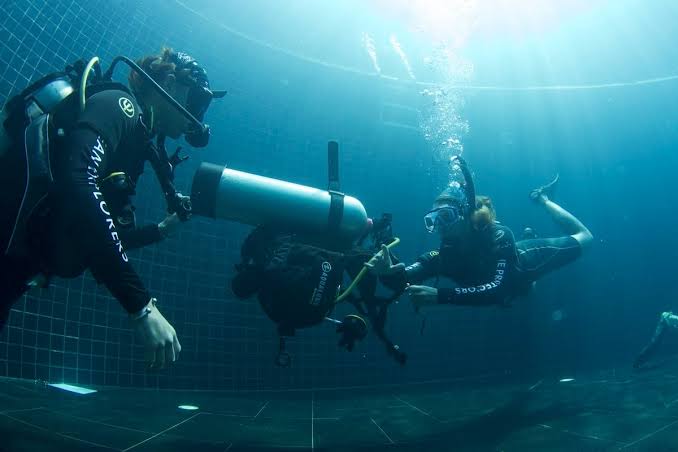
One student trains in a small group with an experienced instructor who explains concepts clearly, watches each student closely, allows additional practice when needed and refuses to rush someone through a skill simply to keep the schedule moving.
Another student may train through the same agency but have a very different experience.
The class may feel rushed. Students may receive limited individual attention. Skills may be completed successfully but without enough repetition for the student to feel genuinely comfortable performing them.
The certification agency is identical.
The certification card is identical.
The experience is not.
This is one reason agency comparisons have limitations.
Comparing PADI with SSI or SDI tells you something about the training systems. It does not necessarily tell you what your individual course will feel like.
The instructor has an enormous influence on that.
A Certification Card Is Not the Same as Confidence
Completing the required skills is only part of becoming a diver.
A good instructor is also helping a student develop judgement, awareness and confidence in the water.
That includes learning how to control buoyancy, monitor gas, communicate with a buddy, respond appropriately when something feels wrong and remain calm while solving manageable problems underwater.
Some students develop these abilities quickly. Others require additional explanation or practice.
The instructor who recognises that difference matters.
A student should not feel that asking to repeat a skill is delaying the course.
A competent instructor should be able to recognise when a diver has technically completed a skill but has not yet become comfortable with it.
There is a meaningful difference between performing a skill once because an instructor asked you to and understanding that skill well enough to use it when a real problem occurs.
That difference is difficult to judge from an agency logo.
What Makes a Good Scuba Instructor?
Before booking a course, prospective students often ask which agency they should choose.
They should also ask about the instructor.
Who will actually teach the course?
How much experience does that instructor have teaching beginners?
How large will the group be?
Will the same instructor teach throughout the course?
What happens if a student needs additional practice?
How does the instructor approach buoyancy training?
Are students encouraged to understand why a skill is performed, rather than simply memorising the steps?
How much time will students actually spend practising in the water?
What environmental conditions will be used during the training?
How does the instructor decide that a student is ready for certification?
These questions can reveal far more about the course you are about to receive than asking only which organisation will issue the certification card.
The Dive Centre Matters Too
There is another layer between the agency and the instructor: the dive centre.
The centre may determine scheduling, equipment, training facilities, class organisation and the amount of time available for instruction.
A highly capable instructor working within an operation that places unrealistic pressure on course schedules may face limitations that have little to do with the training agency.
Conversely, a well managed dive centre can give instructors the time, equipment and support needed to provide high quality training.
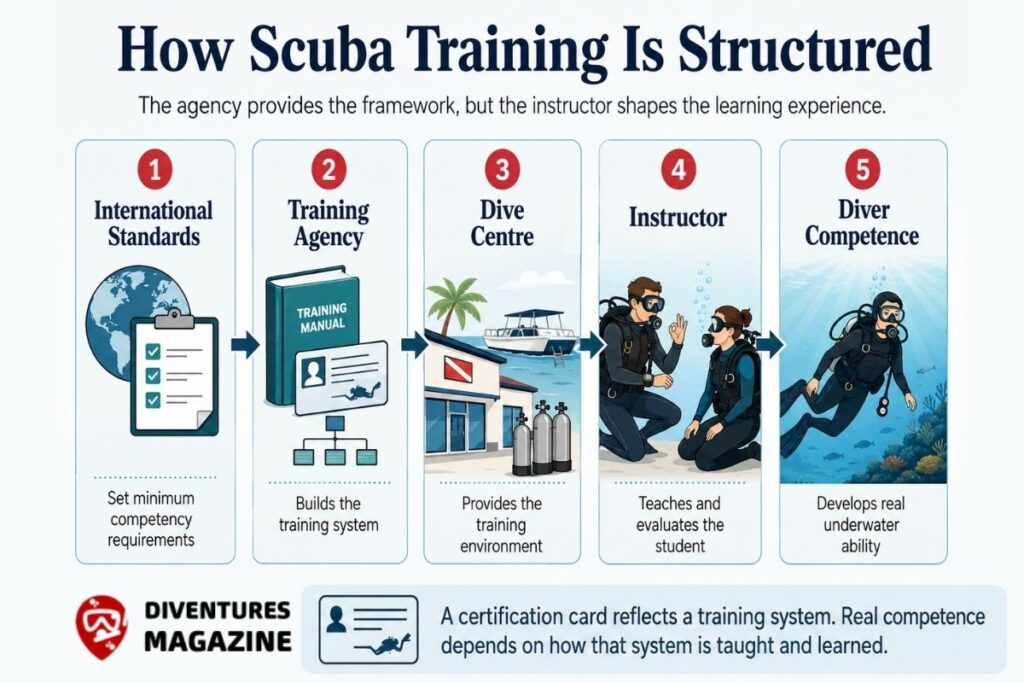
The complete training experience can therefore be thought of as several connected layers.
International standards establish competency frameworks.
Training agencies develop educational systems and agency standards.
Dive centres provide the operational environment.
Instructors deliver and evaluate the training.
Students develop the actual competence.
Every layer matters.
But the layer with which the student interacts most directly is the instructor.
You Do Not Have to Stay With the Same Training Agency
Choosing an agency for your first scuba course does not necessarily mean choosing that agency for the rest of your diving education.
A diver may complete an entry level certification with one recognised training organisation and later continue training with another.
For example, someone who begins with PADI may later take an SSI or SDI course. An SSI diver may continue through PADI. An SDI diver may choose another organisation for a particular specialty or later stage of training.
This is possible because recognised certifications can often satisfy the prerequisites for courses offered by another training organisation, provided that the previous qualification is accepted as equivalent and the diver meets the requirements of the new course.
PADI states that certifications from other diver training organisations can often be used to meet prerequisites for the next level of PADI training. SSI similarly allows certifications from recognised training agencies or federations to be considered equivalent for progression within its education system. SDI course standards also accept equivalent qualifications for a number of continuing education programs.
That does not mean every certification automatically transfers into every course. Course names, required experience and progression structures can differ between agencies. An instructor or training centre may need to verify the diver’s certification, experience and current skills before accepting it as a prerequisite.
This gives divers an important degree of freedom.
Your first certification card does not have to determine your entire diving education.
You might choose one instructor for your Open Water course because you believe that person is the best instructor for you, then later find another instructor from a different agency who has particular expertise in buoyancy, rescue, wreck diving, underwater photography or another area you want to develop.
As your diving becomes more specialised, the instructor may become even more important.
Instead of asking, “Which agency should I stay with?”, a more useful question may be:
Who is the best instructor for what I want to learn next?
Training agencies provide the framework and determine their own course requirements, but divers should not feel that changing the logo on the next certification card somehow invalidates what they have already learned.
Your diving education can develop across more than one training system.
What matters is that each new course recognises your previous qualification where applicable, that you meet its prerequisites, and that the instructor provides the quality of training you are looking for.
So Does the Training Agency Matter?
Absolutely.
Choosing the instructor first does not mean ignoring the training agency.
Agency choice may become particularly important depending on your future plans.
A diver interested in continuing education may want to examine the courses available after the initial certification.
Someone planning to become a professional should consider instructor development pathways, membership requirements and the availability of affiliated centres in the places where they expect to work.
Divers interested in technical diving may look at how recreational education connects with more advanced training.
Digital learning systems, certification management, educational materials and access to replacement credentials may also influence the decision.
Local circumstances matter as well. An agency with strong instructor and dive centre availability in one region may have a smaller presence somewhere else.
These are legitimate reasons to compare training agencies.
They are simply different questions from asking which instructor will provide the best first diving experience.
Do Not Choose a Course Only by Price
For many new divers, price becomes the easiest comparison.
One centre offers a beginner course at one price and another offers what appears to be the same certification for less.
But two courses carrying the same certification name are not necessarily identical experiences.
Price alone does not tell you about group size, instructor attention, equipment condition, training environment, additional practice or the overall pace of the course.
The cheapest course may provide excellent training.
The most expensive course does not automatically provide better training either.
The useful question is not simply how much the course costs.
It is what training you will actually receive for that price.
Be Careful With Agency Rivalries
Divers can become surprisingly loyal to certification organisations.
That loyalty is understandable. Most divers remember the organisation through which they first learned, and instructors naturally become familiar with the systems they teach.
But personal experience with one instructor should not automatically become a judgement about an entire agency.
A diver who had an excellent experience with a PADI instructor has evidence of an excellent experience with that instructor and dive centre.
The same applies to SSI, SDI or any other organisation.
Likewise, one poor training experience should not automatically be treated as proof that every instructor working through that organisation provides poor training.
There can be significant differences between instructors working within the same training system.
That is why the question, “Which agency is best?” may be less useful than it first appears.
Choose the Instructor First
For a new diver choosing an initial scuba course, the training agency should be part of the decision.
But it should not necessarily be the first part.
Research the dive centre.
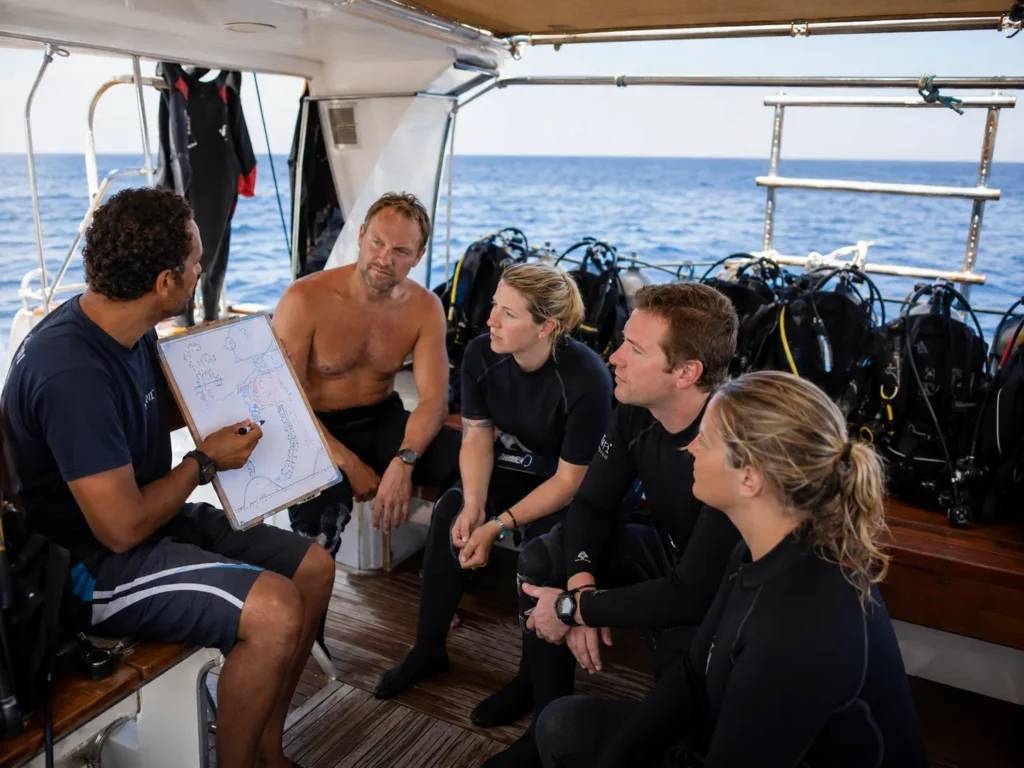
Talk to the instructor.
Ask how the course is conducted.
Ask what happens if you need more time.
Look for an instructor who takes questions seriously, explains rather than simply demonstrates, pays attention to individual students and places competence ahead of simply completing the course.
Then consider whether the agency behind that instructor provides the training system and future pathway that fit your goals.
PADI, SSI and SDI do not need to be treated like competing football teams.
The purpose of scuba training is not to place a particular logo in your wallet.
It is to prepare you to enter an environment where knowledge, judgement, practical ability and comfort in the water matter.
The certification agency creates the framework.
The instructor turns that framework into training.
And ultimately, what matters most is not which logo appears on your certification card, but what kind of diver you have become by the time you receive it.

Mohsen Nabil is the Founder and Editor-in-Chief of Diventures Magazine. A mechanical engineer and scuba diving instructor based in the Red Sea, he writes about diving safety, marine conservation, underwater exploration, and developments in the global dive industry. Through Diventures Magazine, he works to connect divers, scientists, and ocean advocates while promoting responsible diving and protection of the oceans.