

The Spider That Lives Underwater: How a Diving Bell Becomes a Physical Gill
Most spiders live on land. Argyroneta aquatica took a remarkably different evolutionary path.
Commonly known as the diving bell spider or water spider, this small arachnid spends almost its entire life underwater. Yet unlike fish and many other aquatic animals, it has no gills. It still depends on atmospheric oxygen and must breathe air.
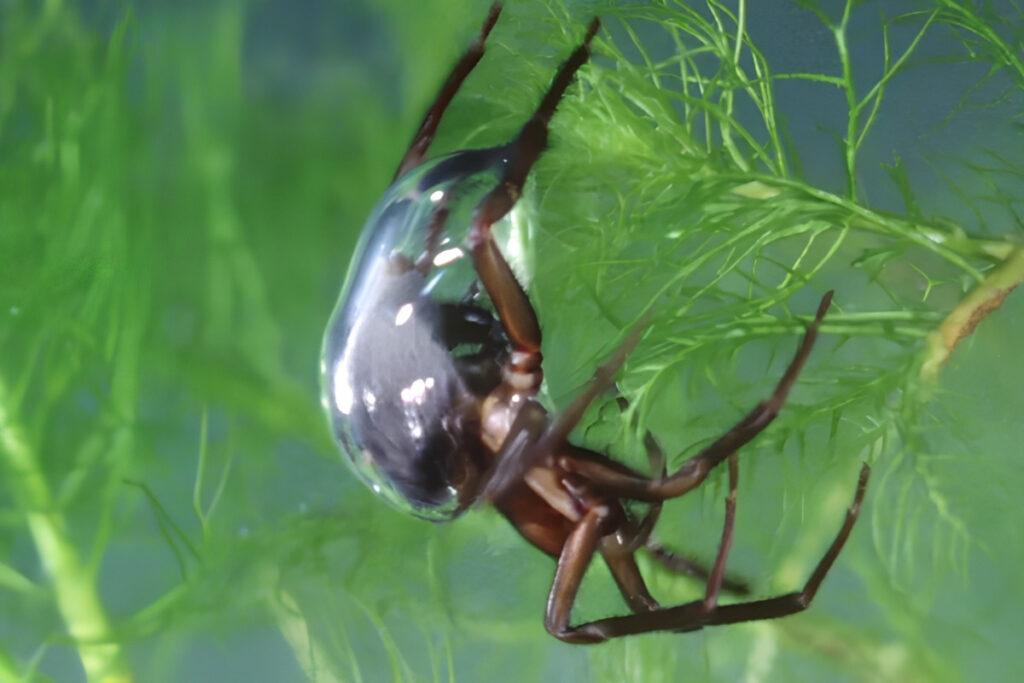
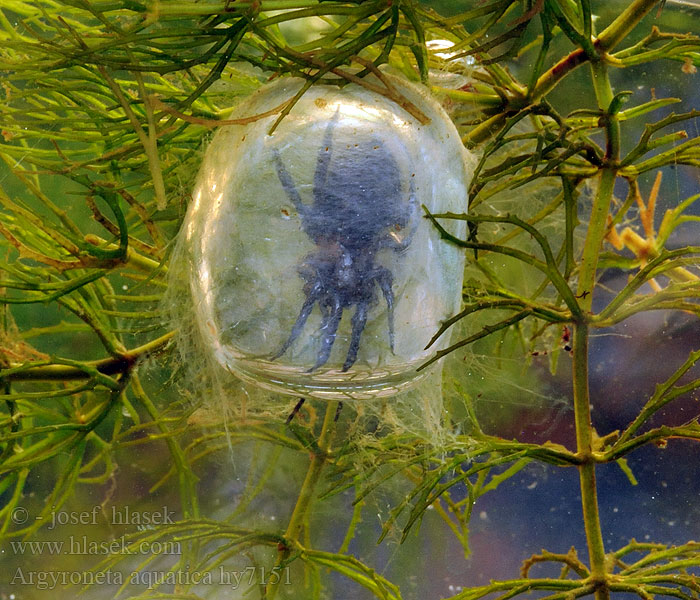
Its solution is one of the most unusual adaptations found among air breathing animals: it builds an underwater chamber from silk, fills it with air from the surface, and uses the resulting diving bell as both a home and a physical gill.
An Air Breathing Spider Living Underwater
Argyroneta aquatica inhabits freshwater environments, particularly ponds, lakes, canals and other relatively still or slow moving waters with aquatic vegetation.
Although highly adapted to an aquatic existence, its respiratory system remains fundamentally that of an air breathing spider.
This creates an obvious problem. Remaining underwater requires continuous access to oxygen.
Instead of evolving anatomical gills, the spider manipulates its environment.
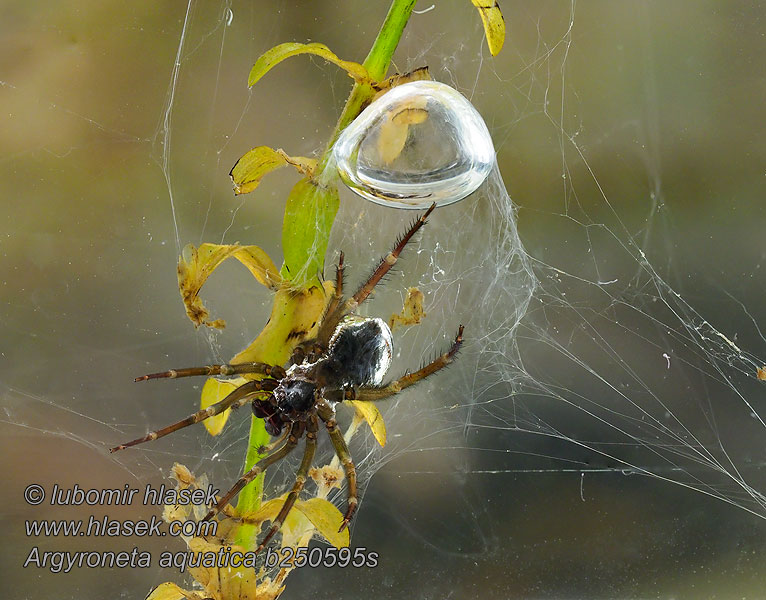
Among submerged vegetation, it constructs a sheet of silk that forms an underwater bell. The spider then travels to the surface to collect air.
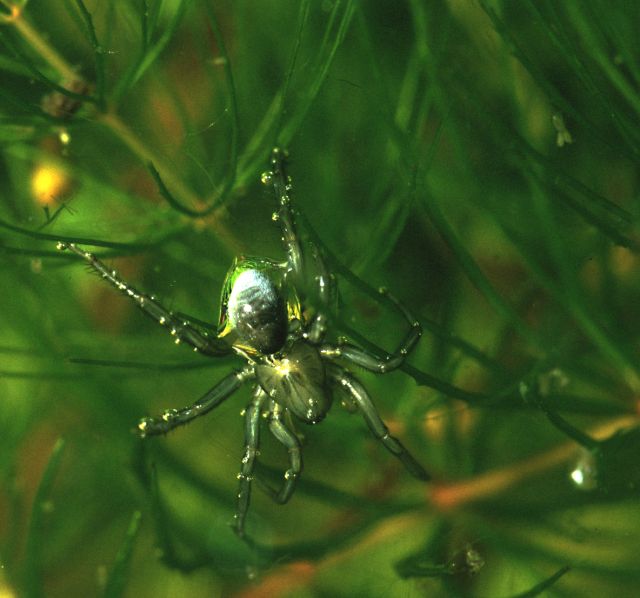
Hydrophobic hairs covering its body help trap a layer of air. The spider carries this air below the surface and releases it beneath the silk structure. By repeating the journey, it gradually inflates the chamber.
The result resembles a small underwater diving bell.
But storing air is only part of the story.
A Diving Bell That Can Extract Oxygen From Water
Researchers studying Argyroneta aquatica discovered that the air chamber performs a much more sophisticated physical function than simply providing a reservoir of atmospheric air.
It acts as what scientists call a physical gill.
As the spider consumes oxygen inside the bell, the partial pressure of oxygen within the chamber decreases. Oxygen dissolved in the surrounding water can then diffuse across the interface between the water and the trapped air.
In effect, the water surrounding the bell can replenish some of the oxygen being consumed by the spider.
Research published in the Journal of Experimental Biology examined this process using oxygen sensitive measuring equipment. The researchers found that the diving bell could obtain a substantial part of the spider’s oxygen requirements from the surrounding water.
This allows the spider to remain submerged for much longer than would be possible if it relied only on the original oxygen carried down from the surface.
Not an Unlimited Oxygen Supply
The diving bell is remarkably effective, but it is not a permanently self sustaining underwater atmosphere.
While oxygen can diffuse from the surrounding water into the bell, other gases are also moving between the trapped air and the water.
Nitrogen gradually diffuses out of the bell, causing its volume to decrease over time. Eventually, the spider must return to the surface and bring down additional air.
Experiments have nevertheless shown that diving bell spiders can remain inside their bells for extended periods without frequently visiting the surface. Under experimental conditions, some remained submerged for more than a day before needing to replenish the chamber.
That ability may provide another advantage.
Frequent trips to the surface could expose the spider to predators or reveal its position. A functioning physical gill allows it to spend much longer periods hidden beneath the water.
More Than an Underwater Air Tank
Calling the structure an underwater air tank does not fully describe what the spider has built.
A conventional tank contains a finite quantity of breathing gas. The diving bell, however, interacts continuously with the water around it.
The interface between the trapped air and surrounding water allows gases to move according to differences in their partial pressures.
This is why researchers describe the structure as a physical gill rather than simply an air store.
Similar physical principles occur in some aquatic insects that carry air bubbles underwater, but the diving bell spider takes the strategy much further by constructing a relatively large, permanent silk chamber.
The silk provides the structure that holds the air pocket among aquatic vegetation, while the exposed air and water interface enables the gas exchange.
An Entire Life Inside the Bell
The diving bell is not simply somewhere for the spider to stop and breathe.
It is effectively the centre of its underwater life.
The spider can use the chamber as a refuge and a place to consume prey. Important stages of its life cycle also take place within air filled silk structures underwater, including moulting, mating and reproduction.
Females construct bells associated with egg laying and care of their offspring.
Rather than repeatedly returning to land to perform these activities, Argyroneta aquatica has moved much of the ordinary life of a terrestrial spider beneath the surface.
It hunts aquatic prey including small crustaceans and insect larvae, returning to its bell when necessary.
A Spider That Carries Its Atmosphere With It
Perhaps the most remarkable thing about Argyroneta aquatica is that evolution did not transform it into something resembling a fish.
It remains recognisably a spider.
Instead, adaptations including hydrophobic body hairs, underwater silk construction and specialised behaviour allow it to transport atmospheric air into an environment where its respiratory system would otherwise prevent it from living.
The diving bell then uses basic physical processes to extend that air supply.
There is no pump extracting oxygen from the water and no biological membrane functioning like the gills of a fish. Gas exchange occurs because of the differences in partial pressure between the trapped air and the surrounding water.
The spider has effectively constructed an external respiratory structure from silk, air and the physical properties of gases.
One of Nature’s Most Unusual Divers
Divers normally carry their breathing environment with them in cylinders.
The diving bell spider approaches the same fundamental challenge from another direction. Rather than carrying a compressed supply for every underwater journey, it establishes an air filled habitat beneath the surface and allows the surrounding water to contribute oxygen to it.
It is an extraordinary example of how an air breathing animal can exploit an aquatic environment without developing anatomical gills.
For Argyroneta aquatica, the boundary between terrestrial and aquatic life has become remarkably thin.
A few strands of silk, a pocket of air and the physics of gas exchange are enough to allow a spider to spend almost its entire existence beneath the surface.
Sources

Mohsen Nabil is the Founder and Editor-in-Chief of Diventures Magazine. A mechanical engineer and scuba diving instructor based in the Red Sea, he writes about diving safety, marine conservation, underwater exploration, and developments in the global dive industry. Through Diventures Magazine, he works to connect divers, scientists, and ocean advocates while promoting responsible diving and protection of the oceans.