

The Dolphin With No Dorsal Fin: Meet the Northern Right Whale Dolphin
A striking photograph from California offers a remarkable look at the northern right whale dolphin, a fast, highly social species whose smooth back and unusually slender body make it unlike almost any other dolphin in the North Pacific.
A photograph shared by ocean photographer @nathoutsidethebox has captured an extraordinary view of one of the North Pacific’s most distinctive marine mammals.
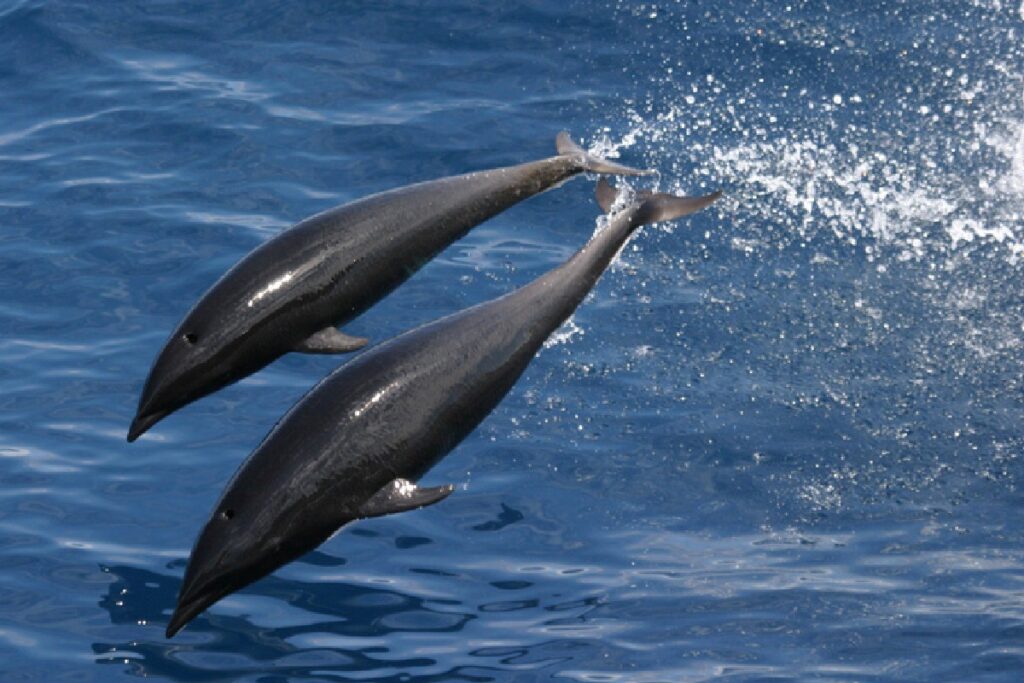
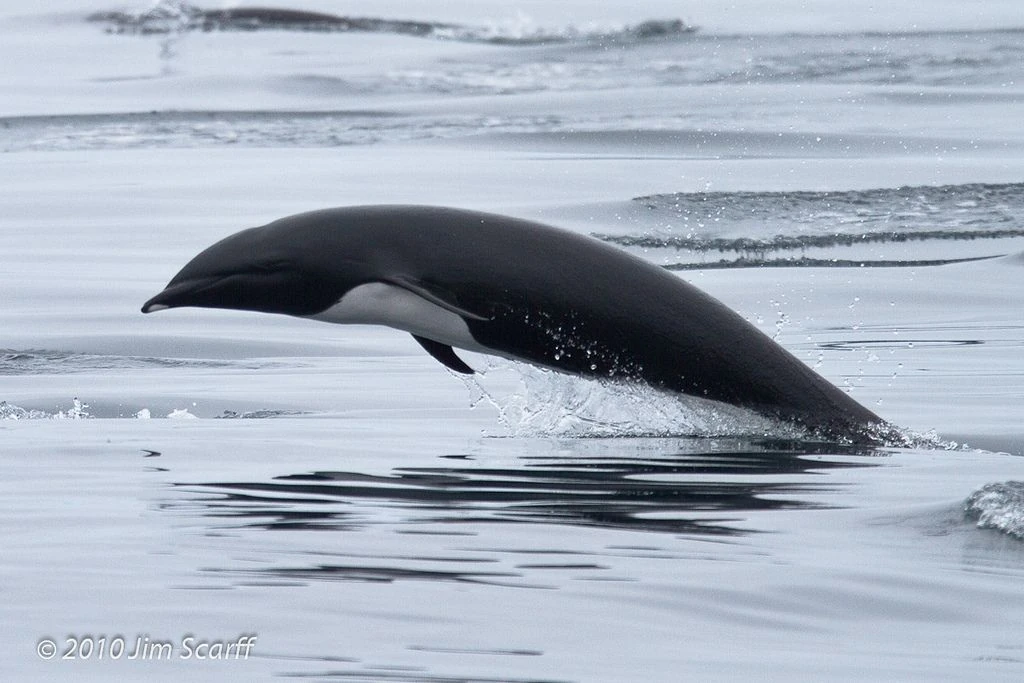
The image, shared with a location tag for the Channel Islands and Oxnard, California, shows a northern right whale dolphin, Lissodelphis borealis, completely airborne above the ocean surface.
At first glance, its black and white coloration resembles several other oceanic dolphins. Look more closely, however, and something is conspicuously absent.
There is no dorsal fin.
The smooth back, combined with an exceptionally slender body and narrow tail stock, gives the northern right whale dolphin a streamlined appearance that can look almost more like a torpedo than the familiar silhouette associated with dolphins.
Far from being a deformity or injury, the absence of a dorsal fin is one of the defining characteristics of the species.
The Only Finless Dolphin of the North Pacific
According to NOAA Fisheries, the northern right whale dolphin is the only dolphin species in the North Pacific that lacks a dorsal fin.
Its body is long and slender, with a short pointed beak, gently sloping forehead and relatively small flukes. Adults are predominantly glossy black across the upper body, contrasted by white coloration underneath.
Young animals can appear considerably lighter, ranging from gray brown to cream before developing the more distinctive adult coloration.
The animal’s appearance becomes particularly striking when it leaves the water completely, as in the photograph shared by @nathoutsidethebox. From this angle, the uninterrupted curve of the back is clearly visible.
The northern right whale dolphin also has a close relative in the Southern Hemisphere, the southern right whale dolphin, Lissodelphis peronii. Both belong to the genus Lissodelphis and both lack dorsal fins, although their coloration, size and geographic ranges differ.
A Fast and Acrobatic Ocean Dolphin
The northern right whale dolphin is not simply unusual in appearance. It is also an exceptionally active oceanic swimmer.
NOAA describes the species as fast and acrobatic, with animals frequently making low, graceful leaps above the surface. Groups can sometimes travel rapidly across open water, with several individuals surfacing and leaping together.
This behaviour may explain why a photograph such as this one can be so visually dramatic. An animal that normally reveals only a relatively small portion of its body at the surface can, during a leap, expose almost its entire streamlined form.
Northern right whale dolphins do not always approach vessels. NOAA notes that groups commonly avoid boats, although some have been observed riding waves produced by vessels, particularly when travelling alongside other cetaceans.
They Can Travel in Enormous Groups
Calling the northern right whale dolphin extremely rare would be misleading.
What can make the species seem rare to many observers is where it lives and how it behaves.
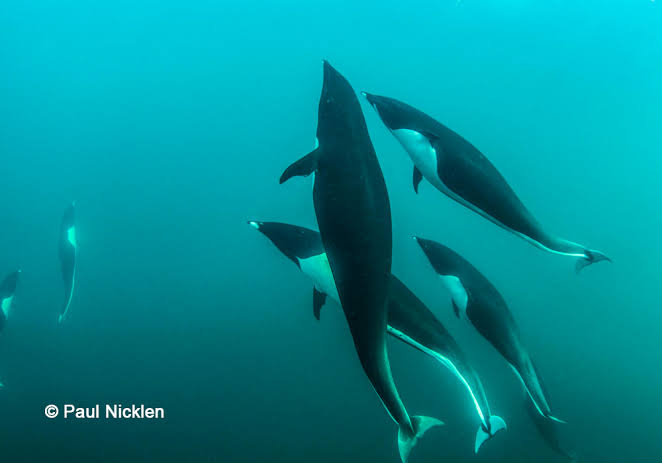
Northern right whale dolphins are highly social and are normally found in groups rather than living solitary lives. NOAA reports that groups commonly contain around 100 to 200 animals, while exceptionally large aggregations involving as many as 3,000 dolphins have also been recorded.
They may also associate with other cetacean species.
Large groups travelling together can create an impressive sight at the surface, but much of the species’ life takes place far from the coastal areas where most people observe dolphins.
Life in the Open North Pacific
Northern right whale dolphins inhabit temperate waters throughout much of the North Pacific.
Their documented distribution includes waters off western North America from northern Baja California towards the Gulf of Alaska, as well as parts of the western Pacific near Russia and Japan.
Along the United States West Coast, researchers have recorded the species mainly in shelf, slope and offshore waters.
NOAA stock assessments also describe seasonal movements. Northern right whale dolphins tend to occur farther south, particularly off California, during colder periods. As waters warm during spring and summer, their distribution can shift north towards Oregon and Washington.
The Channel Islands therefore fall within a region where the species has been documented by marine mammal researchers. NOAA data specifically examining marine mammal distribution around the Channel Islands National Marine Sanctuary include northern right whale dolphins among the species recorded in the area.
What Do Northern Right Whale Dolphins Eat?
Their slender bodies are adapted to an oceanic lifestyle that includes feeding below the surface.
Northern right whale dolphins prey primarily on small fish and cephalopods, including squid. NOAA reports that the dolphins can remain underwater for several minutes while feeding in deeper water.
Like other toothed whales, they rely on sound and echolocation to navigate their environment and locate prey.
Their offshore distribution means much of this behaviour takes place beyond the view of casual wildlife observers.
How Large Do They Become?
Despite their extremely slender appearance, northern right whale dolphins can become surprisingly large.
NOAA gives an adult length range of approximately 2 to 3 metres, with males generally growing larger than females. The agency reports a lifespan of about 42 years or longer.
The combination of length, narrow body shape and lack of a dorsal fin produces proportions quite different from more familiar dolphins such as bottlenose dolphins.
When photographed in midair, those proportions become especially obvious.
Unusual Does Not Mean Rare
Photographs of northern right whale dolphins are sometimes accompanied online by descriptions presenting them as extraordinarily rare animals.
That requires some qualification.
Their appearance is certainly unusual, and encountering them may be difficult for people who spend most of their time around coastal waters. However, their offshore lifestyle should not be confused with evidence that the species is one of the rarest dolphins in the world.
NOAA maintains population assessments for northern right whale dolphins and does not describe the species as exceptionally rare. The animals are, however, vulnerable to several human related pressures, particularly accidental entanglement in fishing gear and disturbance from underwater noise.
What makes an image like this remarkable is therefore not that it necessarily documents an extremely rare animal.
It is the perspective.
For a brief moment above the water, the photograph reveals almost the entire anatomy of an oceanic dolphin that usually offers observers only fleeting glimpses at the surface.
With its narrow black and white body, pointed profile and completely smooth back, the northern right whale dolphin demonstrates just how different the familiar dolphin form can become.
And somewhere in the open waters of the North Pacific, groups numbering in the hundreds may be moving through the ocean with that same distinctive, finless silhouette.
Sources
Primary scientific information in this article is based on NOAA Fisheries species information, United States Pacific marine mammal stock assessments and NOAA research concerning marine mammal distribution around California’s Channel Islands.

Mohsen Nabil is the Founder and Editor-in-Chief of Diventures Magazine. A mechanical engineer and scuba diving instructor based in the Red Sea, he writes about diving safety, marine conservation, underwater exploration, and developments in the global dive industry. Through Diventures Magazine, he works to connect divers, scientists, and ocean advocates while promoting responsible diving and protection of the oceans.