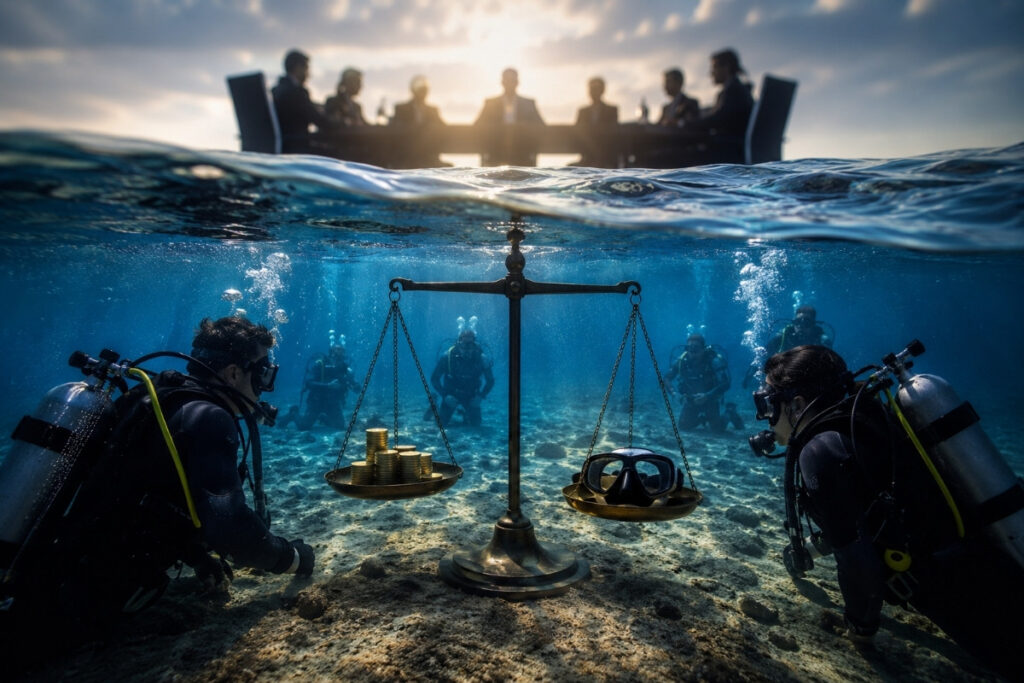


Under Pressure… Two Worlds, One Set of Rules
What did diving teach me about surgery?
“The same rule applies in the operating room and forty meters underwater: panic kills”.
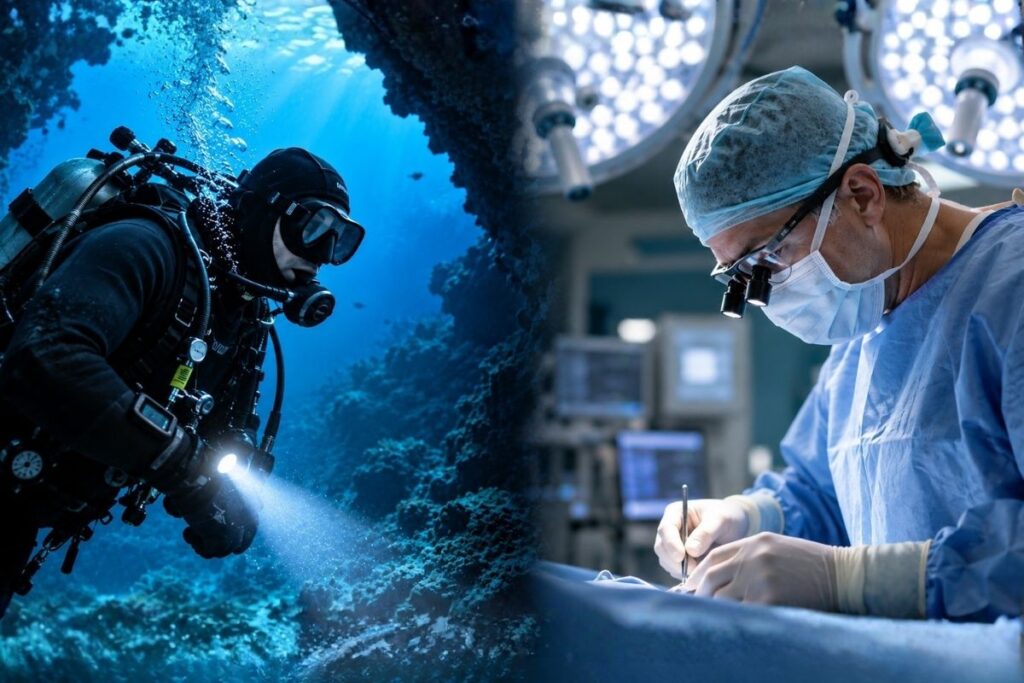
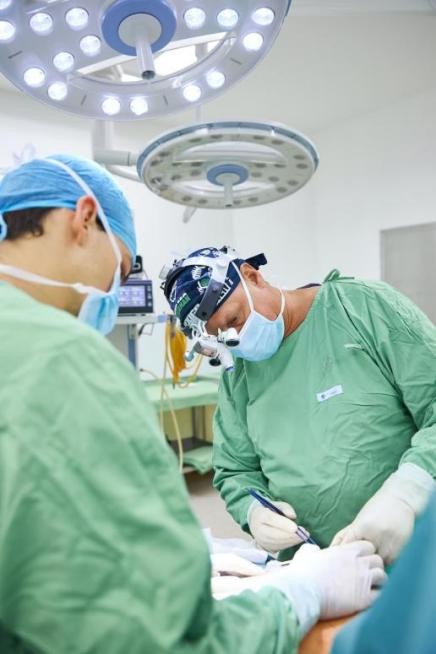
At first glance, the worlds of plastic surgery and scuba diving might seem worlds apart. One takes place in sterile operating rooms, the other in saltwater, often amidst poor visibility. In one, monitors beep; in the other, we hear only the sound of our own breathing. Yet, over the years, it has become increasingly clear to me that the operational logic of these two worlds is surprisingly similar.
Both can function as closed systems in critical moments. Both involve high stakes. And in both, the human factor is the most critical variable. As a surgeon and an active diver, I see the same patterns repeating: planning, checking, discipline, teamwork, and stress tolerance—as well as how quickly overconfidence can turn dangerous.
Experience is important. Yet, it can also be dangerous if it turns into overconfidence.
Both worlds teach the same lesson: safety is not the absence of fear, but the quality of preparation.
And perhaps this is the point where the operating room and the deep sea truly become one and the same world.
The Similarity Between Two Worlds
One of the most important shared characteristics of surgery and diving is that both can become environments where there is no real possibility for a quick “exit.” A problem cannot simply be interrupted or postponed—it must be managed right then and there.
During a deep dive, a diver cannot always immediately ascend to the surface without consequences; ascending too quickly can itself create additional risk. The same applies to the operating room: there is no “pause button” during unexpected bleeding, technical difficulties, or a patient’s instability. Maintaining control of the situation requires constant concentration and structured decision-making.
In both fields, it is particularly true that serious incidents rarely stem from a single major error. A chain of errors is far more common. A minor lapse in attention might be manageable on its own, but several small errors compounding one another can create a critical situation.
In diving, this could be a skipped equipment check, imprecise gas planning, or poor communication with a dive buddy. Similarly, in surgery, a misunderstanding, inadequate preparation, or a step performed too routinely can be dangerous.
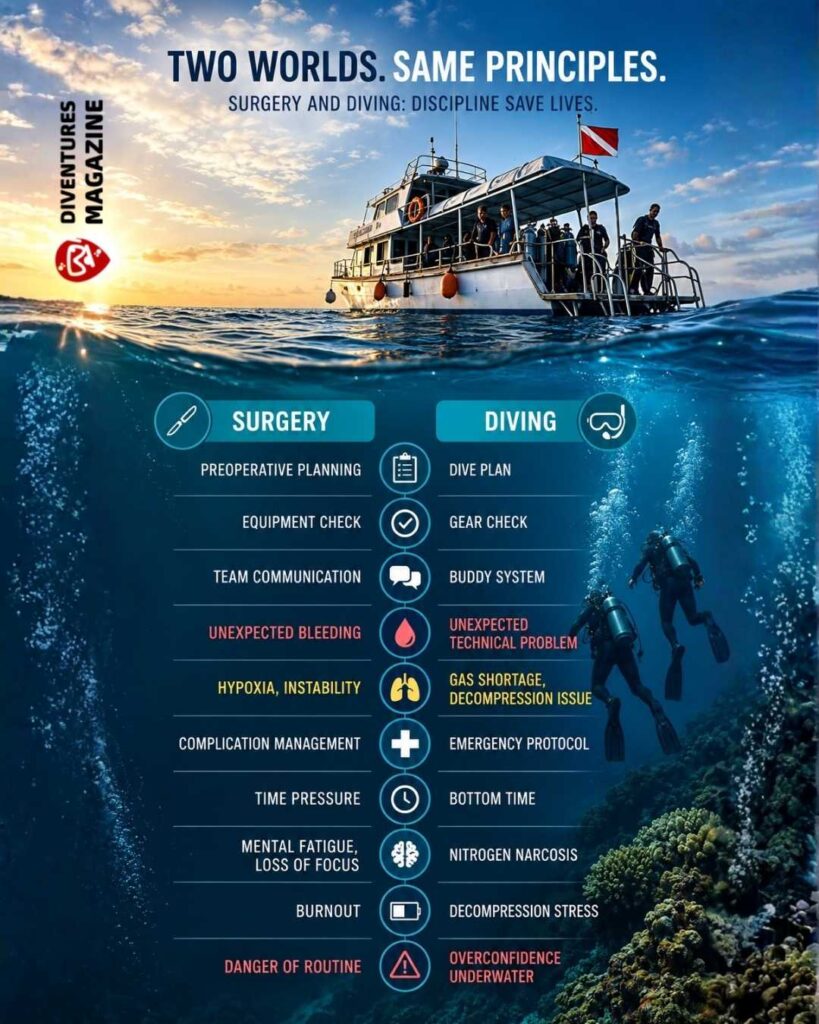
This is precisely why protocols play such a crucial role. To outsiders, checklists and repetitive checks may sometimes seem excessive or mechanical. In reality, they form the foundation of safety. Before a dive, divers check their equipment and emergency procedures in a specific sequence. Modern operating rooms operate on the same logic: patient identification, surgical planning, equipment checks, and team communication.
Protocols do not imply a lack of experience. Quite the opposite: the most experienced professionals are the ones who best understand how easily human error can lead to a dangerous situation.
This is perhaps the most important similarity between a good diver and a good surgeon: neither relies solely on routine or self-confidence for safety.
The checklist system
Most people view routine as proof of experience. In certain professions, however, routine itself can become the greatest danger. There is a well-known saying in diving: “Routine kills.”
This is not because experience is harmful, but because overconfidence gradually erodes the discipline of performing checks. After a while, one tends to think, “I’ve done this a hundred times.” Most errors begin at precisely this point.
This is why the “buddy check” is a standard practice in diving. Before a dive, divers check not only their own equipment but also that of their partner. Air supply, regulator, buoyancy control device, dive computer, backup systems—every check follows a specific sequence. It is not a matter of mistrust, but a recognition that anyone can make a mistake under stress or in a routine situation.
Modern surgery has adopted this same approach.
The use of a surgical checklist is now an important safety element in the operating room. The best-known system is the Surgical Safety Checklist introduced by the World Health Organization. A landmark multicenter study found that implementation of the checklist was associated with reductions in surgical complications and deaths, although subsequent research has shown that outcomes can depend on how such systems are implemented.
The essence of the checklist seems simple at first glance: the right patient, the right side, the right procedure, the right equipment, known risks, and clearly defined team roles.
Yet, these seemingly simple steps can save lives. Aviation, diving, and surgery have all learned that human memory is unreliable under stress. Even the best professionals are not safe because they never make mistakes, but because they work within systems designed to detect and correct errors in time.
Redundancy plays a key role in this—ensuring that a backup solution is available when appropriate in critical situations. Depending on the type of dive and environment, technical divers may carry redundant gas supplies, backup lights, or alternative ascent plans. In surgery, the same principle can manifest in backup equipment, blood products when indicated, alternative surgical strategies, or multiple verification systems.
From the outside, these measures might sometimes appear to be excessive caution. From the inside, however, they are signs of humility—a recognition that, under immense pressure, no individual is infallible. True professionalism often reveals itself not in spectacular technical feats, but in the small, consistently repeated steps that prevent catastrophe.
Stress and Decision-Making
In the operating room and underwater, the human body reacts to stressful situations in surprisingly similar ways. The body shifts into survival mode: heart rate rises, breathing quickens, and adrenaline levels surge. In the short term, this can enhance performance. Beyond a certain point, however, stress ceases to be helpful and instead impairs decision-making.
Divers are well acquainted with the phenomenon of “tunnel vision”—where, in a dangerous situation, attention narrows to a single problem, causing one to lose the ability to grasp the overall situation. A diver focused on a technical malfunction might fail to notice rapid gas consumption or a change in depth.
The same can occur in the operating room during a complication. Unexpected bleeding or a technical difficulty can easily monopolize attention, causing other important parameters to be overlooked. Consequently, one of the most vital skills for an experienced surgeon is not merely technical expertise, but the ability to maintain a view of the “big picture” even under stress.
Escalating stress can also impair fine motor skills. A diver becomes less dexterous, finding it harder to manipulate small fittings or connections. In surgery, this can be particularly critical, as precision often hinges on movements measured in millimeters. Excessive tension can lead to hand tremors, rushed actions, or overly aggressive movements.
Even more dangerous is cognitive narrowing. Under stress, people tend to simplify their thinking. Problem-solving ability narrows, information processing deteriorates, and creative decision-making declines. In such instances, the missing element is often not technical knowledge, but the mental flexibility required to re-evaluate the situation.
That is why a skilled diver or surgeon is not only technically proficient but also mentally trained.
In a critical situation, the role of the team leader becomes especially vital. Leadership in such moments is not about loud direction or dominance, but about providing a calm structure. A good leader is able to slow down the chaos; they set priorities, communicate clearly, and project stability to the team.
Interestingly, panic is often contagious. A single flustered or uncertain individual can impact the entire team’s performance—whether in the operating room or underwater. The reverse is also true: calm leadership can help reduce stress within the team.
One of the best-known rules among experienced divers is: “Slow is smooth. Smooth is fast.”
At first glance, this statement seems like a paradox, yet it perfectly captures the essence of working under high pressure. Controlled, structured movements ultimately lead to faster and safer solutions than rushing does.
Perhaps this is one of the most important lessons shared by the worlds of the operating room and the deep sea: in a high-stress situation, the winner is not the one who reacts the fastest, but the one who can think clearly for the longest.
Complication vs. Underwater Emergency
Most laypeople imagine that “nothing goes wrong” for a skilled surgeon or an experienced diver. The reality is far more complex. There is no such thing as a completely risk-free environment, whether in the operating room or underwater. Even with vast experience, meticulous planning, and the best technology, unexpected situations can arise. An anatomical variation, sudden bleeding, a technical malfunction, or an adverse physiological reaction cannot always be predicted.
The difference often lies not in whether a complication occurs, but in how one reacts to it.
In diving, panic itself can become one of the most dangerous factors. Tragedy is not necessarily caused by the initial problem, but can result from the uncontrolled reaction to it. A lost mask, an unexpected current, or an interruption in gas supply might be manageable situations on their own—but frantic behavior can quickly escalate the crisis.
The same mechanism can be observed in the operating room. A complication rarely becomes truly dangerous in a split second. The critical moment often occurs when the team loses its structure: communication breaks down, movements become rushed, and thinking narrows.
Experienced professionals, therefore, do not prepare for a scenario where problems never occur; instead, they prepare for how to function effectively when a problem does arise.
Before a dive, technical divers consider potential emergencies:
What happens in the event of gas loss?
Where is the backup system located?
How will the ascent be executed? When should a dive be aborted?
A skilled surgeon constantly runs similar “mental scenarios” through their mind:
What is the next step in the event of unexpected bleeding?
When should the strategy be changed?
When is it necessary to call for help?
Where does the safety limit lie?
Interestingly, in both worlds, one of the hallmarks of true professionalism is the ability to keep one’s ego in check. In dangerous situations, the strongest person is not the one who pushes on at all costs, but the one who recognizes their own limits in time.
Divers know full well that aborting a dive is not a failure, but can be a wise decision. The same mature mindset is evident in surgery when a surgeon adjusts the plan in time, calls for assistance, or opts for a safer approach.
There is a crucial rule shared by both worlds: a situation rarely improves simply because one starts moving faster out of panic. Controlled reactions, communication, and structured thinking are often more important than the original technical problem itself.
Perhaps that is why the calmest professionals are not those who have never encountered a complication, but rather those who have learned that surviving critical situations is primarily a matter of mental discipline.
Decompression and Burnout
One of the best-known dangers of diving is decompression sickness.
During a dive, body tissues absorb inert gases from the breathing gas as a result of increased ambient pressure. As pressure decreases during ascent, those gases must be eliminated appropriately. If decompression is inadequate, bubbles can form in tissues or the bloodstream and decompression sickness may develop. Importantly, decompression sickness can sometimes occur even when a diver has followed an apparently acceptable dive profile.
Its presentation can vary considerably. Symptoms may initially be subtle, including unusual fatigue, pain, tingling, dizziness, or other changes, while more serious cases can involve neurological, respiratory, or circulatory problems.
Surgical burnout follows what I see as a surprisingly similar pattern, although the comparison is conceptual rather than physiological. Decompression sickness and burnout are different medical conditions with entirely different biological mechanisms.
A surgeon works under intense mental and emotional pressure for years. Constant responsibility, sleep deprivation, the need to make critical decisions, the weight of complications, and performance expectations slowly become the “new normal.” The body and psyche adapt to this chronic stress—until, eventually, they can no longer compensate.
Burnout rarely develops overnight. Just as decompression stress may not be immediately obvious, burnout is not caused by just one bad week.
Both can appear:
Invisible, gradual, cumulative, and easily downplayed at first.
The person affected often fails to notice the early signs themselves. The diver says, “It’s just a bit of fatigue.” The doctor says, “Everyone is exhausted these days.”
The parallel, however, should not be taken literally. In diving, decompression risk is managed through appropriate dive planning, ascent procedures, required decompression when applicable, and adherence to established diving practices. Mental recovery operates through an entirely different process.
What links the two, in my mind, is the idea of respecting limits.
Burnout can coexist with high performance for a long time. From the outside, one sees a successful professional, while internally, emotional reserves, concentration, and empathy may gradually be depleting.
Perhaps that is why the parallel between decompression and burnout remains compelling to me: both remind us that there are limits to adaptation, even when everything appears normal from the outside.
And both serve as a reminder that survival is not merely a technical matter, but a question of biological and mental balance.
Conclusion
The idea for this article was prompted by the May 2026 Devana Kandu cave diving tragedy in the Maldives.
This article does not attempt to determine the cause of that incident or assign responsibility. Rather, the tragedy made me reflect on the broader human factors that exist in both diving and medicine.
In the wake of such tragedies, outsiders often look for a single error—a bad decision, a technical issue, or a human oversight. The reality, however, can be far more complex. Critical situations may involve an interplay of human factors, communication, stress, complacency, overconfidence, technical issues, environmental conditions, and timing.
As a surgeon, it is particularly difficult not to recognize the parallels.
Both worlds teach the same lesson: danger cannot be entirely eliminated. Safety stems not from becoming flawless, but from the ability to recognize one’s own limits, respect protocols, and maintain structured thinking even under stress.
Ultimately, the same rule applies in the operating room and in the depths: survival is not a matter of improvisation.
And perhaps that is why I feel these two worlds are so closely linked. Both demand constant self-control, discipline, and mental stability. Both swiftly punish decisions driven by ego. And both teach us that true professionalism is often quieter than we might imagine.
“A good surgeon and a good diver remain calm not because they are free from danger, but because they are prepared for it”.
Opinion Disclaimer
This article reflects the author’s personal professional perspective and experiences as a surgeon and diver. The comparisons between medicine and diving are intended to explore human factors and safety culture and should not be interpreted as medical or diving advice. The views expressed are those of the author and do not necessarily represent the editorial position of Diventures Magazine.
Sources: DAN, WHO, Diventures Magazine

Dr. Béla Zoltán Debreczeni, MD, PhD, is a Hungarian plastic and reconstructive surgeon with more than 25 years of experience. He is also an experienced divemaster with a particular interest in diving safety, human factors, risk management, and decision making under pressure.