
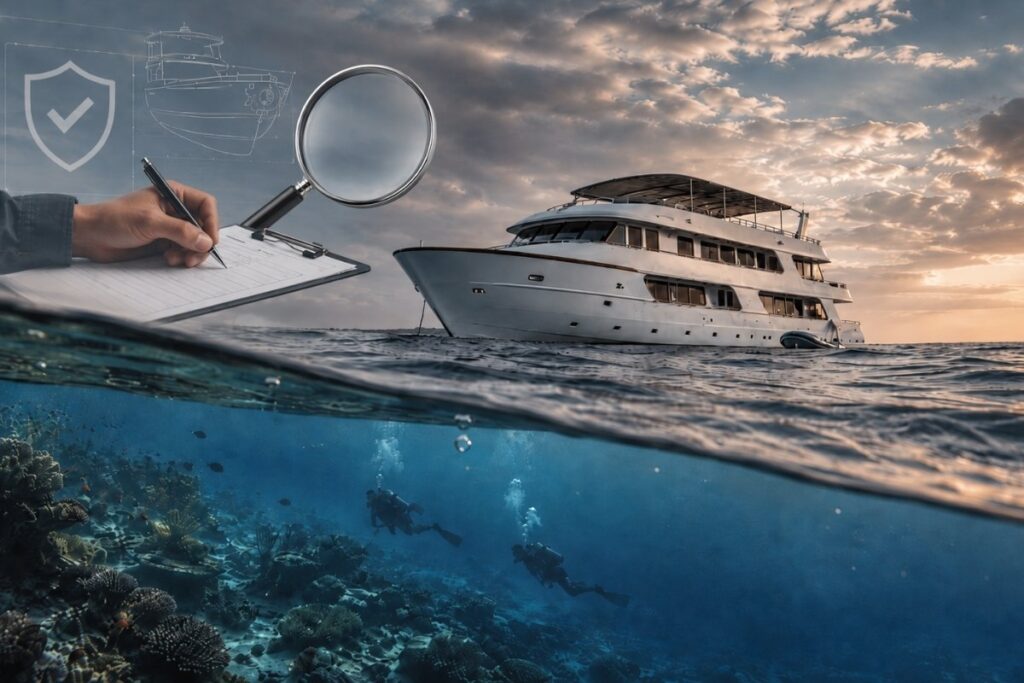

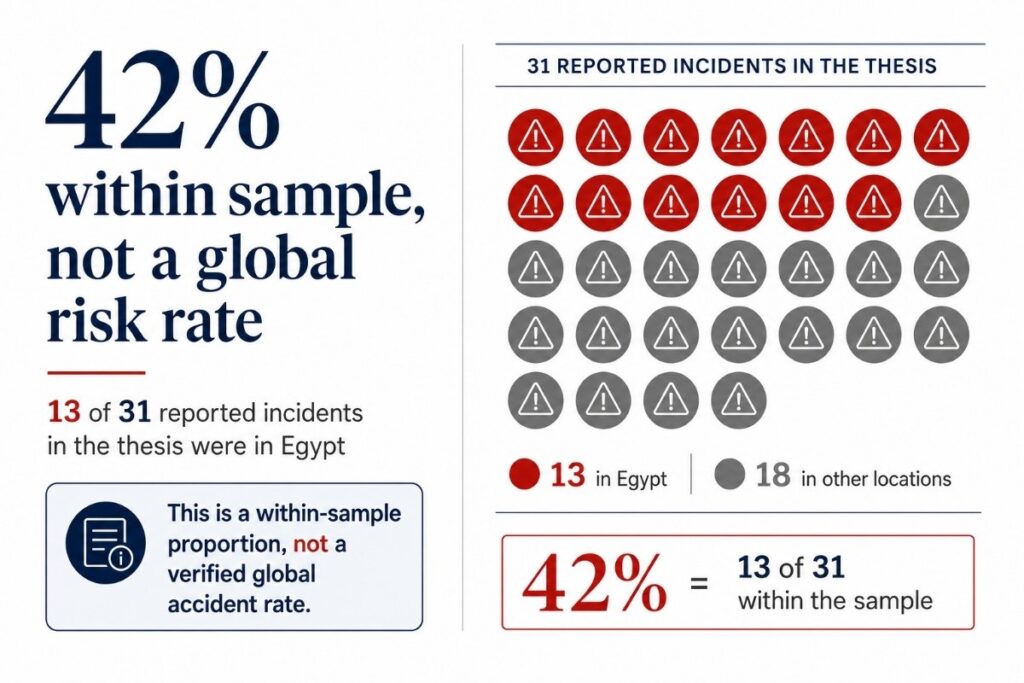
In November 2023, a German marine engineering student named Justus Schiszler from Kiel University of Applied Sciences (FH Kiel) submitted a bachelor’s thesis entitled ‘An Investigation into a Series of Accidents Involving Diving Safari Boats’,which he prepared in collaboration with the German website Taucher.Net. The researcher compiled data on 31 incidents involving dive safari boats around the world between 2006 and August 2023, and concluded that 13 of them – approximately 42 per cent – occurred in Egypt’s Red Sea, even though Egypt operates only about one-fifth of the global liveaboard fleet.
Since the publication of the thesis, this figure of 42 per cent has begun to creep into discussions on European diving forums and in some press coverage, as if it were a definitive judgement on the safety of diving in Egypt. As we work at the heart of this industry, in Hurghada specifically, we felt it was our professional duty to provide a comprehensive response – neither a blind defence of our sector nor a passive acceptance of a figure being used out of context.
Before writing this response, we subjected the thesis and its claims to an independent and extensive research review, which included scrutinising its methodology, tracking incidents that occurred after its publication up to 2026, and reviewing official international positions, notably the statements issued by the UK Marine Accident Investigation Branch (MAIB). What we present here is a summary of that review.
To summarise our position in a single sentence: the figure has been misused, and the problem is genuine at its core. Both points deserve to be stated in unison.
Firstly: What we acknowledge regarding the researcher, and fairness before criticism
In all fairness, we should begin with what Schlessler got right, because criticism that fails to acknowledge merit loses its credibility.
This thesis is one of the very rare, if not the first, academic attempts to compile incidents involving safari boats worldwide into a single database and analyse them from an engineering perspective. Our entire sector – from operators to regulatory bodies to the specialist media – has failed for decades to produce such documentation, yet an undergraduate student has managed to do so with limited resources.
The strongest aspect of the work is the systematic comparison of regulatory frameworks: the SOLAS Convention, the Caribbean SCV Code, the rules of the classification societies Bureau Veritas and DNV, European standards and German regulations, together with a realistic assessment of what can actually be applied to vessels of the size of safari boats and what is not economically viable. And its final recommendations… Fire alarms in all guest cabins and engine rooms; practical stability tests instead of costly calculations; the provision and maintenance of rescue equipment; crew training in accordance with the STCW Convention; and ensuring the functionality of emergency exits… These are sound engineering recommendations that are cost-effective, and we have no choice but to adopt them.
We also acknowledge his courage in admitting the limitations of his work: the thesis itself states explicitly that its data is incomplete, and that it relied on media coverage and testimonies from those affected in the absence of official reports; furthermore, the local authorities — including the Egyptian authorities — did not respond to his enquiries. The researcher made no secret of the shortcomings of his sample; it was those who came after him who misused his figures.
Finally, Schlessler demonstrated with a single example what we have been saying for years: the Egyptian vessel Royal Evolution, built in accordance with the SOLAS Convention and classified by Bureau Veritas, is operational and turning a profit. In other words, compliance with international standards is economically viable in our market, and the ‘prohibitive cost’ argument put forward by some operators is unfounded.
Secondly: Analysing the 42 per cent figure – a lesson in the difference between a percentage and a rate
This is the crux of our methodological response, and we ask anyone quoting this argument to read it carefully.
The proportion within the sample is not a risk ratio
When we say ‘42 per cent of the incidents took place in Egypt’, the only accurate way to phrase this is: 13 out of 31 incidents that a German researcher, working with European sources, was able to access, took place in Egypt. This is a within-sample proportion, not an incidence rate.
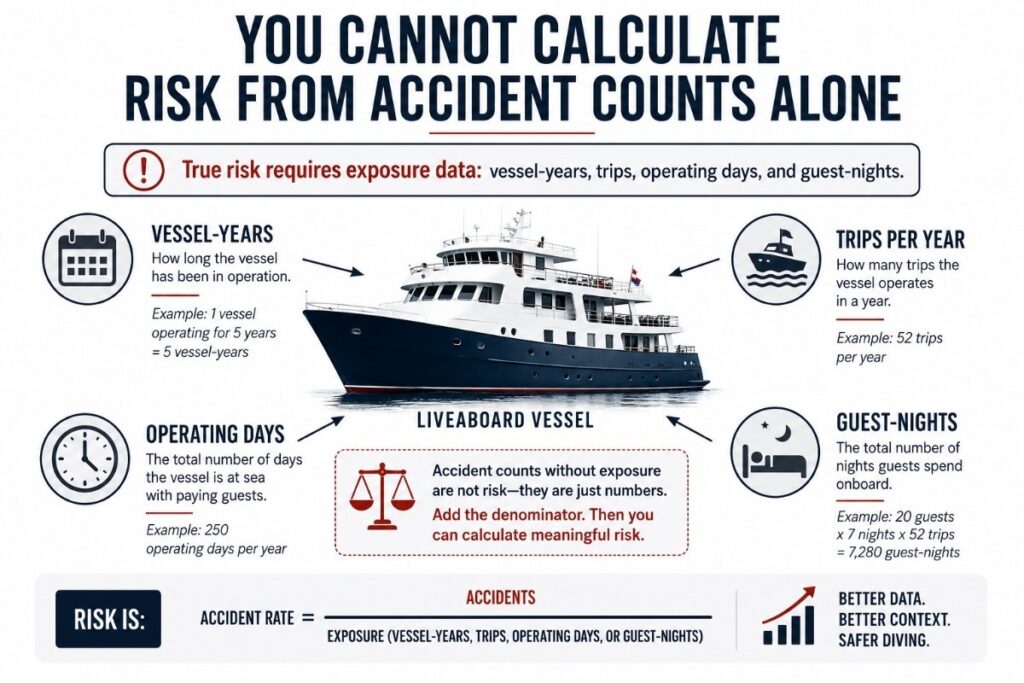
The true risk rate requires a reliable numerator and denominator: the total actual number of incidents in each region, divided by a standardised exposure measure — the number of vessels in operation, years of operation, number of voyages, or nights spent on board. None of this was available to the researcher, as he himself acknowledges. Our independent review in 2026 confirmed that this information (the denominators) remains unavailable to this day, neither for Egypt, nor for Indonesia, nor for Thailand, nor for the Maldives, and that any numerical ranking of regions by risk would be governed by uncertainty in the figures rather than reflecting the actual operational risk.
Bias is not random; it has a specific direction
What is more serious than the lack of data is that the shortfall is skewed in a particular direction, and this is precisely what makes Egypt’s figure particularly susceptible to exaggeration:
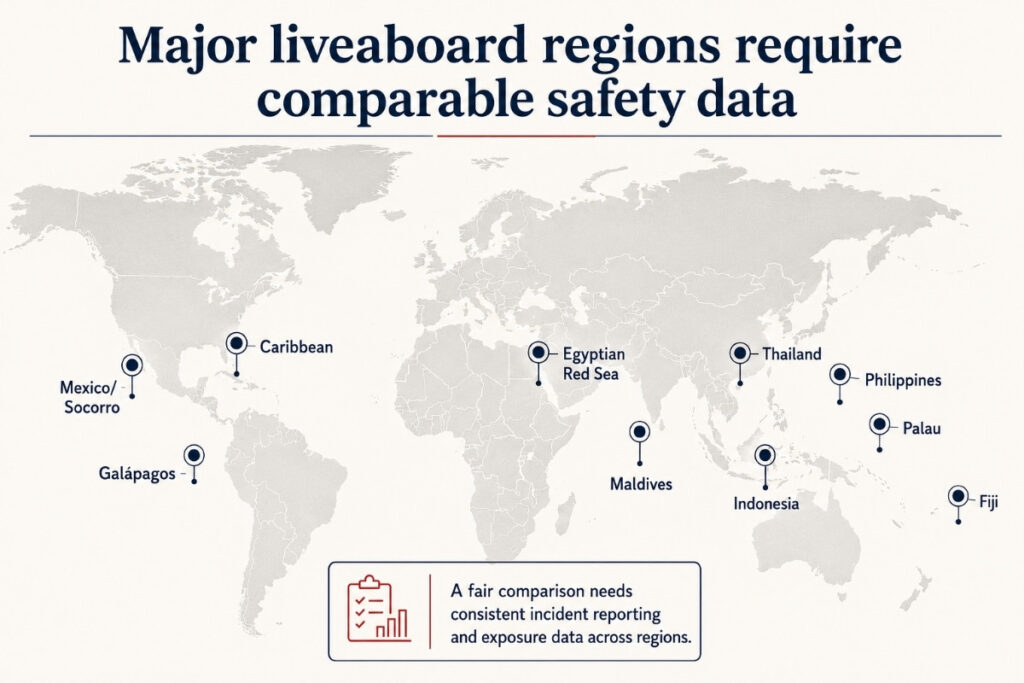
Biased reporting: The Red Sea is a prime European destination; its visitors are German, British and Dutch. An incident involving European tourists reaches taucher.net and Divernet within hours, and prompts the intervention of European investigative bodies if there are casualties. A similar incident involving a local boat carrying local passengers in a remote Indonesian archipelago might not even make it beyond a regional newspaper in a language the researcher could not read in the first place.
Language barrier, as acknowledged by the researcher: The thesis explicitly states that access to regulations and records in Indonesia and Thailand was unsuccessful due to the language barrier, that the websites of the relevant authorities there are not translated, and that his enquiries went unanswered. In other words, South-East Asia – Egypt’s main competitor in the live-aboard market – is under-represented in the sample in structural terms. Every Asian case that is omitted mathematically increases Egypt’s share without the reality changing in any way.
The unreliability of the data: even the comparison with ‘one-fifth of the global fleet’ is based on a single expert’s estimate, provided in a personal correspondence (866–1,096 vessels worldwide), with a margin of error of approximately 25 per cent.
And the irony is: Egypt does not actually have the worst incident in the sample
In the Schessler database itself, the most significant incident of all – the fire on the Conception, in which 34 people died in 2019 – took place in California, the United States, under the watchful eye of the US Coast Guard, on a vessel that was, in theory, subject to one of the strictest regulatory regimes in the world. In fact, the NTSB report documented that the mandatory night-watch rule was not being enforced and that the Coast Guard was not monitoring its implementation. The message is clear: the failure to regulate small vessels is a global phenomenon, not a uniquely Egyptian flaw. Anyone who uses this argument to demonise Egypt alone has not read the report in full.
Thirdly: the aspect that we cannot afford to deny
If we had stopped at the previous point, this would have been a defence plea, not a newspaper article. The painful truth is that the events following the publication of the thesis have reinforced the essence of its warning, even whilst rendering its digital application obsolete.
The thesis was completed in August 2023. The following events then took place, documented to the highest standards:
- On 25 November 2024, the safari boat Sea Story capsized and sank off Marsa Alam, with 31 tourists and 13 crew members on board; the final death toll stood at 11, marking the worst disaster in the history of Egypt’s tourism sector. One detail that must not be overlooked: the boat had passed an official safety inspection in March 2024, just eight months before it sank. This fact alone shifts the debate from the question ‘Are there regulations?’ to the more difficult one: ‘Do the inspections themselves have any meaning?’ — which, incidentally, is the very same question raised by Schlessler’s thesis when she suggested that the problem lay in enforcement rather than a lack of legislation.
- On 16 December 2024, the UK Marine Accident Investigation Branch (MAIB) issued a statement in an unprecedented tone, stating that it had been notified of three incidents over a twenty-month period involving British nationals on Egyptian diving boats in the Red Sea — the capsizing of the Carlton Queen (April 2023), the fire on the Hurricane which killed three British nationals (June 2023), and the Sea Story disaster — and that it had“cause for serious concern” regarding the safety of certain Egyptian dive boats. The MAIB has officially recognised the UK as a State with a substantial interest in the investigations, in accordance with the International Maritime Organisation’s Code for the Investigation of Marine Accidents, and has written to the Egyptian Maritime Safety Authority. The MAIB is neither a forum for angry divers nor a tabloid newspaper. It is a sovereign investigative body, one of the world’s most prestigious maritime investigation authorities, which uses strongly worded diplomatic language and is taking formal procedural steps regarding our sector. To ignore this is not patriotism; it is a dereliction of duty towards the future of the industry itself.
Our review also highlights further incidents in 2024 reported in subsequent coverage, a fire reported on a boat in February 2024 in which a German diver was killed; the evacuation of 24 French tourists before their boat sank in June; and the rescue of 30 people near the Daedalus Reefs in November, We are reporting these here as accounts requiring verification from primary sources, not as established facts, in keeping with the same rigour we demand of others. However, even if we were to dismiss them entirely, the documented series of events from 2023–2024 remains sufficient to draw a conclusion: there is a systemic problem, and the world can see it.
The fair conclusion, therefore—one that is consistent with the independent review we conducted—is that the hypothesis that the Egyptian Red Sea does indeed have a high accident rate per operating unit is plausible but unproven (plausible but unproven); and the hypothesis that a significant part of the picture is attributable to the size of the market, the intensity of operations throughout the year and the level of media coverage is highly probable. The two hypotheses are not mutually exclusive, and it is possible—indeed, likely—that they are both correct.
Fourthly: What was it that the researcher could not see from his office in Kiel?
This, precisely, is our niche – one occupied by no one else. The thesis was written in Germany using open-source material, whilst the international reports are written in London in English. As for us, we work wherever the boats dock.
What has changed since the Sea Story incident: According to reports circulating, the Egyptian authorities have tightened the operating requirements for safari boats following the disaster, including the requirement for each boat to have two licensed captains and two qualified mechanics, and linking crew registration to the boat’s operating licence. These measures, if confirmed in official texts, are a step in the right direction. However, we must be honest with our readers: at the time of writing, we have not found the original regulatory texts published and made available, nor any published enforcement statistics: how many boats have been inspected? How many licences have been suspended? How many vessels have been taken out of service?
Regulations whose text is not published and whose enforcement numbers are not announced do not inspire confidence, neither in the MAIB nor in insurance companies, nor in European tour operators, some of whom have already begun reviewing their contracts with the Egyptian market.
A question for the Centre for Diving and Water Sports (CDWS):
The thesis documented that the standards for safari boat cabins, communications equipment, first aid, a generator and crew quarters fall far short of any international benchmark and do not come close to the stability and fire-fighting requirements set out by SOLAS or classification societies. This judgement, harsh as it was, was not unfair at the time. The question that remains today is: will anything fundamental change after 2024? We are prepared to publish the full answer, whatever it may be, should we receive it.
The Arab documentation gap: It is striking that our extensive review did not find a single primary Arabic source amongst the international publications concerning these incidents. These were incidents that took place in our waters, investigated by our officials, with the findings published in our official gazette, yet their history is recorded only in German and English. This is a gap for which we, the specialist Egyptian media, bear part of the responsibility, and we hereby declare our commitment to bridging it.
Fifth: What next? A roadmap rather than an exchange of accusations
The true response to the German thesis is not an article, but a set of statements. We shall therefore conclude with specific, measurable demands, and start with ourselves.
What we are calling on the authorities to do: for the Chamber of Diving and Marine Activities to publish an up-to-date public register of the number of licensed safari boats in operation at each port – Hurghada, Marsa Alam, Sharm El-Sheikh and Borg Al-Ghalib. This figure alone – which is by no means a military secret – enables the world to calculate a genuine accident rate per vessel-year rather than relying on estimates; and it may well be – and this is, in our view, likely to be – in Egypt’s favour when compared with other fleets for which less data is available.
We also call on the Egyptian Maritime Safety Authority to publish the final investigation reports into the Hurricane and Sea Story incidents, as the NTSBdid in the case of the Conception;as the International Code of Investigation requires that reports on ‘very serious’ accidents – and any accident involving fatalities or the total loss of a vessel is, by definition, very serious – be forwarded to the International Maritime Organisation.
What we are calling on operators to do: do not wait for regulations to be imposed. Schessler’s short-term recommendations include interconnected smoke alarms in all cabins and engine rooms, fire extinguishers distributed in accordance with spacing requirements, documented stability testing, a proper safety briefing for guests covering assembly points and the use of life jackets – all measures whose cost is negligible compared to the cost of a single vessel catching fire or capsizing. And the Royal Evolution precedent proves that the highest standard – full international classification – is also commercially viable.
Our commitment at Divers: to document every incident in our waters in Arabic and English from primary sources; to translate and publish Egyptian regulatory texts issued after 2024 as soon as they are obtained; to formally seek fleet figures from the Chamber and publish them; and to follow up on the findings of MAIB and Egyptian investigations until they are published. Because the alternative to writing our own story is exactly what is happening now: that it is written by an undergraduate student at Keele, based on an incomplete sample, and his partial figure becomes a global judgement against us.
In a nutshell
Schlesser’s thesis is a serious and impartial piece of work that has been misused: the figure of 42 per cent represents a proportion within a small, biased sample and, as the researcher himself acknowledged before anyone else, is not suitable as evidence of a global risk rate. However, dismissing the figure does not invalidate the warning. Between the capsizing of the Carlton Queen, the Hurricane fire, the Sea Story disaster and the MAIB’s landmark report, the question is no longer ‘Is the picture bleak?’, but ‘What are we going to do about it?’. And the only answer that honours the victims of these incidents and safeguards the future of hundreds of vessels and thousands of families who depend on this sector for their livelihood is: transparency in the figures, the publication of investigations, enforcement measured by results rather than by the letter of the law, and a specialist press that tells the whole truth, in the language of those it serves first and foremost.
Methodological note: This article draws on the Schiszler thesis (FH Kiel, November 2023) and its corrigendum (February 2024), and on an independent, extended research review conducted in 2026 encompassing official MAIB materials and international maritime and diving press coverage of the Sea Story, Hurricane, and Carlton Queen accidents. Items described as “reports requiring verification” are drawn from secondary sources and have not yet been confirmed against their primary texts; this article will be updated as official documents become available.

Mohsen Nabil is the Founder and Editor-in-Chief of Diventures Magazine. A mechanical engineer and scuba diving instructor based in the Red Sea, he writes about diving safety, marine conservation, underwater exploration, and developments in the global dive industry. Through Diventures Magazine, he works to connect divers, scientists, and ocean advocates while promoting responsible diving and protection of the oceans.