
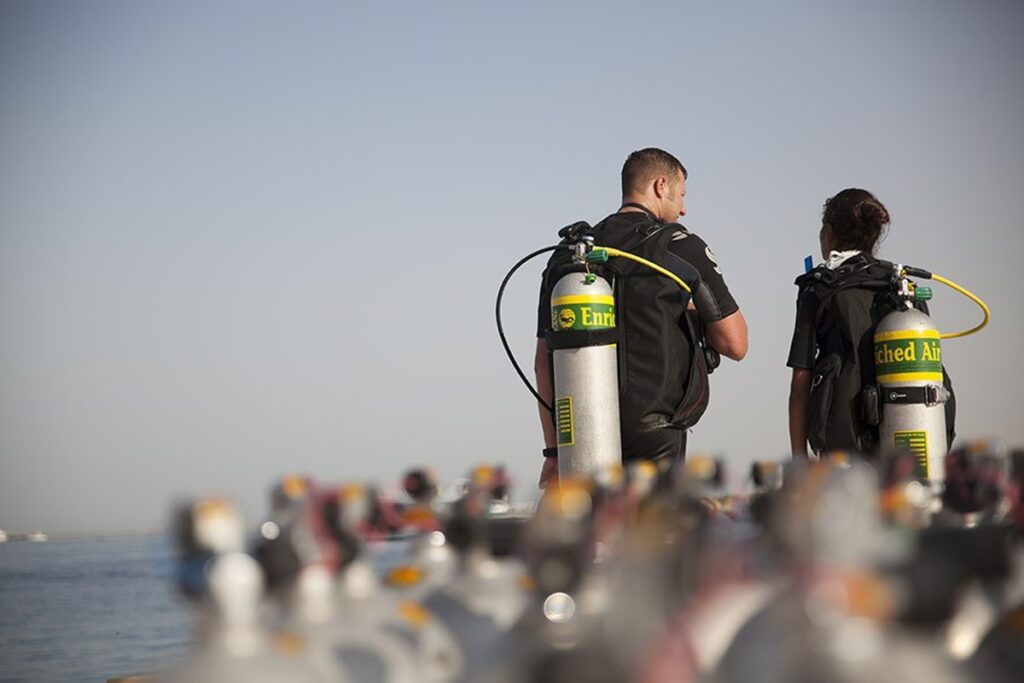

4 Reasons Why Enriched Air Nitrox Should Be Your Next Specialty
For many newly certified divers, the next course decision can feel overwhelming. Deep diving, wreck diving, buoyancy training, navigation and other specialties all offer obvious ways to expand your skills.
Enriched Air Nitrox is different. It may not immediately take you somewhere you could not dive before, but it changes the way you can plan many of the dives you are already doing.
Nitrox is a breathing gas containing a higher percentage of oxygen and therefore a lower percentage of nitrogen than normal compressed air. Standard air contains approximately 21 percent oxygen. By reducing the proportion of nitrogen in the breathing gas, Nitrox can give divers more flexibility in managing nitrogen exposure and no decompression limits.
That makes it particularly useful for repetitive recreational diving, dive holidays and liveaboard trips.
But Nitrox comes with an important tradeoff. More oxygen means that oxygen exposure becomes a more significant part of dive planning. Every Nitrox mixture therefore has a maximum operating depth, and divers need to understand how to analyze their gas, establish the correct depth limit and configure their dive computer accordingly.
That is exactly why the training matters.
1. You Can Extend Your No Decompression Time
The most obvious advantage of Nitrox is the reduction in the amount of nitrogen a diver breathes compared with air.
At many recreational depths, this can increase the time available before reaching a no decompression limit. The benefit can be especially noticeable on dives where nitrogen exposure, rather than gas supply, is the factor limiting the dive.
Imagine spending time photographing a reef, exploring a wreck within recreational limits or waiting for marine life at a particular depth. With the appropriate Nitrox mixture, the dive computer may allow more no decompression time than it would for the same profile while breathing air.
This does not automatically mean every Nitrox dive should be longer.
A diver may instead choose to keep approximately the same dive profile they would have used on air, while benefiting from lower nitrogen exposure. DAN notes that Nitrox can be used in different ways, including extending bottom time or reducing decompression stress when the same dive profile is maintained.
The important lesson is that Nitrox provides options.
2. It Becomes Particularly Useful on Repetitive Dive Days
A single relaxed dive may not always demonstrate the biggest practical advantage of Nitrox.
Its usefulness often becomes clearer when diving repeatedly.
This is common on Red Sea liveaboards, resort diving holidays and other trips where several dives may be planned over consecutive days. Every dive contributes to the diver’s overall nitrogen exposure, and previous dives influence the no decompression time available on subsequent dives.
Because Nitrox contains less nitrogen than air, it can offer additional flexibility when planning repetitive dives.
That does not mean surface intervals become optional or that divers should simply make every dive as long as their computers allow. Good planning, hydration, reasonable ascent practices, appropriate surface intervals and conservative decision making remain important regardless of the breathing gas being used.
Nitrox should be viewed as another tool for managing a dive profile, not as permission to push the limits of every dive.

3. The Course Makes You a Better Gas Planner
One of the most valuable parts of Nitrox training actually happens before you enter the water.
Divers learn that knowing what is inside the cylinder matters.
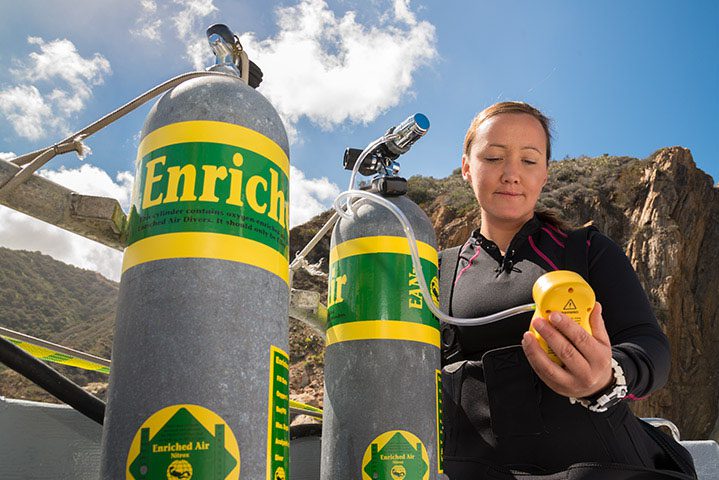
Before using a Nitrox cylinder, the oxygen percentage must be known because that percentage determines important parts of the dive plan, particularly the maximum operating depth.
Training normally introduces divers to procedures such as analyzing the breathing gas, confirming the oxygen concentration, determining the appropriate depth limit and correctly configuring a Nitrox capable dive computer.
These are simple procedures once learned, but they encourage an important habit: never assume that the gas in a cylinder is what someone says it is.
The diver is ultimately breathing that gas underwater.
Nitrox training also introduces recreational divers to oxygen exposure and partial pressure, concepts that become increasingly important as divers progress into more advanced forms of diving.
Understanding these principles can make the diver more aware of what the computer is calculating rather than simply following the number displayed on the screen.
4. It Opens the Door to More Advanced Diving
Nitrox is useful as a recreational qualification in its own right, but it also provides an important foundation for divers who later become interested in more advanced training.
Technical diving, advanced decompression procedures and several forms of mixed gas diving require a much deeper understanding of breathing gases, oxygen exposure and decompression planning.
A recreational Nitrox course is not technical diving training, and certification in Nitrox does not qualify someone to conduct decompression dives.
What it does is introduce some of the concepts that become essential later.
Even divers with no intention of entering technical diving can benefit from understanding why different gases behave differently at depth and why changing the oxygen content changes both the advantages and limitations of a dive.
That knowledge makes Nitrox one of the more broadly applicable specialties a recreational diver can complete.
Nitrox Does Not Let You Dive Deeper
This is one of the most important misconceptions to understand.
Nitrox is generally not used to increase maximum depth.
In fact, increasing the oxygen percentage reduces the depth at which a particular gas can safely be breathed because oxygen partial pressure increases with depth. Exceeding the maximum operating depth of the gas can expose a diver to the risk of central nervous system oxygen toxicity. DAN specifically emphasizes respecting the maximum operating depth associated with the mixture being used.
The correct question is therefore not, “How deep can I go with Nitrox?”
It is, “What breathing gas is appropriate for the depth and profile of this dive?”
That change in thinking is itself an important part of becoming a more knowledgeable diver.
Does Nitrox Make You Less Tired?
You will frequently hear divers say they feel less tired after diving with Nitrox.
Some genuinely report this experience, particularly after repetitive diving.
However, it should not be presented as an established benefit.
Research examining fatigue after air and Nitrox dives has produced mixed findings, and DAN notes that scientific evidence has not established a reliable reduction in post dive fatigue simply from breathing Nitrox.
So if you personally feel fresher after diving Nitrox, enjoy the feeling. Just do not treat reduced fatigue as one of the scientifically guaranteed effects of the gas.
Nitrox Is a Tool, Not a Shortcut
The real value of Nitrox is not simply getting more minutes underwater.
It teaches divers to think more carefully about breathing gases, nitrogen exposure, oxygen limits and dive planning.
For a diver who expects to make repetitive dives, travel regularly, join liveaboards or continue into more advanced training, those skills can become useful almost immediately.
And unlike some specialties that are valuable only in particular environments, Nitrox can be relevant on reefs, wrecks, photography dives, drift dives and ordinary recreational dives around the world.
Your next specialty does not necessarily need to take you deeper.
Sometimes becoming a better diver means understanding more about the gas you are already breathing.

Mohsen Nabil is the Founder and Editor-in-Chief of Diventures Magazine. A mechanical engineer and scuba diving instructor based in the Red Sea, he writes about diving safety, marine conservation, underwater exploration, and developments in the global dive industry. Through Diventures Magazine, he works to connect divers, scientists, and ocean advocates while promoting responsible diving and protection of the oceans.