
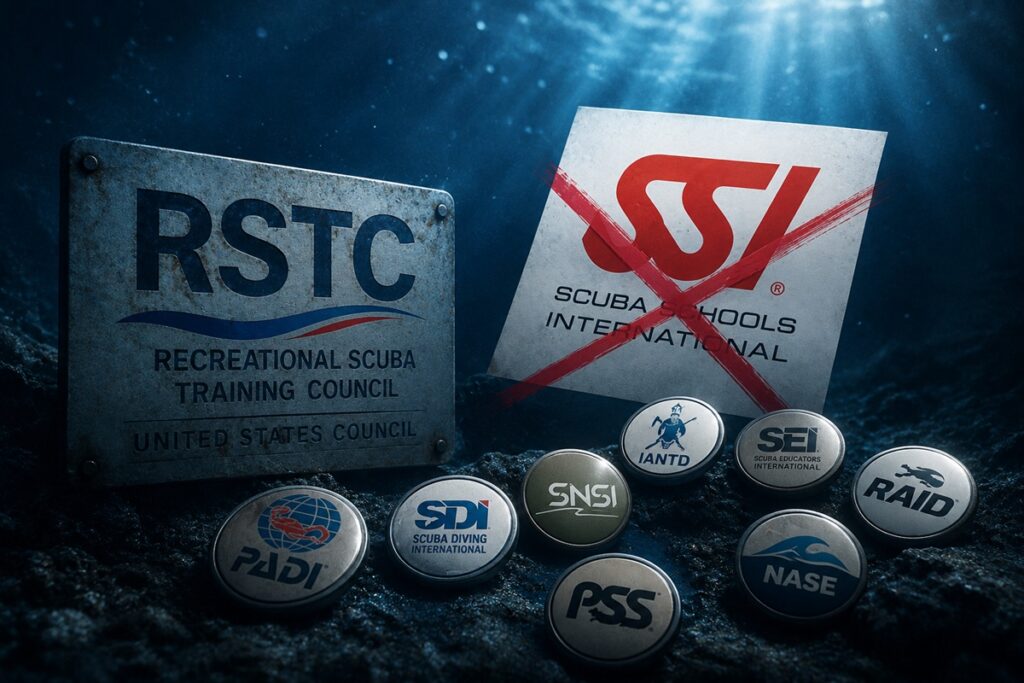

Scuba Schools International (SSI) has quietly disappeared from the membership page of the Recreational Scuba Training Council (RSTC) United States Council, in what appears to be a significant and unannounced departure from one of the diving industry’s most important standards bodies.
The WRSTC website — which lists the current members of the US RSTC — was updated on 24 June 2026. SSI is no longer among those listed. No statement has been issued by either SSI or the RSTC to explain the development.
The departure is notable given SSI’s deep historical ties to the council. SSI was among the founding members of the RSTC when it was formed in 1987, alongside IDEA, PADI, PDIC, and NASDS — the predecessor body that later merged with SSI itself. The RSTC was established to give member agencies a shared framework for developing minimum training standards and monitoring quality control across the recreational diving industry. Idea-scuba
As recently as February 2026, SSI’s own press materials continued to reference its RSTC founding membership as a core part of its institutional identity. SSI described itself as “a founding member of the RSTC” that plays “an active role in setting industry minimum training standards.” DiveNewswire
The US RSTC currently lists seven remaining members: IANTD, PADI, SEI (Scuba Educators International), RAID, SDI, SNSI, and NASE, along with PSS as an associate member. NAUI, which had rejoined the RSTC in 2017 after years outside the council, is also no longer listed — though that development predates this latest change.
A Standards Dispute, Not a Safety Issue
SSI has now broken its silence on the matter. In a statement distributed via email to all SSI professionals worldwide, the agency confirmed the removal and set out its position. Karim Salah, International Training Director at SSI Middle East, confirmed the authenticity of the statement and shared its contents publicly. SSI has not published the statement on its public-facing channels at the time of writing.
According to SSI, the dispute centres on a gap between two sets of standards governing the Assistant Instructor qualification. The RSTC’s standard — the Recreational Assistant Scuba Instructor Certificate — dates to June 2002. SSI has long operated under the more current ISO 24802-1 standard, second edition, issued in April 2014 and reviewed and confirmed in 2024. SSI argues that the ISO standard is both more current and more widely recognised across the global diving industry.
In February 2026, SSI submitted a draft standard to both the US RSTC and RSTC Europe, requesting confirmation that the councils would move to address the discrepancy. RSTC Europe responded positively, confirming the draft and declaring the issue resolved, with an updated Training Standards release planned for 1 October 2026. The US RSTC, by contrast, did not respond — and subsequently moved to remove SSI from its membership without notifying the agency in advance.
SSI has stated it will continue efforts to resolve the matter with the US RSTC.
What This Means for SSI Professionals and Certified Divers
SSI was independently ISO-certified as of April 2008 and most recently reaudited and recertified on 30 May 2025, within a five-year audit cycle. That certification stands regardless of RSTC membership status.
The agency has been explicit that the removal does not affect the validity of SSI certifications, nor the ability of SSI professionals and training centres to continue delivering SSI programmes under current SSI standards.
For SSI’s 4,000-plus affiliated training centres and more than 100,000 professionals worldwide, the practical implications remain limited for now. The dispute is administrative and standards-based — not a question of diving safety.
Update: 26 June 2026
Karim Salah, International Training Director at SSI Middle East, has confirmed the authenticity of SSI’s internal statement, noting that it was distributed via email to all SSI professionals worldwide. SSI has not published the statement on its public-facing channels at the time of writing. Diventures continues to seek a formal response from the WRSTC, which has not commented on the matter.

Mohsen Nabil is the Founder and Editor-in-Chief of Diventures Magazine. A mechanical engineer and scuba diving instructor based in the Red Sea, he writes about diving safety, marine conservation, underwater exploration, and developments in the global dive industry. Through Diventures Magazine, he works to connect divers, scientists, and ocean advocates while promoting responsible diving and protection of the oceans.