


When 40°C Is More Dangerous Than 50°C
When a summer weather report tells you it is 35°C outside, it is only giving you half the story. The number on the thermometer measures air temperature in the shade with no wind and no moisture. The moment you add humidity, direct sun, and a neoprene wetsuit, that number becomes almost irrelevant. What matters is the heat index — the “feels like” temperature — and for divers it carries a set of consequences that go far beyond personal comfort.
Understanding why heat kills, and why it kills some populations far more readily than others, is information every diver working in a tropical or desert climate should have in their kit bag, right alongside their dive computer and dive flag.
What the Heat Index Actually Measures
The heat index combines air temperature and relative humidity to calculate how hot conditions actually feel to the human body. The science behind this is straightforward. Your body cools itself by sweating. Sweat only works when it can evaporate from your skin, and it can only evaporate when the surrounding air has room to absorb moisture. High humidity blocks that process, reducing the body’s ability to shed heat through perspiration. The gap between what the thermometer says and what your body experiences can be enormous: at 32°C with 70 percent humidity, the effective felt temperature can climb to approximately 41°C. Source: National Geographic
The formula used to calculate this was developed by physicist Robert Steadman in 1979 and has since underpinned most national weather services around the world. Steadman’s model, however, was designed around an ideal scenario — a healthy adult, in the shade, appropriately dressed, with access to as much water as needed. Researchers at the University of California, Berkeley have since identified a major limitation: Steadman’s equations were never validated at temperatures above 31°C because extreme heat waves were less frequent in the 1970s than they are today. At the highest temperature and humidity combinations, alternative stand-in calculations can underestimate the felt temperature by as much as 10 to 20 degrees.
For a recreational diver gearing up on the deck of a Red Sea liveaboard at noon in July & August, that miscalculation is not academic. It is a physiological hazard.
Europe’s Summer Deaths: What the Numbers Tell Us
The stakes of ignoring the heat index are written clearly in European mortality data.
Between June and September 2022, large parts of Europe were affected by persistent heat waves that killed tens of thousands of people and caused billions of euros in damage, making them the deadliest meteorological event of that year. Revised research from the Barcelona Institute for Global Health placed the total death toll at over 70,000 heat-related deaths across Europe during the summer of 2022. The following year was barely less severe. An estimated 47,690 heat-related deaths occurred across 35 European countries in 2023, making it the second-highest heat mortality burden of the previous decade, surpassed only by 2022.
The highest mortality rates during the 2022 crisis were concentrated in Mediterranean countries — Italy, Greece, Spain, and Portugal — with Italy recording approximately 295 heat-related deaths per million people, and Greece close behind at 280. Source: Nature
These were not countries experiencing unfamiliar climates. Southern Europeans live with warm summers. Yet the deaths kept coming. The question is why.
Why Do Heatwaves Impact Some Populations More Than Others?
This is the part of the heat discussion that rarely makes it into Western media reports, and it deserves proper attention.
Residents of Egypt, Saudi Arabia, the UAE, Jordan, and the broader GCC region routinely endure summer conditions that would generate emergency alerts in northern Europe — air temperatures regularly exceeding 40°C, combined with the physical demands of daily life. Yet heat mortality statistics in these countries are a fraction of what Europe records during its periodic crises. European visitors who spend extended time in the Red Sea diving industry — instructors, liveaboard crew, dive guides working season after season — similarly seem to tolerate the heat with little difficulty. Why?
The answer is physiological acclimatisation, and the science behind it is well established.
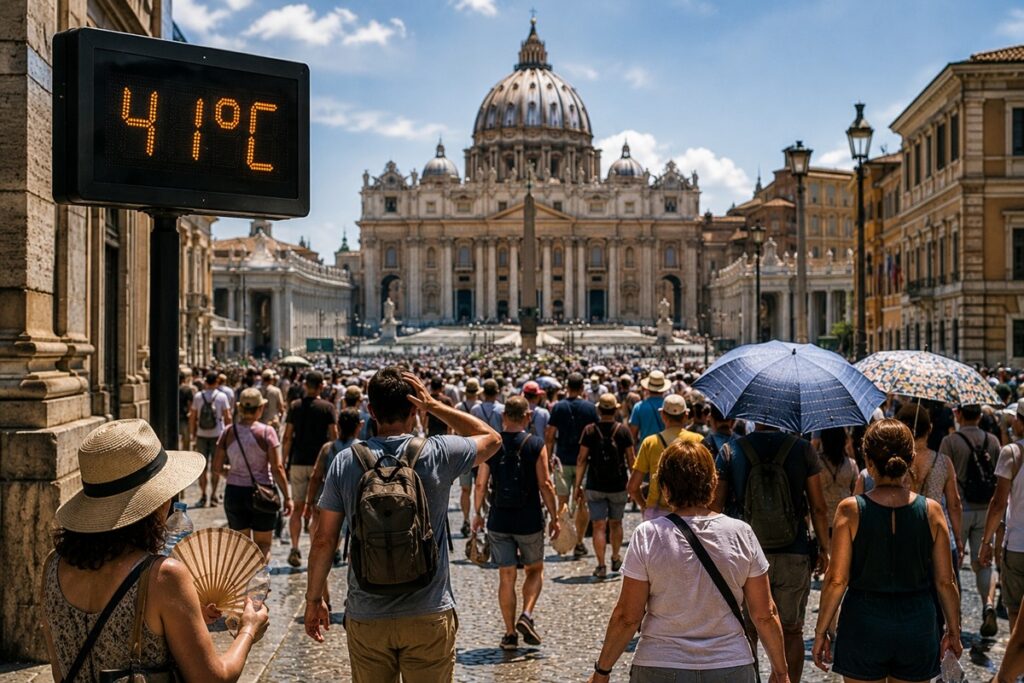
When the human body is regularly exposed to heat over a period of days and weeks, it undergoes measurable and significant changes. The most important adaptations include an expansion of blood plasma volume, a reduction in resting and exercising heart rate, a drop in core body temperature during exertion, an increase in sweating rate, and a shift in the body’s cooling threshold so that it begins to sweat earlier — before core temperature has had a chance to climb dangerously. Cardiovascular adaptations tend to develop within the first week of regular heat exposure, while improvements in sweating efficiency typically require 10 to 14 days. Source: ScienceDirectScienceDirect
The practical effects of these adaptations are profound. Heat-acclimatised individuals show better maintenance of fluid balance, enhanced sweating and skin blood flow, a lower exercising heart rate, and reduced physiological strain overall. Their bodies are, quite literally, better machines for managing thermal stress.
Residents of hot climates maintain this state year-round. Their bodies are not repeatedly surprised by heat — they are permanently adapted to it. A person living in Cairo or Dubai is physiologically calibrated to function in conditions that would rapidly push an unacclimatised body toward heat exhaustion.
By contrast, much of northern and central Europe has historically had cool to mild summers. Climatologists have linked the increasing frequency of European heat waves to changes in the jet stream driven by climate change, with European countries experiencing heat wave increases at a rate three to four times higher than countries at similar latitudes elsewhere in the world. For populations that have never needed to acclimatise, the physiological machinery for managing extreme heat is simply not primed. When a heat wave arrives, they face the same temperatures as a Cairo resident — without any of the biological preparation.
Research from the Barcelona Institute for Global Health estimated that without the societal adaptation processes developed across Europe since 2000, the 2023 heat mortality burden would have been 80 percent higher than the already-staggering figure recorded. Even with those adaptations — better building insulation, cooling centres, public health warnings — tens of thousands still died. Physiological acclimatisation, the kind that comes from actually living in the heat, provides protection that no air-conditioning policy can fully replicate.
This is also why European visitors who arrive in the Red Sea for a one-week dive holiday remain more vulnerable than local residents, particularly in the first two to three days. Acclimatisation is a process, not a switch. A diver arriving from Copenhagen in July needs time and care before their body is operating at full heat tolerance.
Before the Dive: The Heat Index Window That Divers Ignore
For divers, the hour before entering the water may be the most dangerous part of the day in a hot climate — and it is the part that receives the least planning.
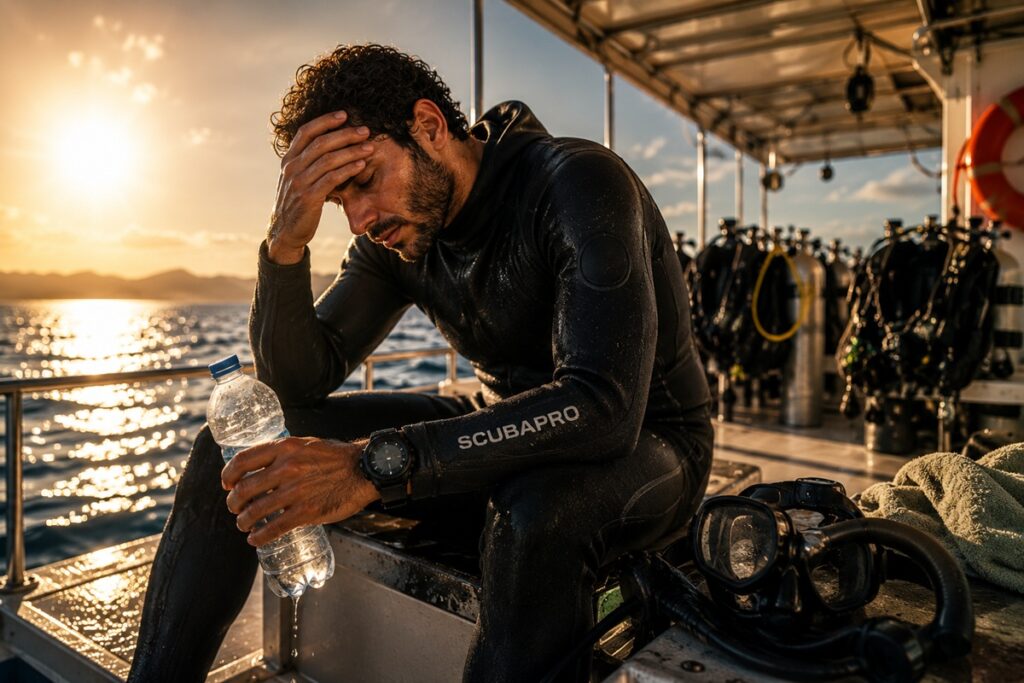
Consider the standard pre-dive routine on a summer liveaboard or shore-based operation in the Red Sea: equipment assembly on a sun-exposed deck, fitting and zipping a wetsuit, donning a buoyancy compensator loaded with a full cylinder, walking to a giant stride point or climbing down a ladder to a RIB. All of this happens under direct sun, often in 40°C air, in what is essentially a neoprene heat suit.
DAN has noted that when a diver is fully suited and zipped up, prolonged time on the deck of a dive boat or onshore prior to entering the water can cause heat stress and exhaustion, with common symptoms including dizziness and nausea. DAN’s guidance is straightforward: avoid fully suiting up until immediately before donning your buoyancy compensator and entering the water, and once out of the water, remove the top half of the wetsuit as soon as possible to allow the body to vent heat. Source: Divers Alert Network
Dehydration is the compounding factor. Hot and humid climates, direct sun exposure, the dry compressed air delivered through a regulator, and the diuretic effect of immersion all contribute to a diver’s fluid loss throughout a dive day. Dehydration reduces blood plasma volume, which directly affects the body’s ability to transport and eliminate dissolved nitrogen — creating a measurable link between poor hydration and elevated decompression sickness risk.
The compounded picture is this: a diver who arrives at the water’s edge already heat-stressed and partially dehydrated is entering the dive with a cardiovascular system already under strain, reduced plasma volume, impaired thermoregulation, and potentially compromised cognitive function — before the dive has even begun.
During the Dive: Heat Management Underwater
Once below the surface, the heat threat shifts rather than disappears.
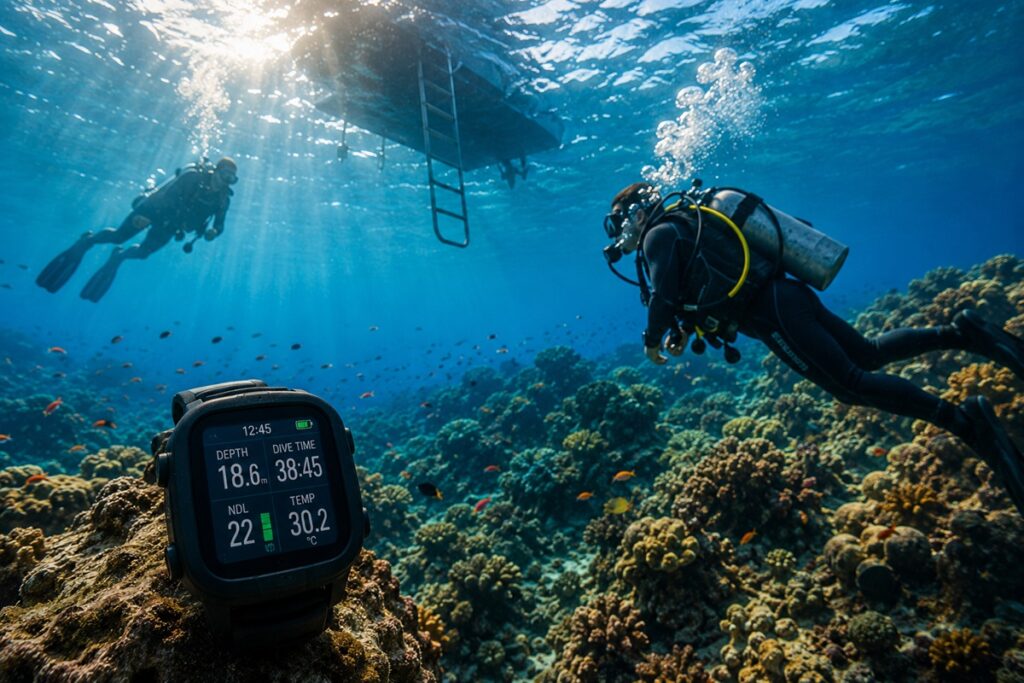
Water temperature in the Red Sea reaches 30°C or above at the surface in summer. While the body loses heat more readily in water than in air, warmer water reduces the temperature gradient that drives that loss. Research has found that divers exercising in warmer water temperatures experience accelerated fatigue and rising core temperatures, with the cardiac and neurological demands increasing as water temperature climbs.
For the diver in a 3mm wetsuit in 30°C water, the concern is not hypothermia — it is remaining warm enough at depth where the suit compresses and loses insulating efficiency, while also avoiding thermal build-up during energetic phases of the dive, such as swimming against current.
The surface interval is where heat management becomes critical again. Heat during surface intervals causes vasodilation — the widening of blood vessels — which can disturb the stable off-gassing process and affect how microbubbles behave in the bloodstream. Shade, rest, and hydration during surface intervals are not comfort measures; they are active contributors to decompression safety.
After the Dive: The Recovery Window
The post-dive period carries its own heat risk, and one that is counterintuitive to many divers.
The body’s nitrogen off-gassing continues for hours after surfacing. Any factor that disrupts circulation — including heat stress, vasodilation from sun exposure, and dehydration — can slow that process or create conditions that increase bubble formation. DAN’s guidance on thermal management after dives is explicit: avoid hot showers, hot tubs, or other heat exposure immediately after surfacing, as these promote conditions that can increase decompression stress. Source: Divers Alert Network
Rehydration is the most productive post-dive activity in a hot climate. The surface interval between dives and the period immediately after the day’s final dive represent the best windows for fluid restoration — water or low-sugar electrolyte solutions, rather than coffee or alcohol, both of which accelerate fluid loss.
A Practical Protocol for Hot-Climate Diving
The science translates into a clear set of practices:
Do not suit up early. Assemble your equipment, confirm your configuration, and complete your buddy check before pulling on your wetsuit. Time in neoprene on the surface is time spent accumulating heat stress.
Hydrate from the morning, not from the moment you feel thirsty. Thirst is a late indicator of dehydration. By the time you are thirsty on a hot dive boat, you are already behind. Consistent sipping throughout the morning before a dive is more effective than drinking a large volume immediately before entry.
Seek shade aggressively during surface intervals. Sitting in full sun between dives adds unnecessary heat load, promotes dehydration, and can interfere with off-gassing. Use the boat cover, the cabin, or any available shade as a matter of habit, not preference.
Remove your wetsuit top as soon as you are out of the water. The evaporative cooling effect of a damp wetsuit in the open air is an asset; the insulating effect of a zipped-up suit in 40°C heat is not.
Give yourself time to acclimatise if you have just arrived from a cooler climate. The first two to three days in a hot environment are the highest-risk period. Plan less demanding dives, stay close to shade and fluids, and allow your body to begin the physiological adjustment it needs.
Pay attention to the heat index, not just the air temperature. On a day when the thermometer reads 38°C and humidity is high, the actual thermal load on your body may be equivalent to conditions well above 45°C. That number determines your risk.
The Broader Lesson
Europe’s annual heat death toll is a public health tragedy rooted in a combination of climate change, inadequate infrastructure, and — critically — physiological unpreparedness. The populations of Egypt and the Gulf have, through simple sustained exposure, developed a biological advantage that no heat action plan can easily replicate. That advantage does not make extreme heat harmless or trivial; it means the body has learned to manage it.
Divers who work, live, or regularly visit hot-climate dive destinations have an opportunity to develop that same protection. But it requires respect for the process — understanding that the heat index on a summer afternoon in the Red Sea is not just a weather statistic. It is a physiological challenge that begins the moment you step onto the dive deck, continues through every surface interval, and does not fully end until you are rested, rehydrated, and out of the sun.
The thermometer only tells you half the story. As a diver, you need the full one.

Mohsen Nabil is the Founder and Editor-in-Chief of Diventures Magazine. A mechanical engineer and scuba diving instructor based in the Red Sea, he writes about diving safety, marine conservation, underwater exploration, and developments in the global dive industry. Through Diventures Magazine, he works to connect divers, scientists, and ocean advocates while promoting responsible diving and protection of the oceans.