
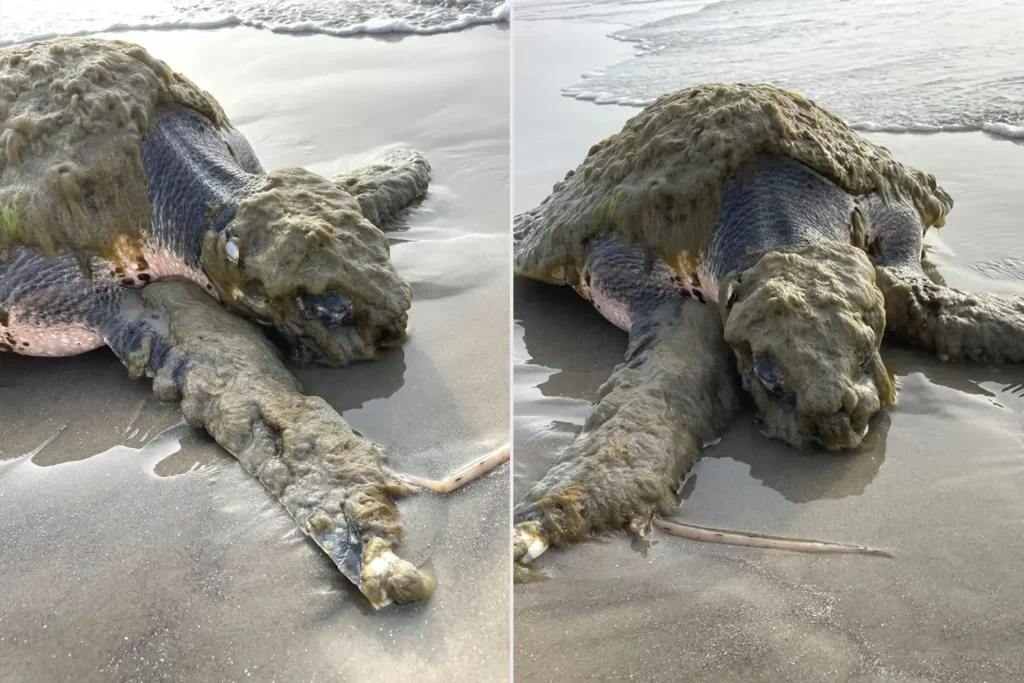

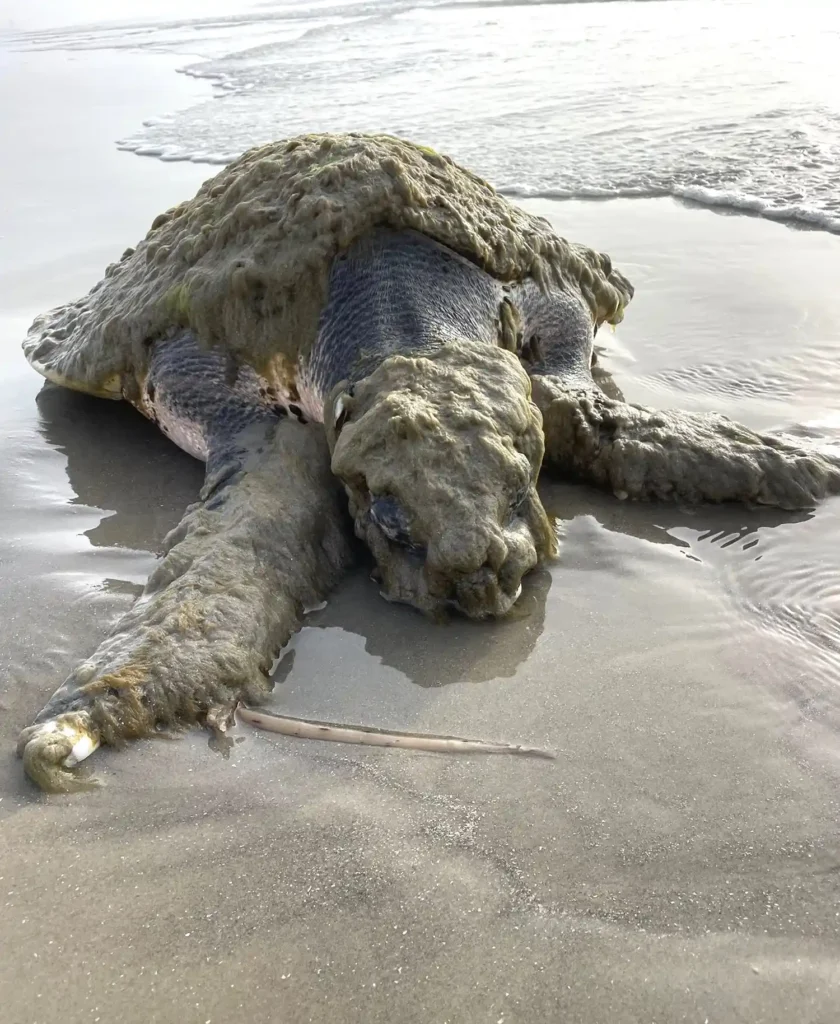
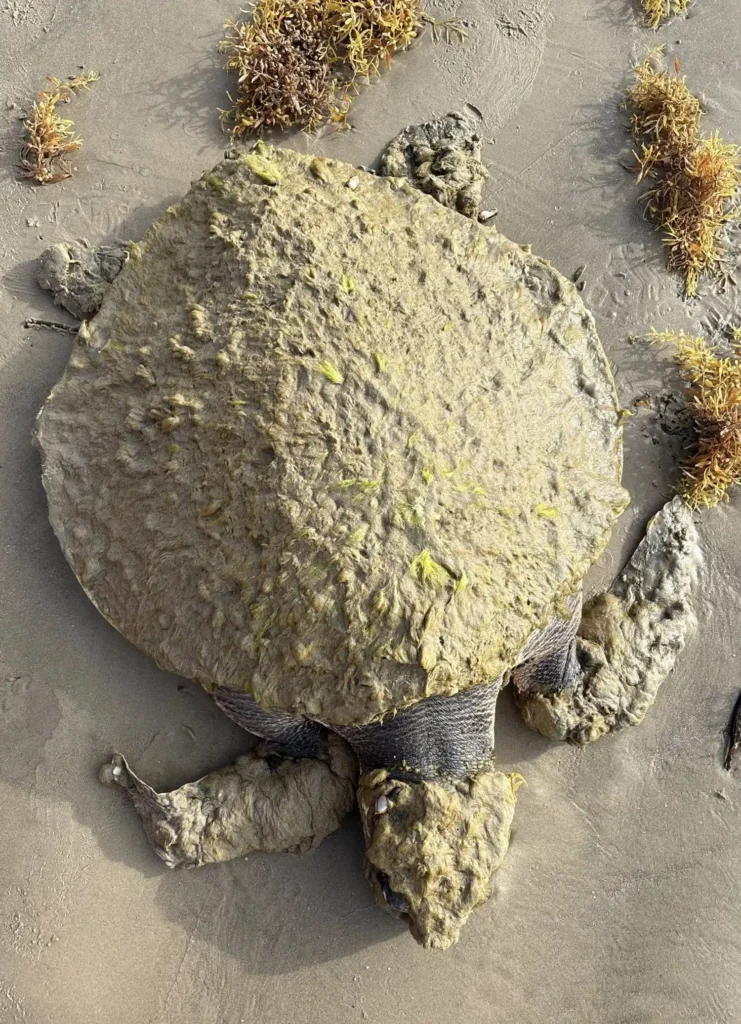
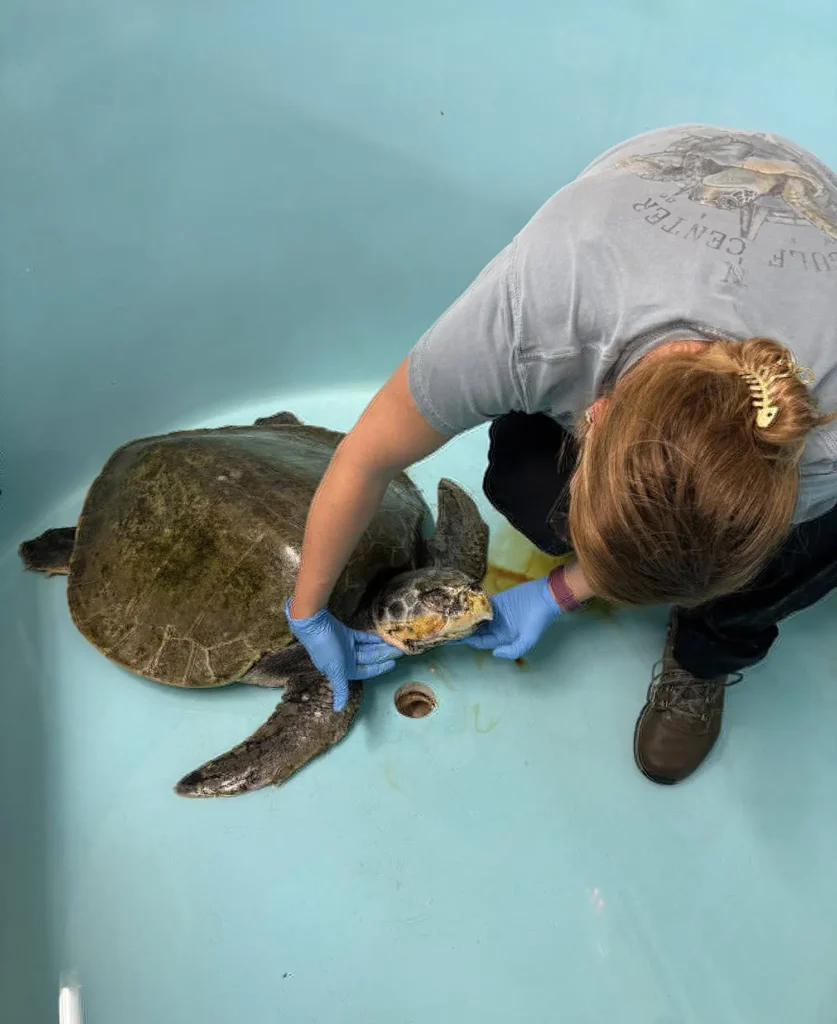
On Saturday, March 7, a stranded adult female Kemp’s ridley sea turtle was reported on a beach near Galveston, Texas. When rescuers arrived, they found a turtle that looked as if it had green “fur.” The coating was not fur. It was a heavy load of living growth and debris: epibionts, barnacles, algae, and sediment. The turtle was lethargic and weighed down, which suggested she had been struggling for some time.
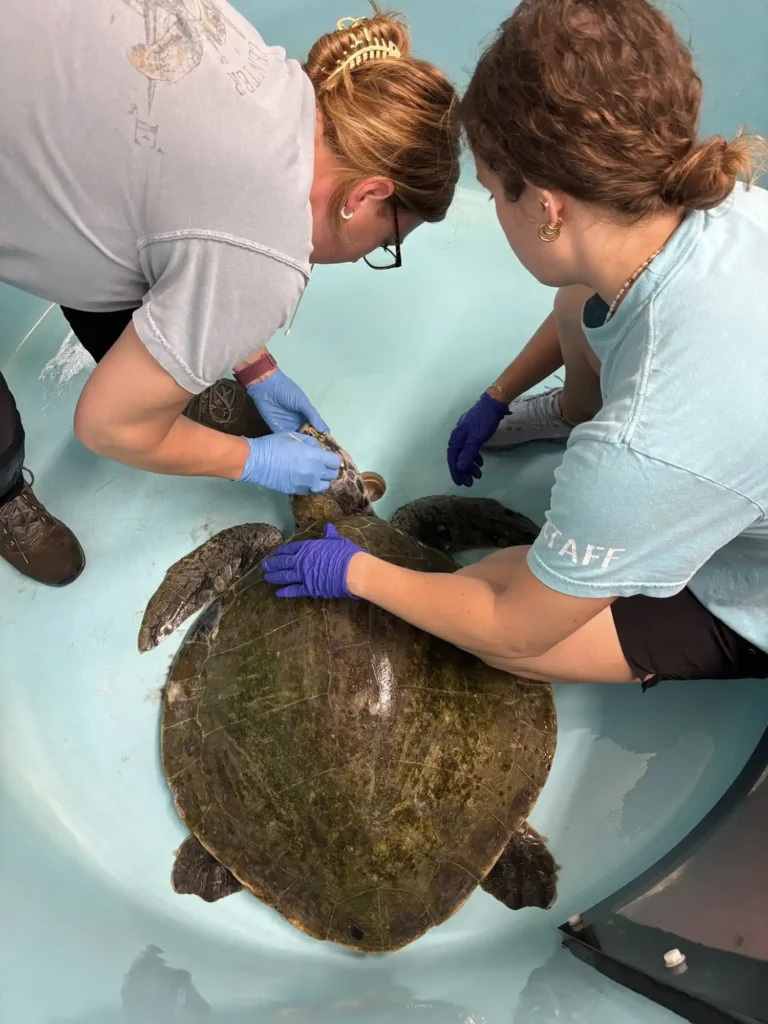
The rescue was handled by the Gulf Center for Sea Turtle Research (GCSTR). After the turtle was recovered, she was taken to the Houston Zoo for emergency veterinary care and then moved to the GCSTR rehabilitation hospital. The center described her condition as critical, but said she was receiving focused care from veterinary partners and a team of staff, volunteers, and students.
For experienced divers, this type of news can feel far from our usual dive planning. But it is not separate from diving. Stranding events connect directly to what we see underwater: turtle behavior, body condition, boat traffic, fishing pressure, and the state of nearshore habitats.
Why Kemp’s ridley matters to Gulf divers
Kemp’s ridley sea turtles are the smallest sea turtle species in the world. They are strongly tied to the Gulf region, where many individuals feed and migrate. NOAA Fisheries notes the species is primarily found in the Gulf (NOAA now uses “Gulf of America” in some materials), with juveniles also appearing along parts of the Atlantic.
People.com’s reporting on this rescue also notes that Kemp’s ridley is Texas’ official state turtle and that the species is rare, with an estimated 22,300 mature adults, and is listed as critically endangered by the International Union for Conservation of Nature.
That combination—smallest sea turtle, strongly regional, and under high conservation concern—makes every adult female important. Adult females are the future of the nesting population. When one shows up stranded and exhausted, it is a serious event for the species and for the local conservation network.
The “green fur” problem: epibionts are a warning sign
Divers often see turtles with some barnacles or algae, especially on older individuals. That can be normal. What stood out in this case was the amount of attached growth and the turtle’s overall state. The turtle was described as lethargic and heavily colonized by epibionts.
Christopher Marshall, director of the GCSTR, explained the basic logic in simple terms: healthy sea turtles keep moving. When a turtle slows down because of illness or injury, organisms in the water can attach and build up quickly. That extra weight and drag can slow the turtle further, forcing it to spend more energy, which can allow even more growth to accumulate. It becomes a harmful cycle.
This is a useful field lesson for experienced divers. A turtle that allows heavy growth to take hold may not be healthy, even if it is still swimming. If you see a turtle with extreme barnacle coverage, thick algae mats, or a “dirty” shell that looks unusually loaded, treat it as a possible distress sign. Do not “clean” it yourself. But do note the location, time, and any clear injuries, and report it to the proper network after the dive.
What divers should do if they find a stranded or injured sea turtle
Texas has a clear pathway for reporting turtles in distress. NOAA Fisheries lists the Texas Sea Turtle Stranding and Salvage Network hotline as (866) TURTLE-5, which is also (866) 887-8535.
The National Park Service guidance for Texas also repeats the same hotline and adds practical steps: report the turtle’s location, size, proximity to the surf, and whether it is alive or dead, and mark the location. If the turtle is alive, stay nearby if you can until help arrives.
For divers, the key is to combine good intention with good restraint:
- Do not push the turtle back into the water. A stranded turtle may be sick, exhausted, injured, or cold-stunned. Returning it to the surf can make survival less likely. Professional responders know how to evaluate and transport turtles safely.
- Do not attempt treatment. Removing barnacles or algae sounds helpful, but it can injure the turtle, add stress, or interfere with diagnosis. This rescued turtle was moved through veterinary care and into a rehabilitation hospital for a reason.
- Control the scene. Keep people and pets back. Reduce noise and crowding. Shade can help, but avoid covering the turtle’s face or restricting movement. Follow responder instructions when they arrive. (If you are in a managed area like a park, follow staff guidance.)
- Document responsibly. A few photos from a respectful distance can help responders, especially if it shows obvious entanglement, injuries, tags, or the extent of epibionts. But do not delay the call to get perfect images.
Why strandings connect to boats, fishing, and debris
People.com notes that Kemp’s ridley faces multiple pressures, including habitat degradation, interactions with fishing, boats, and ocean debris.
This matters to divers because many of these issues are visible underwater. Lost fishing line, hooks, and net fragments are common near jetties, passes, and popular fishing spots. Boat traffic concentrates in the same coastal corridors where turtles may feed. Even when we do not witness a strike or an entanglement, a stranding can be the end result of a chain that started offshore.
Experienced divers can support solutions in practical ways:
- Report active hazards (like heavy line accumulations around structure) to local site managers when possible.
- Join organized cleanups where there is a plan for safe removal and proper disposal.
- Dive with sharp awareness around turtle habitat. Keep a safe distance and avoid chasing for photos. Stress adds energy cost, and energy matters when an animal is already compromised.
A note on rehabilitation, and what “release” really means
The GCSTR said the turtle was in critical condition, but emphasized hope for recovery and eventual release back into the Gulf.
Rehabilitation is not quick. In many cases, a turtle needs supportive care, diagnostic testing, and time to rebuild strength. A stranded turtle may have multiple problems at once: infection, injury, exhaustion, buoyancy issues, or other internal challenges. That is why the rescue network matters. It is not only about picking an animal up from the beach. It is about giving it a real chance to return to normal swimming and feeding behavior.
For divers, the most useful takeaway is simple: if you see a turtle that is not acting like a strong swimmer, treat it as a serious sign, and contact professionals as soon as you can.
Conclusion
This Kemp’s ridley rescue near Galveston is a reminder that “healthy sea turtles are swimming sea turtles.” Heavy epibiont growth and lethargy can signal an animal in trouble. For experienced divers, the right response is calm and practical: do not handle the turtle, protect the scene, and call the Texas Sea Turtle Stranding and Salvage Network at 1-866-TURTLE-5 so trained responders can act fast.

Mohsen Nabil is the Founder and Editor-in-Chief of Diventures Magazine. A mechanical engineer and scuba diving instructor based in the Red Sea, he writes about diving safety, marine conservation, underwater exploration, and developments in the global dive industry. Through Diventures Magazine, he works to connect divers, scientists, and ocean advocates while promoting responsible diving and protection of the oceans.