
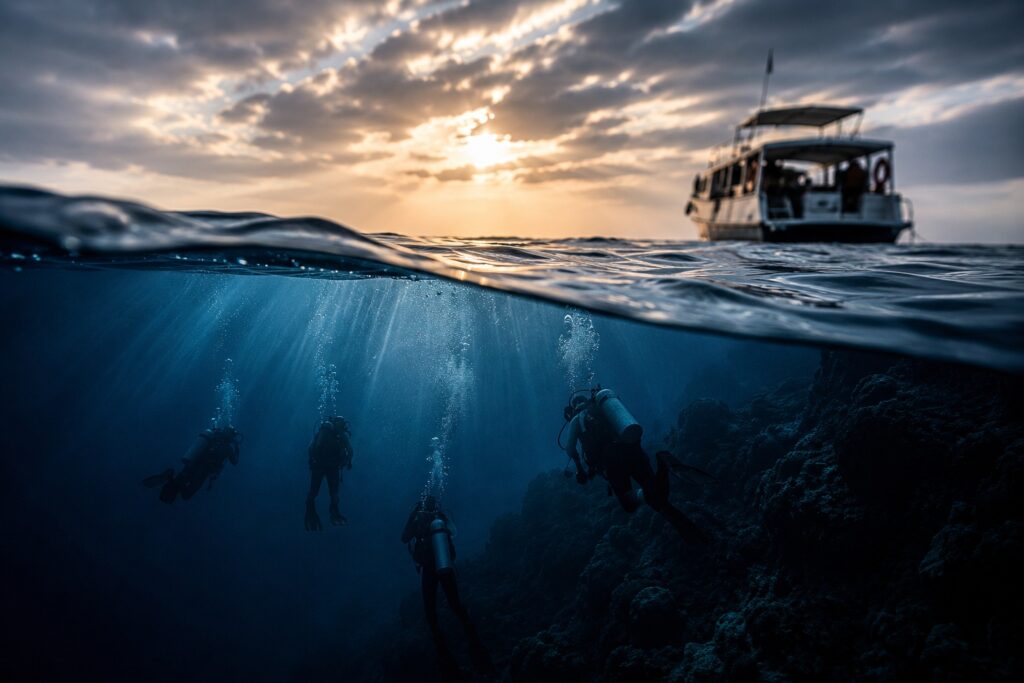

A reflection on diving safety, operational planning, and the responsibility we carry every time we enter the water
The news arrived the way difficult news always does — abruptly, with a weight that settles slowly. Five Italian divers lost their lives during a diving operation in the Maldives. The details, still being pieced together by investigators and the diving community, are less important right now than what the fact itself demands of us: honest, serious, and technically responsible reflection.

Not judgment. Reflection.
Those of us who work in this world — as instructors, operators, dive guides, researchers, or simply as passionate practitioners — have an obligation that goes beyond mourning. We owe it to the victims, and to everyone who will enter the water after them, to ask the hard questions with clarity and without defensiveness.
Not All Dives Are the Same
One of the most persistent misconceptions in diving culture is the idea that experience in one context automatically transfers to another. It does not.
A recreational dive in a shallow coral garden, a commercial underwater inspection, a scientific survey, a search and recovery operation, a deep technical dive in a submerged wreck — these are not the same activity wearing different clothes. They carry different risk profiles, demand different training, different equipment configurations, different decision-making frameworks, and different thresholds for what constitutes an acceptable margin of error.
What unites all of them, however, is a principle that holds regardless of depth, purpose, or certification level: safety begins long before you enter the water.
This is not a slogan. It is the structural backbone of every operation that ends well.
Planning Is Not a Checklist
There is a version of dive planning that looks like safety but is not. It is the version where the team gathers, someone confirms the tanks are full, someone else points at the entry point on a map, and the briefing closes with “any questions?” in a tone that discourages them.
Real planning is something different entirely.
It is understanding the full operational scenario before committing to it. It is identifying threats — not just obvious ones, but the quiet ones. It is setting operational limits and being honest about whether the actual human team in front of you, on that specific day, has the genuine capability to work within those limits. It is mapping exit routes before you need them. It is managing gas with discipline, not optimism. It is anticipating emergency scenarios and rehearsing responses — mentally, and sometimes physically — before the environment creates a situation that forces improvisation.
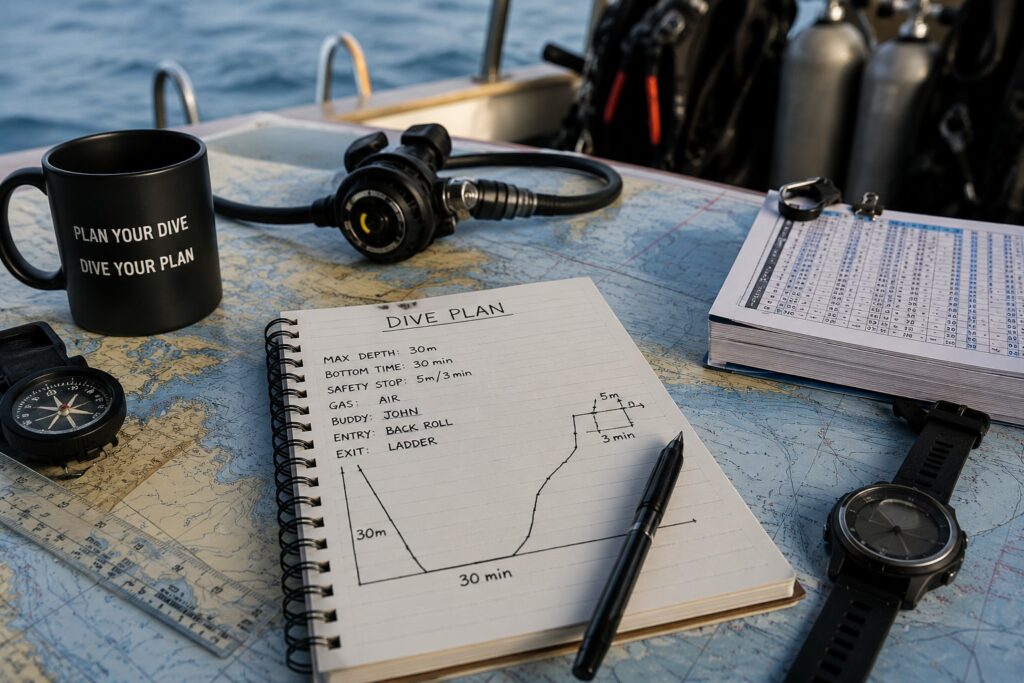
Improvisation underwater is expensive. The water does not negotiate.
When additional factors are present — significant depth, reduced visibility, strong or unpredictable currents, submerged structures, confined environments, or any condition that eliminates the option of a direct ascent — the margin for error does not simply shrink. It collapses. In those scenarios, risk management stops being a theoretical framework discussed in a classroom and becomes the concrete, operational condition that determines whether everyone comes home.
The Quiet Accumulation of Risk
What makes diving genuinely challenging from a safety standpoint is not the dramatic risk. It is the subtle one.
Catastrophic failures in diving are rarely caused by a single, catastrophic decision. More commonly, they are the product of accumulation — a sequence of individually minor factors, each one manageable in isolation, that combine into something unmanageable. A slightly underestimated current. A brief lapse in communication between team members. A planning gap that no one flagged because everyone assumed someone else had covered it. A diver who was slightly less rested, slightly less focused, slightly less prepared than usual — and who said nothing.
This is what makes post-incident analysis so difficult, and so necessary. The chain of events rarely looks obvious in hindsight until it is reconstructed carefully, step by step, with technical honesty. And it is precisely that kind of reconstruction — not blame, but rigorous understanding — that makes the diving community safer over time.
Operational Humility as a Professional Skill
There is a quality that separates experienced, trustworthy diving professionals from merely technically proficient ones, and it is not the number of dives in their log or the certifications on their wall. It is what can be called operational humility — the capacity to accurately assess a situation, recognize its actual risk level, and make a decision based on that reality rather than on what was planned, what was expected, or what would be easier to justify.
Operational humility means being willing to say: this needs to be adjusted. It means being willing to say: this needs to be paused. And on certain days, in certain conditions, with certain teams, it means being willing to say the most professionally demanding thing of all: this should not be done today.
That decision — the one that cancels or postpones an operation — is not a failure of nerve. It is a demonstration of exactly the kind of judgment that diving demands. The ability to exercise it, without pressure from external expectations, commercial interests, or the social dynamics of a team that has already committed to a plan, is a fundamental component of safe underwater operations.
It is also, historically, one of the hardest things to teach.
What We Owe the Victims
Tragedies like the one in the Maldives are not useful if they only produce grief. They need to produce learning — concrete, applicable learning that strengthens criteria, refines procedures, and deepens the culture of prevention across the entire diving community.
That is not disrespect to the victims. It is the opposite. It is the most honest way to honor them: by ensuring that the conditions, decisions, or gaps that contributed to their deaths are understood clearly enough that they do not repeat themselves.
This requires the industry to engage with difficult questions without closing ranks. It requires training agencies to revisit whether their curricula adequately prepare divers for the real complexity of operational environments. It requires dive operators to examine whether commercial pressures ever quietly override safety margins. It requires every instructor, dive leader, and experienced diver to ask themselves whether they are modeling the culture of rigor, honesty, and restraint that this activity demands.
Diving is not a sport that forgives complacency. It never was.
A Final Word
To the five Italian divers who lost their lives, and to their families — our deepest respect and condolences. To the teams who responded, searched, and worked in the aftermath: your effort and courage do not go unnoticed.
And to every diver reading this: let this moment remind you of what you already know, but what is sometimes easy to set aside under the pressure of conditions, schedules, and expectations. Plan with rigor. Train with honesty. Decide with humility.
The water is extraordinary. It deserves our full preparation every single time.

Daniel Araos Alcayaga is a Risk Prevention Engineer, with a Diploma in Emergency Management, a lecturer, and a specialist in special operations. He has experience in underwater rescue, commercial diving, public safety, and risk management in complex aquatic environments.
His work focuses on specialized training, operational planning, prevention, and underwater emergency response.