

Disclosure: I am a former member of the Recreational Scuba Training Council (RSTC) Board of Directors, and previously served on the NAUI Board of Directors and NAUI Training Committee. The views expressed here are solely my own.
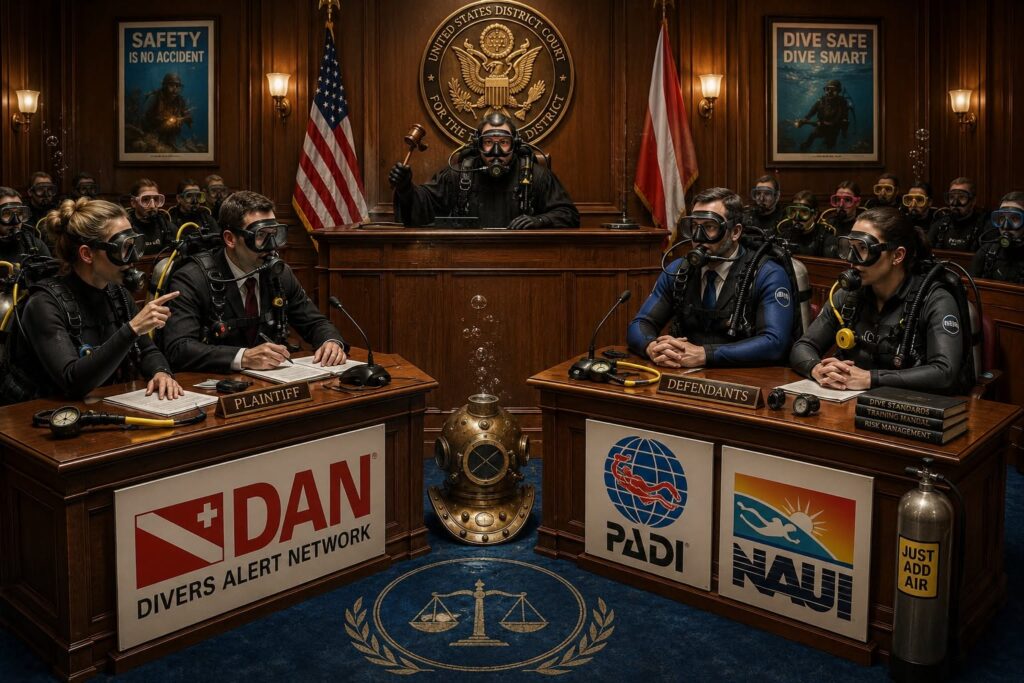
Yesterday, Divers Alert Network filed suit against PADI, NAUI, ScubaToys, Scuba Ranch, and several individual dive professionals. The case is already being discussed throughout the diving industry as an insurance dispute.
Legally, that’s exactly what it is.
I believe it is also something much bigger.
For those unfamiliar with the filing, DAN has gone to federal court seeking a declaration on whether various insurance policies provide coverage for allegations arising from the tragic death of a twelve-year-old student diver during training in Texas. DAN is currently defending the parties under a reservation of rights while asking the court to determine whether coverage ultimately exists.
That alone is unusual.
But what makes this case remarkable is not simply that a lawsuit was filed. It is that DAN filed it.
DAN is not just another insurance company.
For decades, DAN has been one of the most respected institutions in recreational diving. It has relationships with agencies, instructors, dive centers, manufacturers, resorts, liveaboards, and individual divers throughout the world. Many of the organizations and individuals involved in this case have worked alongside DAN for years, in some cases decades.
That reality matters.
Because when an insurer with those relationships decides to file a public federal lawsuit, people should ask why.
Many will compare this case to Tuvell — the 2011 case in which a twelve-year-old boy died during a PADI Discover Scuba program in Utah. I understand why.
Tuvell remains one of the most controversial cases in modern recreational diving, not simply because of the tragedy itself, but because of the industry’s reaction afterward. Fairly or unfairly, many divers came away with the perception that organizational interests were being protected before the facts were fully understood. Questions of accountability, transparency, and responsibility lingered long after the litigation ended. It left industry professionals wondering if their agency and insurer were going to throw them under the bus.
This case feels fundamentally different.
DAN is not quietly handling this behind closed doors. DAN is not making an internal membership decision. DAN is not issuing a carefully worded press release and walking away. Instead, DAN is publicly placing the allegations, the policy language, and the coverage questions before a federal judge and asking the court to decide.
From an ethical standpoint, that distinction matters.
The legal issues are one thing. The ethical questions are another. Trust in the industry was damaged after Tuvell partly because many divers felt important questions were never addressed publicly or transparently.
Transparency is often uncomfortable.
Transparency creates friction.
Transparency can strain relationships that have existed for decades.
But transparency is also how mature industries confront difficult truths.
What I find most interesting is not the coverage dispute itself.
It is what the coverage dispute says about the allegations.
Legally, DAN is not admitting the allegations are true. Any attorney will correctly point out that insurers often analyze coverage based on the allegations as pleaded, rather than whether those allegations are ultimately proven.
That is true.
But there is another reality.
DAN has now placed before a federal court allegations involving standards-setting, credentialing, supervision, facility oversight, training practices, student-to-instructor ratios, and organizational responsibility.
Think about that for a moment.
DAN is not arguing these allegations are absurd. DAN is not arguing these allegations are impossible. DAN is not arguing that such claims could never exist. Instead, DAN is arguing that if those allegations are what the case is about, they fall within exclusions relating to standards-setting, credentialing, supervision, and professional conduct.
To many in the industry, that distinction may seem technical.
I do not believe it is.
For decades, recreational diving has operated under a series of assumptions.
We assumed agency standards were largely beyond challenge. We assumed certification organizations functioned primarily as standards bodies rather than entities with broader responsibilities. We assumed membership programs carried limited accountability. We assumed liability waivers would continue to provide substantial protection. We assumed insurance would remain available and affordable. Most importantly, we assumed the existing framework was working.
This lawsuit forces us to revisit those assumptions.
Because beneath all of the legal language lies a question that many in the industry would rather avoid.
Are our standards good enough?
Not merely whether standards exist. Not whether standards were followed in this particular case. But whether the standards themselves, the oversight mechanisms supporting them, and the enforcement systems behind them remain fit for purpose in 2026.
That is an uncomfortable discussion.
It should be.
What we as an industry have been less willing to examine are the institutions that govern training itself. I can tell you from personal experience that even raising the question is a good way to get escorted out of the room.
How often do standards evolve? Are instructor requirements appropriate? Are student-to-instructor ratios appropriate? Are oversight mechanisms effective? Are enforcement actions consistent? Do economic pressures influence training standards? Do agencies respond appropriately when concerns are raised?
Those questions are not attacks on the industry.
They are the questions responsible industries ask themselves.
The significance of this case may ultimately have little to do with who wins.
DAN may prevail. The defendants may prevail. Coverage may exist. Coverage may not exist. The courts will decide those issues.
What may matter far more is that one of the industry’s most respected organizations has effectively signaled that allegations involving standards, credentialing, supervision, and oversight are serious enough to justify federal litigation.
That should get everyone’s attention.
Not because DAN is abandoning the industry. Not because DAN is declaring agencies negligent. Not because DAN is admitting standards are defective. But because DAN has looked at the allegations surrounding the death of a child and concluded they are significant enough that the boundaries of responsibility, accountability, and insurability must be examined publicly.
That is new.
And perhaps long overdue.
The diving industry should resist the temptation to treat this as merely a fight between lawyers.
The real question is much larger.
If courts ultimately determine that standards, credentialing, oversight, supervision, or enforcement contributed to this tragedy, will we view it as an isolated failure? Or will we have the courage to ask whether parts of the system itself need improvement?
Because if the answer is that our standards are strong, our oversight is effective, and our enforcement mechanisms work, then this case will help confirm that.
But if the answer is otherwise, then the most important outcome of this litigation may not be a court ruling.
It may be the conversation that follows.

Founder, Deep 6 Gear | Training Director, SNSI
Chris Richardson is a diving industry leader, military veteran, and the founder of Deep 6 Gear. An elite Instructor Trainer and Course Director for SDI, TDI, ERDI, and NAUI, he specializes in technical, cave, and public safety diving. With an MBA and a history of shaping global standards on the NAUI and RSTC boards, Chris currently serves as the US/Canada Training Director for SNSI and is an SSI Platinum Pro 5000 recipient.