


Lots of rules, lots of use of the word professional but… are we?
Every so often, you stumble across something that makes you stop and think. Not because you disagree with it, but because you suddenly realize not enough of us are asking the question.
This is one of those moments.
I found myself doing some light reading: the Codes of Ethics and Professional Conduct for the major recreational diver certification agencies. They are fine documents. Seriously. They hit all the expected notes: protect the student, protect the environment, follow the standards, maintain a professional public image, and don’t harass people. Some have done genuine work regarding youth protection; others explicitly note that economics shouldn’t compromise educational quality. None of that deserves criticism.
But the more I read, the more a single, uncomfortable question kept bouncing around in my head:
Am I reading the ethical code of a profession, or am I reading the corporate operating manual of a certification manufacturer?
Because those are fundamentally different things. And right now, recreational diving is confusing corporate risk management with professional ethics.
The Inverted Enforcement Mechanism
Let’s stop playing polite and look at the structural machinery here.
In mature professions like medicine, engineering, law, or accounting the ethical code exists primarily to protect the public from the professional and the professional’s employer.
Because of that, the ultimate enforcement mechanism is a self-governing board. If a medical board strips a doctor of their license for unsafe practices, they aren’t doing it to protect the brand reputation of the university they graduated from. They do it because their primary allegiance is to the public interest. In those worlds, if the system is broken, you are ethically required to blow the whistle. Silence is malpractice.
Now look at recreational diving.
If an instructor speaks out publicly about an inadequate standard, a flawed training timeline, or an unsafe but normalized industry practice, what happens? They don’t get a whistleblower commendation. They get a quality assurance letter for “professional misconduct.”
Look closely at the language across the industry’s largest agencies. One major agency explicitly requires its members to “support the official decisions adopted” by the organization. Another explicitly bans “disparaging” the international brand, fellow professionals, or members of the diving industry. Across the board, variations of these non-disparagement clauses are heavily enforced to protect the shield on the card.
Let’s call that what it actually is: private corporation(s) enforcing a non-disparagement clause under the guise of “ethics.”
When a dive agency revokes an instructor’s credentials for public criticism, they aren’t acting as a regulatory body protecting public safety; they are acting as a franchise protecting its intellectual property and market share or even that of a competitor to maintain confidence in the industry. The ethical code has been completely inverted. In a true profession, loyalty to the public interest overrides loyalty to the employer. In recreational diving, loyalty to the brand name on your card is a QA requirement.
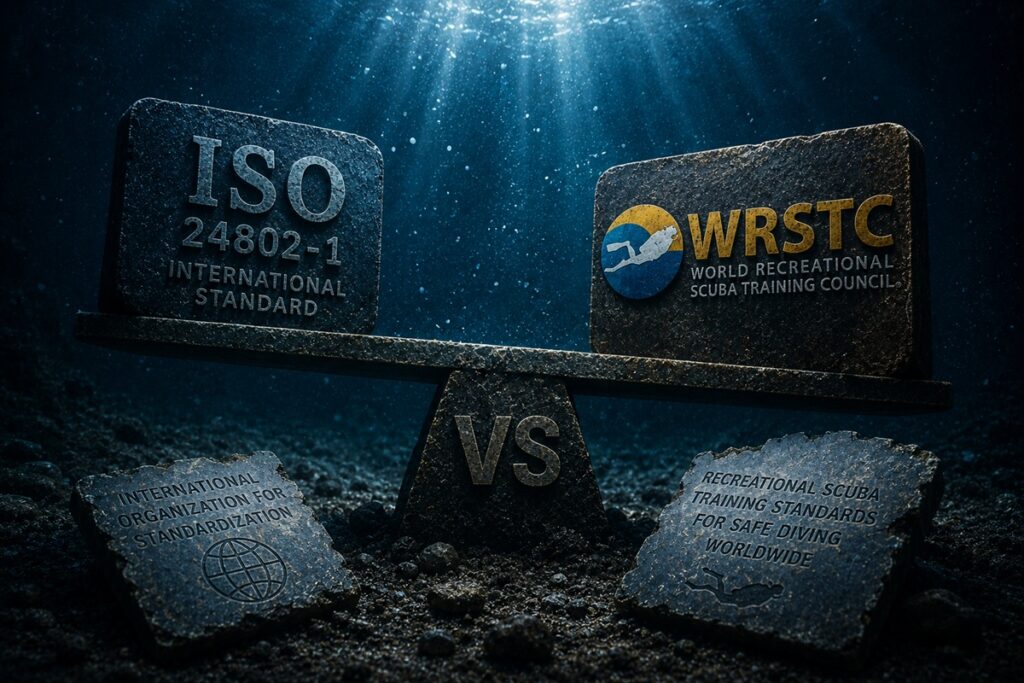
The Total Regulatory Void: The Truth About the RSTC
When you point this out, industry insiders like to wave a hand toward the RSTC (Recreational Scuba Training Council) and say, “But we have a standards body!”
Let’s pull back the curtain on that one.
The public, and many instructors mistakenly believe the RSTC is a regulatory watchdog ensuring the integrity of dive safety for the world. It isn’t. By its own history and design, the RSTC has absolutely zero mechanism to handle complaints from the public, and even fewer tools to handle grievances from professionals. If a diver is mistreated or an instructor is exploited, the RSTC will not take your call.
The only complaints the RSTC handles are internal squabbles when one member agency believes another member agency is violating the baseline consensus standards. It’s an insular mechanism designed to keep the peace among competitors, not a governing body designed to hold the industry accountable to a higher ethical standard.
And why does it exist? Let’s be comfortable enough to say the quiet part out loud: The real mission of the RSTC has always been to avoid government regulation.
Historically, it was formed as a shield to prove the industry could “self-regulate” so that outside lawmakers wouldn’t step in and impose real, independent oversight. There is a grand irony here: the public is told the mission is “dive safety,” while the actual operational goal is “keep the regulators out of our business.” By treating the avoidance of regulation as the highest structural goal, the industry has left a massive ethical void where an independent governing body should be.
The Elephant Wearing Flippers: Economic Exploitation as an Ethical Choice
If the recreational diving industry genuinely believes that instructors owe a duty to the long-term sustainability of diving, then we need to talk about the elephant in the room. Or rather, the elephant wearing flippers.
Why do our ethical codes have pages of rules on how an instructor must behave, but are completely silent on how an instructor should be treated?
The Reality Check: Industry observers commonly cite an average instructor lifespan of roughly two to three years. They enter the industry fueled by pure passion, get ground up by unsustainable workloads and sub-living wages, and leave when they realize passion doesn’t pay rent.
In “grown-up” professions, gatekeeping entry is a tool used to maintain high standards and ensure a viable, sustainable career for those who make it through. But the current business model of recreational diving is a volume game. It requires a high churn rate. The machine is designed to mint a constant supply of new, enthusiastic, low-cost professionals to replace the burnt-out ones who just left.
We have normalized an ecosystem that relies heavily on an endless conveyor belt of unpaid or underpaid divemasters and instructors working for “tips and gear discounts” in domestic markets and near indentured servitude in destination markets so they can “live the lifestyle.”
If an agency code stated, “Professionals should contribute to the long-term sustainability of recreational diving,” everyone would nod and applaud. But if you ask the next logical questions, the room gets very quiet:
Is selling professional certifications at ever-lower margins and lower barriers to achieve them so as to maximize volume sustainable?
Is creating professionals faster than the market can equitably employ them sustainable?
Is a business model that treats its core workforce as a consumable resource ethical?
This isn’t an antitrust question or a matter of simple price-fixing. It is a professional ethics issue.
When an industry’s ethical framework completely ignores workforce exploitation and structural career burnout, it isn’t an oversight. It’s a choice. It allows organizations to claim the moral high ground of “professionalism” while washing their hands of the economic reality they created.
Confidence vs. Trust
There is a massive difference between manufacturing confidence and earning trust.
Confidence says: “Please don’t say negative things about diving publicly, because it might hurt equipment sales and course enrollments.”
Trust says: “If there is a systemic flaw, we will drag it into the sunlight, debate it openly, fix it, and tell everyone what we learned.”
Confidence is fragile; it requires constant image management and the suppression of dissent. Trust is resilient; it survives scandals because it doesn’t hide from them. By prioritizing the protection of corporate images over honest, evidence-based self-criticism, the diving industry is constantly choosing short-term market confidence over long-term professional trust.
A Profession, If We Can Keep It
To be absolutely clear: this is not a rant about any one agency being “evil.” The agencies are doing exactly what private corporations are designed to do: managing risk, protecting their brand, and chasing growth.
The problem is that we, the professionals, have mistaken their corporate bylaws for a professional soul.
Recreational diving has matured massively over the last fifty years, but our ethical framework is still stuck in a franchise model. A mature profession doesn’t run away from uncomfortable questions. It doesn’t confuse loyalty to a corporate acronym with a duty to public safety. And it certainly doesn’t pretend that the systemic exploitation of its own people is just “paying your dues.” Yes, pay your dues, get experienced and benefit from the industry, not just be a tool to support the industry that views you as disposable.
It is time to build a professional code for recreational diving that belongs to the professionals, not the manufacturers. One that recognizes that a profession remains sustainable not because people avoid making waves, but because they have the courage to look at the system honestly and fix what’s broken.

Founder, Deep 6 Gear | Training Director, SNSI
Chris Richardson is a diving industry leader, military veteran, and the founder of Deep 6 Gear. An elite Instructor Trainer and Course Director for SDI, TDI, ERDI, and NAUI, he specializes in technical, cave, and public safety diving. With an MBA and a history of shaping global standards on the NAUI and RSTC boards, Chris currently serves as the US/Canada Training Director for SNSI and is an SSI Platinum Pro 5000 recipient.