

How Many Calories Do You Burn During Scuba Diving?
Scuba diving often feels surprisingly effortless.
You descend, establish neutral buoyancy and move slowly over a reef. You may spend much of the dive watching marine life rather than feeling as if you are exercising.
But your body is still working.
Swimming through water, controlling buoyancy, breathing through scuba equipment, maintaining body temperature and dealing with current all require energy. Carrying cylinders, weights and other equipment before and after the dive can add even more physical effort.
So how many calories do you actually burn during scuba diving?
And how does diving compare with activities such as cycling, running, golf or horse riding?
The answer is not as simple as saying that scuba diving burns 600 calories per hour.
How Many Calories Does Scuba Diving Burn?
There is no single number that applies to every diver and every dive.
One of the most widely used scientific references for comparing the energy demands of different activities is the Compendium of Physical Activities.
The 2024 edition lists several values for scuba diving depending on the level of effort:
| Scuba activity | MET value |
|---|---|
| Scuba diving, light effort | 5.3 MET |
| Scuba diving, moderate effort | 5.8 MET |
| Recreational scuba diving | 6.8 MET |
| Scuba diving, general | 7.0 MET |
The Compendium is designed to provide a standardized way of classifying and comparing the energy cost of different physical activities.
But what exactly does MET mean?
What Is a MET?
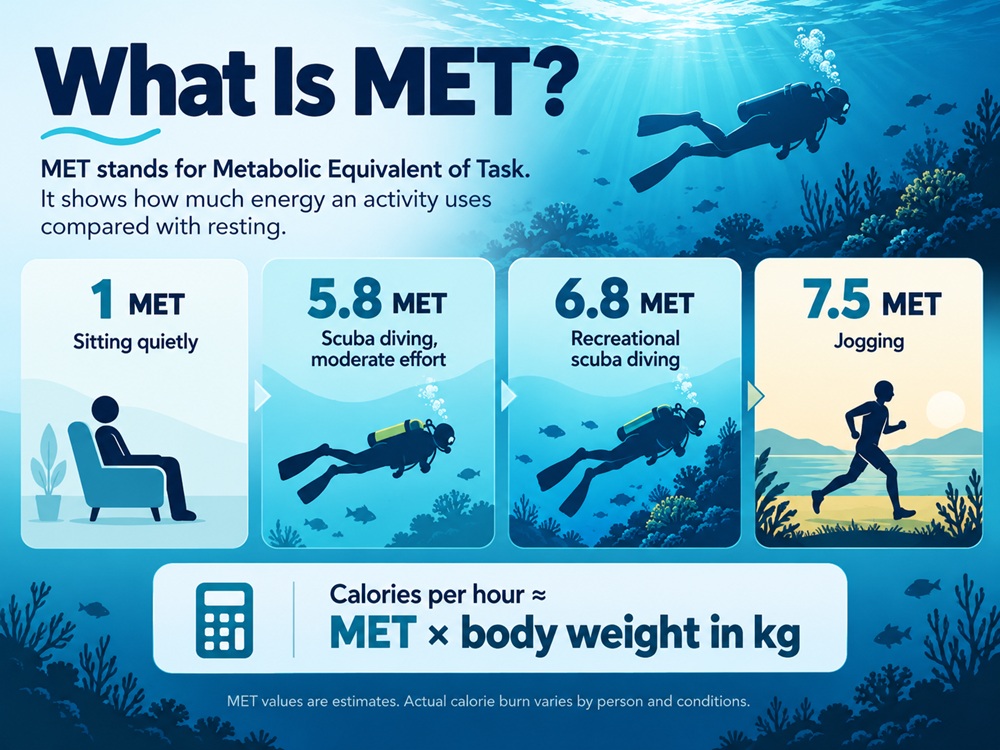
MET stands for Metabolic Equivalent of Task.
It is a way of comparing how much energy an activity requires relative to resting.
1 MET represents approximately the energy your body uses while sitting quietly at rest.
So an activity rated at 2 MET requires roughly twice the resting energy expenditure, while an activity rated at 6 MET requires roughly six times the resting energy expenditure.
For example:
Sitting quietly is around 1 MET.
Driving a car is around 2 MET.
Moderate effort scuba diving is around 5.8 MET.
Recreational scuba diving is around 6.8 MET.
General scuba diving is around 7 MET.
This does not mean every person will burn exactly the same number of calories.
MET values are useful for comparing activities, but actual energy expenditure varies between individuals.
How Do You Convert MET Into Calories?
A commonly used simplified estimate is:
Calories per hour ≈ MET × body weight in kilograms
Using an 80 kilogram diver as an example:
At 5.3 MET, light effort scuba diving would equal approximately 424 calories per hour.
At 5.8 MET, moderate effort diving would equal approximately 464 calories per hour.
At 6.8 MET, recreational scuba diving would equal approximately 544 calories per hour.
At 7 MET, general scuba diving would equal approximately 560 calories per hour.
These should be treated as estimates rather than exact measurements.
Is 600 Calories Per Hour Realistic?
Yes, it can be.
But it should not be presented as a universal number.
For an 80 kilogram diver, current Compendium values produce an estimate of approximately 424 to 560 calories per hour depending on the level of effort.
A heavier diver, a diver working harder, or someone swimming against current could reasonably exceed those values.
So the frequently repeated claim that scuba diving burns around 600 calories per hour is plausible under some circumstances.
What is misleading is presenting 600 calories as if every diver burns exactly that amount during every dive.
What Does Research on Real Recreational Divers Show?
Laboratory estimates are useful, but what happens during real dives?
A study published in Diving and Hyperbaric Medicine monitored 959 recreational air dives performed by 139 divers.
The dives had an average maximum depth of approximately 20 metres and an average underwater duration of about 50 minutes.
Researchers estimated the average exercise intensity of these dives at approximately 5 MET.
They also found that an exercise capacity of around 7 MET covered the effort required during the great majority of the dives studied.
The researchers described uncomplicated recreational scuba diving as requiring moderate intensity energy expenditure.
They also emphasized that divers should maintain additional aerobic fitness so they have reserve capacity when conditions become more demanding.
That distinction is important.
A calm drift dive may require relatively little sustained finning.
The same diver suddenly swimming against current may experience a much higher workload.
How Does Scuba Diving Compare With Other Activities?
To make a fair comparison, the same body weight must be used for every activity.
Using an 80 kilogram adult as an example gives a more meaningful picture.
| Activity | Approximate MET | Estimated calories per hour for an 80 kg adult |
|---|---|---|
| Sitting quietly | 1.0 | 80 kcal |
| Driving a car | 2.0 | 160 kcal |
| Playing piano while seated | about 2.3 | about 184 kcal |
| Gymnastics, general | about 3.8 | about 304 kcal |
| Leisure cycling | about 4.0 | about 320 kcal |
| Golf, general | about 4.5 | about 360 kcal |
| Horse riding, general | about 5.5 | about 440 kcal |
| Moderate effort scuba diving | 5.8 | 464 kcal |
| Recreational scuba diving | 6.8 | 544 kcal |
| General cycling | about 7.0 | about 560 kcal |
| Jogging | about 7.5 | about 600 kcal |
| Running at around 6 mph | about 9.3 | about 744 kcal |
The important point is not that diving is “better” exercise than another sport.
It is that recreational scuba can require substantially more energy than it appears to from the surface.
Why Can Diving Burn So Many Calories?
There are several reasons.
Moving Through Water
Water creates much more resistance than air.
Every fin kick requires muscular effort, even when a diver appears to be moving slowly.
A streamlined diver using efficient propulsion may expend less energy than someone who is poorly trimmed, heavily weighted or constantly correcting position.
That means two divers following the same route may not have the same physical workload.
Current Makes a Big Difference
Current can dramatically change the effort required during a dive.
A relaxed drift dive may involve very little continuous swimming.
Swimming against current can quickly become strenuous.
This is one of the reasons cardiovascular fitness remains important for divers even when most normal dives feel easy.
The study of 959 recreational dives estimated an average intensity of around 5 MET but still recommended greater aerobic capacity so divers have reserve fitness available when conditions become more demanding.
Buoyancy Control Also Requires Energy
An experienced diver may appear almost motionless underwater, but maintaining depth and position still requires continuous small adjustments.
Breathing changes lung volume and therefore affects buoyancy.
Divers also make subtle changes in posture, fin position and breathing pattern to remain stable.
These movements may be small, but they are still part of the diver’s overall workload.
Equipment Adds to the Physical Effort
A large part of the effort associated with diving may happen before and after the underwater portion of the dive.
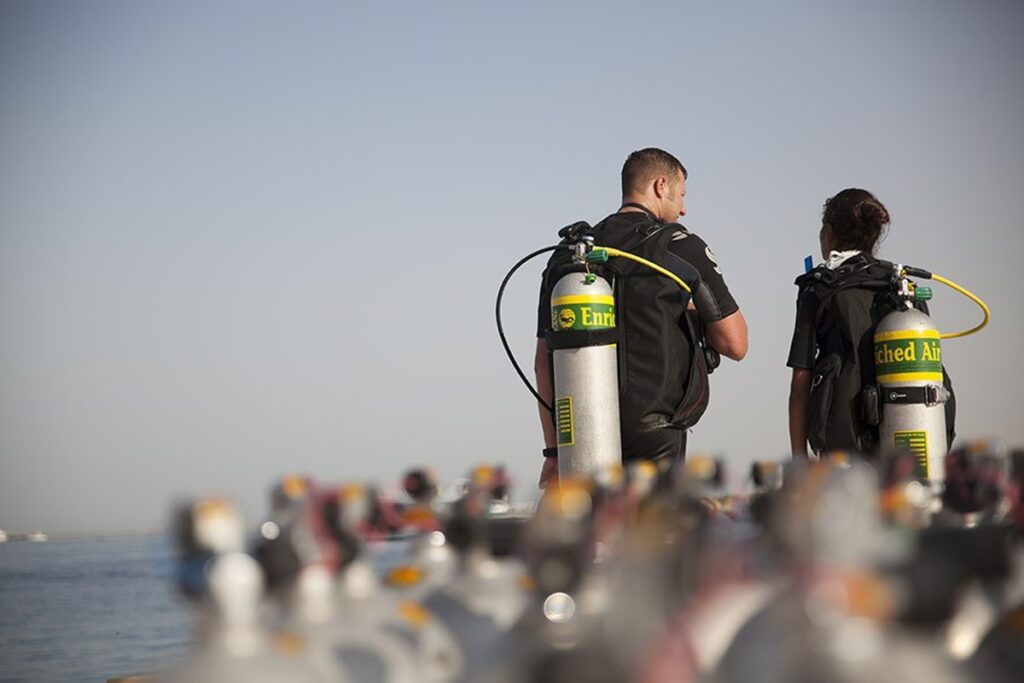
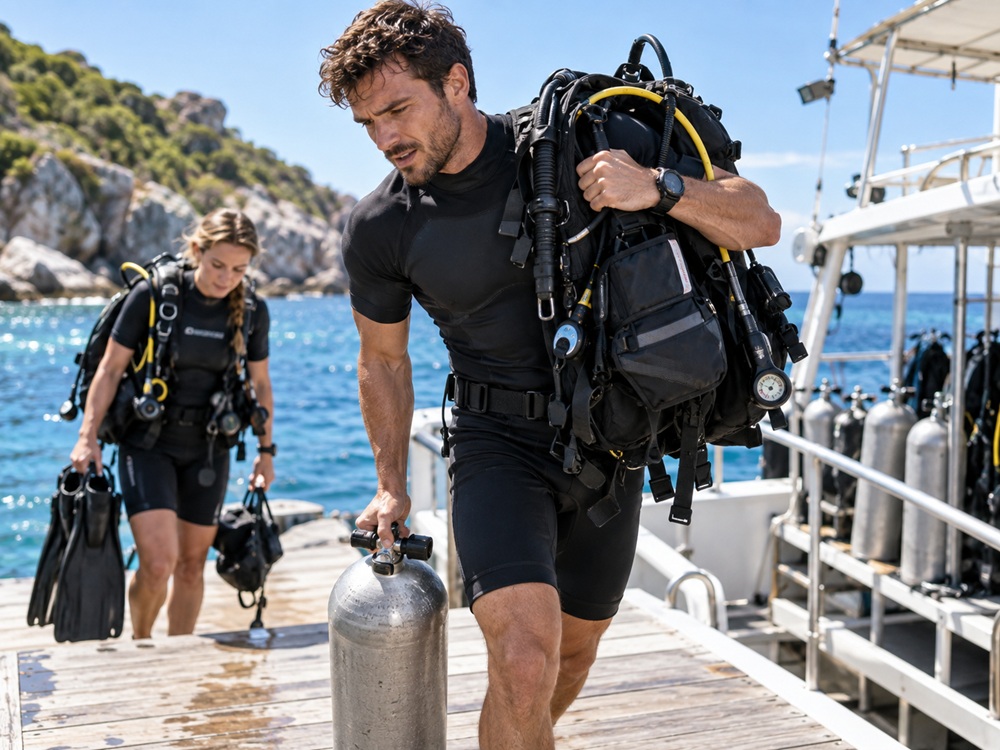
A diver may need to carry a cylinder, BCD, regulators, weights and exposure protection.
Walking along a beach, climbing a ladder or moving across a boat while carrying equipment can require considerable effort.
This matters when people talk about the calories burned during “a dive”.
One hour underwater is not necessarily the entire physical workload associated with the dive.
Cold Water Can Increase Energy Demand
Water temperature can also affect energy expenditure.
The human body constantly tries to maintain its core temperature.
During cold exposure, the body can increase metabolic heat production to compensate for heat loss.
A study involving 16 U.S. Naval Special Warfare divers examined a six hour training immersion in approximately 5°C water.
Researchers found that metabolic rate increased following the prolonged cold water exposure, although there was considerable variation between individual divers.
These were military divers undergoing an extreme cold water training exposure, so their results should not be directly applied to an ordinary recreational dive.
However, the study demonstrates an important point: cold water can increase metabolic demand.
More recent recreational diving research has also highlighted individual differences in thermal response during cold water scuba diving.
Does Diving Deeper Burn More Calories?
Not necessarily.
A dive to 30 metres does not automatically burn twice as many calories as a dive to 15 metres.
Depth can affect breathing workload and other physiological demands, but calorie expenditure depends on the entire dive.
Important factors include swimming effort, current, water temperature, equipment configuration, exposure protection and individual physiology.
A deep dive with little swimming may require less muscular effort than a shallow dive involving strong current.
Depth alone therefore cannot be used to calculate calorie expenditure.
Does Body Weight Affect the Number of Calories Burned?
Yes.
Because body mass is part of the simplified MET calorie calculation, estimated calorie expenditure increases with body weight.
Using the recreational scuba value of 6.8 MET:
| Body weight | Estimated calories in 60 minutes |
|---|---|
| 60 kg | about 408 kcal |
| 70 kg | about 476 kcal |
| 80 kg | about 544 kcal |
| 90 kg | about 612 kcal |
| 100 kg | about 680 kcal |
Again, these are estimates rather than precise individual measurements. The recreational scuba value of 6.8 MET comes from the 2024 Compendium of Physical Activities.
Fact Checking the Diving Calorie Graphic
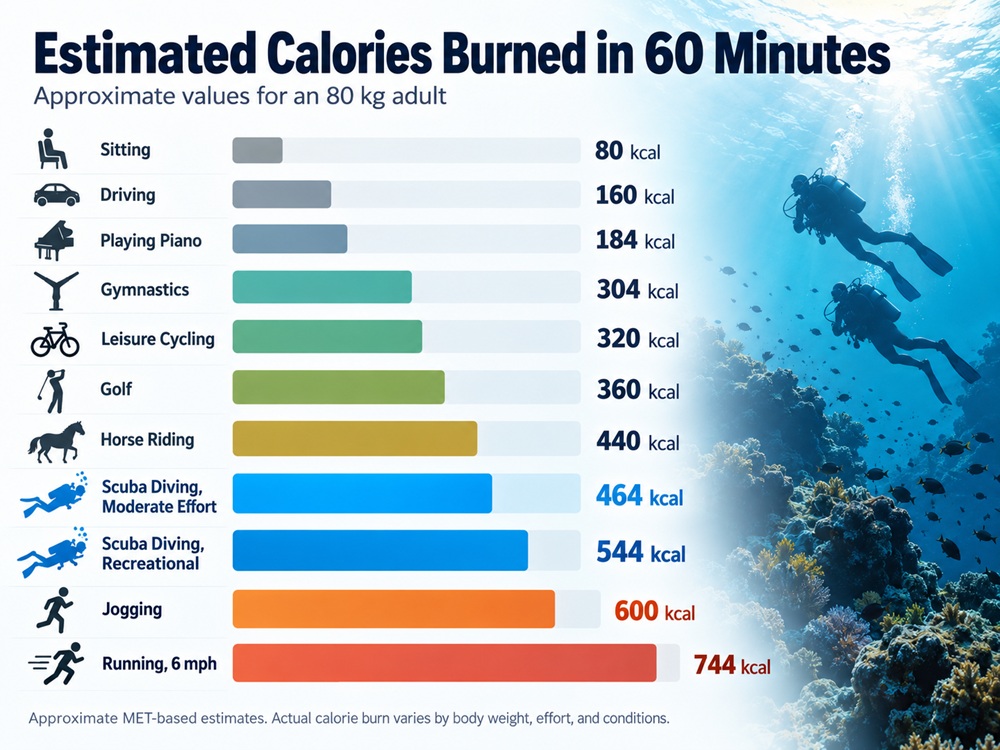
The graphic comparing scuba diving with several other activities lists the following calorie expenditure over 60 minutes:
Diving: 600 calories
This table also helps explain why quoting one fixed calorie number without mentioning body weight can be misleading.
Sitting: 26 calories
Driving: 60 calories
Playing piano: 80 calories
Cycling: 170 calories
Gymnastics: 300 calories
Golf: 350 calories
Horse riding: 530 calories
Running: 600 calories
The idea behind the comparison is interesting, but several of the figures should not be used as fixed values.
Diving: 600 Calories
Plausible, but not universal.
Current Compendium values place recreational scuba at 6.8 MET and general scuba at 7 MET.
For an 80 kilogram adult, that produces an estimate of about 544 to 560 calories per hour.
Six hundred calories is certainly possible, particularly for a heavier diver or during a more demanding dive.
But it should not be presented as the amount every diver burns.
Sitting: 26 Calories
This figure is too low if the comparison is intended to show total energy expenditure.
Sitting quietly is approximately 1 MET.
An 80 kilogram person would therefore expend roughly 80 calories per hour using the simplified MET calculation.
Driving: 60 Calories
Driving an automobile is listed at approximately 2 MET in the Compendium.
For an 80 kilogram adult, that corresponds to roughly 160 calories per hour.
Playing Piano: 80 Calories
The calorie cost of playing piano while seated is also higher than shown in the graphic when total energy expenditure is being compared.
As with every activity, actual expenditure depends on the individual and how the activity is performed.
Cycling: 170 Calories
Cycling is particularly difficult to represent with a single number.
A relaxed bicycle ride and fast road cycling have very different energy demands.
Any comparison should therefore specify the type and intensity of cycling rather than simply listing “cycling”.
Gymnastics: 300 Calories
This figure can be reasonable for some forms of general gymnastics.
More vigorous or competitive gymnastics can involve considerably higher energy expenditure.
Golf: 350 Calories
This can also fall within a reasonable range depending on how the activity is performed.
Walking the course and carrying equipment is physically different from riding between holes in a golf cart.
Horse Riding: 530 Calories
Horse riding varies greatly in intensity.
Gentle riding, trotting, cantering and competitive equestrian activities should not all be represented by the same calorie value.
Running: 600 Calories
Six hundred calories per hour is plausible for some jogging speeds and body weights.
However, running energy expenditure increases significantly with speed, so again, a single fixed figure does not describe every runner.
So Is Scuba Diving Really Exercise?
From an energy expenditure perspective, yes.
The Compendium classifies recreational scuba diving at 6.8 MET, while research from actual recreational dives has estimated typical exercise intensity at around 5 MET.
That places scuba diving within a meaningful level of physical activity.
But diving is unusual because the workload can change quickly.
A diver may spend most of the dive moving slowly with little effort and then suddenly need to swim against current, assist another diver or manage rough surface conditions.
That is why fitness matters.
The important issue is not simply how many calories a normal dive burns, but whether the diver has enough physical reserve when the dive becomes more demanding.
Can Scuba Diving Help You Lose Weight?
Diving uses energy, but it should not be treated primarily as a weight loss activity.
The number of calories used during a dive varies too much to rely on one fixed figure.
Divers also need adequate hydration and nutrition to support safe diving.
Trying to deliberately restrict food or fluid intake simply because a dive may burn several hundred calories would not be appropriate.
The more useful lesson is that diving places genuine physical demands on the body, even when the experience feels relaxed.
The Bottom Line
So, how many calories do you burn during scuba diving?
There is no universal answer.
The 2024 Compendium of Physical Activities lists light effort scuba at 5.3 MET, moderate effort at 5.8 MET and recreational scuba at 6.8 MET.
For an 80 kilogram diver, those values correspond to rough estimates of approximately 424 to 544 calories during an hour underwater.
A more demanding dive, greater body weight, cold water or strong current could increase that amount.
The popular figure of 600 calories per hour is therefore possible, but it should not be treated as a rule.
Scuba diving may look effortless from the surface.
Your metabolism may tell a very different story.
Sources
PubMed – Exercise intensity inferred from air consumption during recreational scuba diving
Pacompendium – Water Activities

Mohsen Nabil is the Founder and Editor-in-Chief of Diventures Magazine. A mechanical engineer and scuba diving instructor based in the Red Sea, he writes about diving safety, marine conservation, underwater exploration, and developments in the global dive industry. Through Diventures Magazine, he works to connect divers, scientists, and ocean advocates while promoting responsible diving and protection of the oceans.