
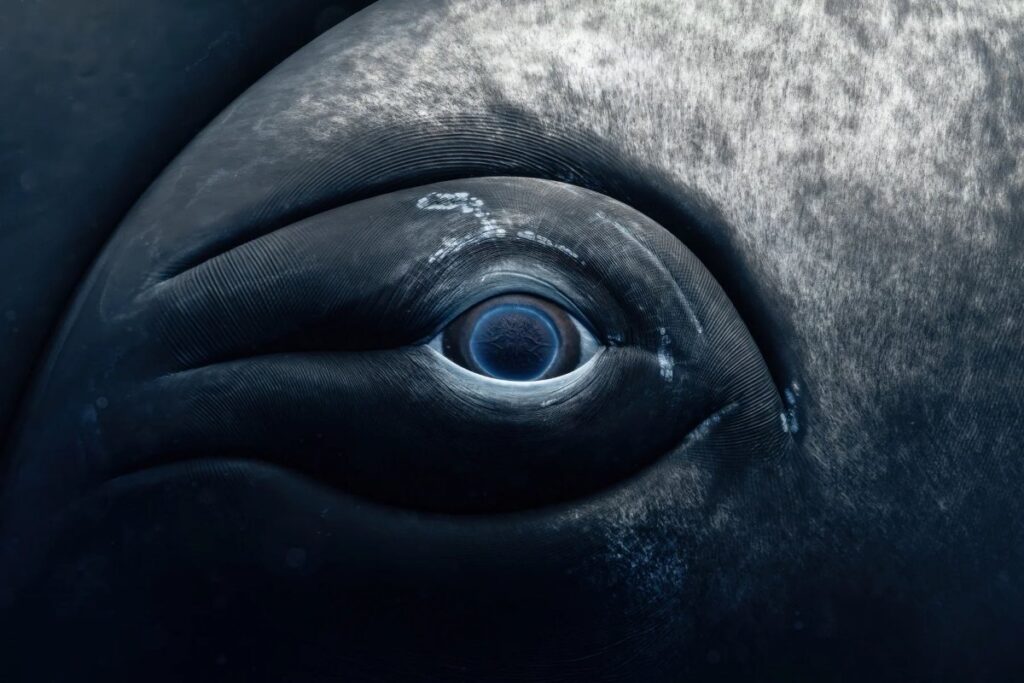

In October 2024, ocean photographer Rachel Moore slipped into the warm waters off Mo’orea, French Polynesia, expecting an ordinary end to a long day of shooting. Instead, she met a young humpback whale who would not let her go, and whose death, four days later, would turn a single photograph into a rallying point for divers, freedivers, and conservationists worldwide.
An Encounter Few Divers Ever Get
Moore had already spent the day in the water with a male humpback when she noticed a juvenile playing near the surface with a pod of spinner dolphins. Tired but curious, she went back in. What followed was, in her own words, one of the most profound encounters of her career: the whale, later nicknamed “Sweet Girl” by the boat crew, approached and held eye contact with her for several minutes at close range, rolling to keep her gaze on the photographer.
Moore used the moment to capture an extreme closeup of the whale’s eye, detailed enough to show the electric blue ring around the pupil and the thick pad of fat that cushions and insulates a whale’s eye underwater. She titled the image “Galaxies in Her Eyes.” For anyone who has locked eyes with a marine animal underwater, a curious grouper, a resting turtle, a passing dolphin, the appeal of the photo is instantly recognizable: it captures the rare, quiet moment where a wild animal seems to look back.
A Story That Turned
Sweet Girl, estimated to be three to four years old, was a humpback calf that had stopped in the waters around Tahiti and Mo’orea, a known resting and calving area for the species before their long migration south to Antarctic feeding grounds. Days after the encounter, she was struck by a vessel believed to be a high speed ferry operating between the two islands. According to Moore’s own account, shared publicly after the strike, the whale suffered severe trauma and did not survive.
Moore has said she initially doubted the whale involved was Sweet Girl, given how many whales pass through the area during the season, but she was able to confirm it from distinctive markings on the animal’s body. The vessel responsible has not been officially identified, and reports at the time noted an investigation was underway.
Ship Strikes: A Global, Underreported Threat
Sweet Girl’s death is one entry in a much larger and largely invisible problem. According to the International Marine Mammal Project, an estimated 20,000 whales are killed by vessel strikes worldwide every year, with large baleen species, humpback, fin, gray, and blue whales, most frequently affected in busy shipping lanes and along migratory corridors. The same organization notes that official strike counts almost certainly understate the true toll, since many struck whales sink or drift out to sea before they can be recorded.
The International Whaling Commission, which maintains a global ship strike database, has acknowledged the same limitation: collisions with large vessels often go unnoticed, and whale carcasses are rarely recovered intact. Researchers who model strike mortality using vessel traffic and whale density data, rather than relying on confirmed carcass reports alone, have found that actual death tolls in well studied regions, such as the U.S. West Coast, likely run several times higher than official minimum estimates.
For the diving and ocean tourism industry, this is not an abstract statistic. Liveaboard operators, whale swim tour companies, and dive centers in whale corridors, from the Silver Bank to Tonga to French Polynesia, depend on the same animals surviving long enough to return season after season. A single high traffic strait shared by tour boats, ferries, and cargo vessels can become one of the more dangerous stretches of water a whale will cross in its lifetime.
What Comes Next
Sweet Girl’s story pushed the issue into public view in a way that statistics alone rarely manage. Moore has since campaigned for French Polynesia to adopt and enforce vessel speed limits. She has called for a cap of 12 knots or less within roughly two kilometers of Tahiti and Mo’orea during whale season, arguing that slower speeds give both whales and vessel operators more time to react. Her push echoes measures already in place elsewhere, including California’s seasonal vessel speed reductions in whale habitat, designed to cut the risk and severity of collisions in areas where whale and ship traffic overlap.
Whether these specific proposals are adopted is a matter for local authorities and maritime regulators to decide, and the debate touches on competing interests: conservation groups, ferry operators, and shipping companies each weigh safety, cost, and logistics differently. What is not in dispute is the underlying pattern documented by marine scientists: wherever whale migration routes cross busy vessel lanes, strikes follow, and most of them go unrecorded.
For the diving community, Sweet Girl’s photograph endures less as a conservation statistic and more as a reminder of what is actually at stake underwater, a reminder familiar to anyone who has ever paused mid dive because a large, wild animal chose, briefly, to look back.

Mohsen Nabil is the Founder and Editor-in-Chief of Diventures Magazine. A mechanical engineer and scuba diving instructor based in the Red Sea, he writes about diving safety, marine conservation, underwater exploration, and developments in the global dive industry. Through Diventures Magazine, he works to connect divers, scientists, and ocean advocates while promoting responsible diving and protection of the oceans.