
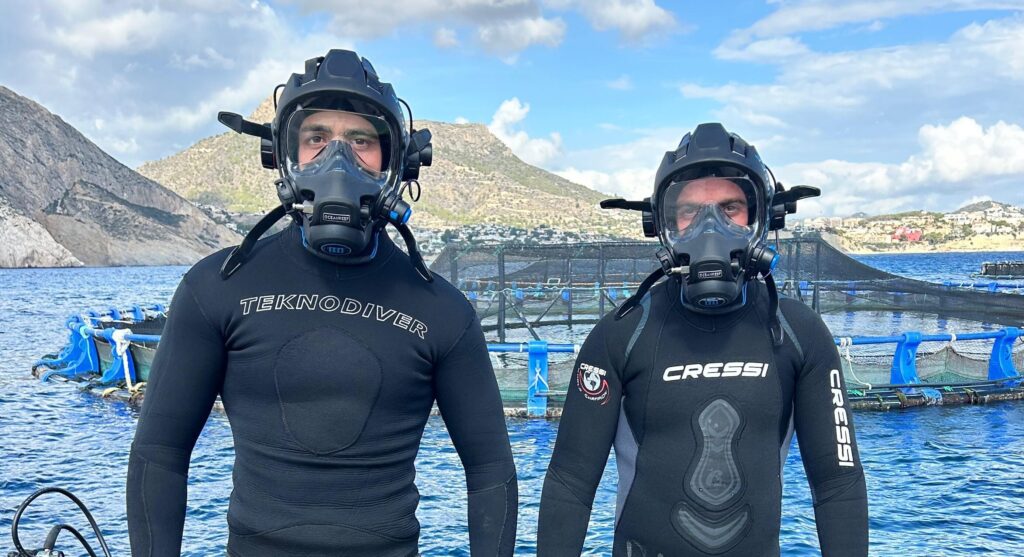
Real-time communication underwater is not new, but it has not been standard in many work settings. That is starting to change. In January 2026, Mediterranean fish farmer Avramar said it introduced a diver safety system that uses full-face masks with wireless underwater communication. The company said the system supports real-time diver-to-surface and diver-to-diver communication, and it is based on ultrasound technology.
For experienced divers, this matters because communication is often the weak point in task diving. Hand signals depend on visibility and position. Slates take time and shift attention away from the job. Line signals are limited in what they can say. In busy work sites, those limits can turn small problems into larger ones.
What Avramar deployed and why
Avramar said the goal is to boost diver safety and reduce the need for frequent ascents and descents during operations. It also linked this to reducing risks connected to rapid pressure changes, which it described as a key safety concern in professional diving.
The company framed this system as part of a wider safety strategy developed over two years. It said pilot tests took place across several of its marine farms in Spain, including El Campello, Villajoyosa, and Calpe. After testing, Avramar said it planned to roll out the system to its full diving workforce, described as nearly 50 divers.
What changes for experienced divers
A full-face mask is already a common platform in working dives because it can support comfort and task focus. Adding comms changes the mask’s role again. It becomes both life support equipment and a message channel. That means audio quality, fit, and routine checks become safety items, not convenience features.
The practical advantage is not constant talk. It is control at the moments when the team needs it. Real-time voice can allow a surface supervisor to stop a task early, redirect a diver away from lines or nets, or confirm steps without forcing a diver to surface for instructions. In an incident, clear voice contact can also reduce confusion and speed decisions.
The limits: systems need procedures
Communication systems can also add distraction if teams do not use simple discipline. Working divers and supervisors need agreed phrases, clear authority for “stop work” calls, and a plan for what happens when communication fails. Without that, the technology can create a false sense of safety.
Conclusion
Avramar’s move shows a clear direction in dive equipment for professional operations: treat underwater communication as a safety system, not a specialty add-on. Full-face mask comms, tested in real work sites and planned for broad rollout, reflect a push toward fewer unplanned depth changes and stronger surface control of risk.
Diventures Team is a multidisciplinary team of scuba professionals, editors, and digital creators, producing accurate and experience-driven coverage of diving, marine life, and ocean culture.