
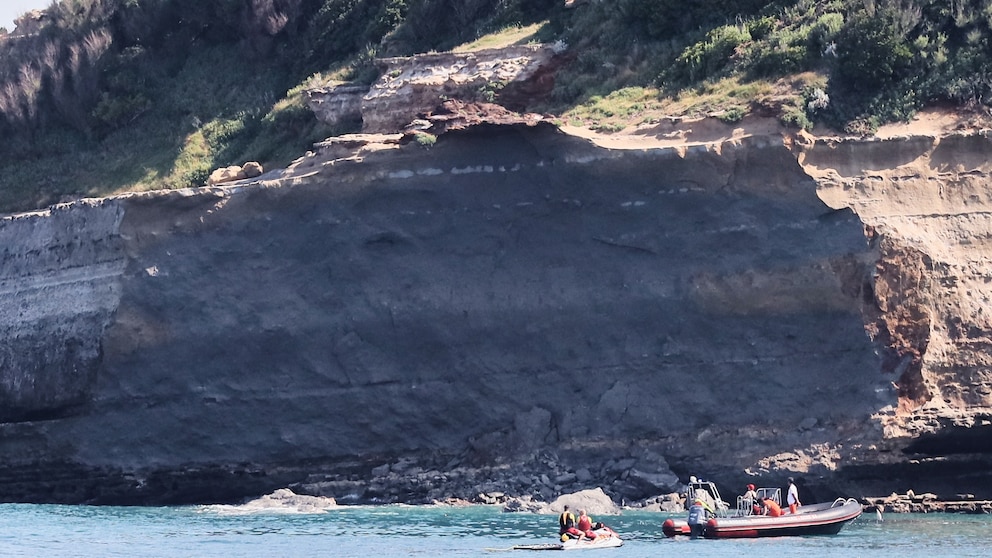

A diver has been killed and her partner remains missing after a massive section of cliff collapsed onto them during a dive near the lighthouse at Biarritz, on France’s Atlantic coast, on the evening of Wednesday 24 June.
Three local divers were at the base of the cliff near Miramar Beach when approximately 2,000 cubic metres of rock — equivalent to around 5,000 tonnes — gave way at around 8:20 p.m. local time. The collapse sent a wave estimated at 1.5 metres across the water and was heard by bystanders on the shore as a sound described by one witness as resembling a thunderclap.
One diver managed to reach safety unaided and alerted emergency services. The body of Salomé Lasla-Boireau, 33, was recovered from the water later that evening. She had been freediving — spearfishing — with her partner, a 34-year-old man who remains missing as of the time of publication. The couple were local residents.
Search operations, which involved specialist rescue divers, firefighters, a gendarmerie helicopter, and underwater drones, were suspended overnight due to darkness and difficult sea conditions and resumed the following morning. On Thursday 25 June, firefighters passed responsibility for the search to municipal services, which deployed a sonar-equipped submarine drone capable of covering a 250-metre radius. The operation was further complicated by a local wind advisory and the continuing instability of the remaining cliff face, which was still showing signs of movement. As of Friday 26 June, searches resumed under the supervision of BRGM, France’s national geological survey body, though the missing diver had not been located.
The collapse occurred beneath the Pointe St-Martin lighthouse, one of Biarritz’s most recognisable landmarks. The divers are understood to have entered the water from shore, reaching the base of the cliff by swimming. The area is not a designated or commercially operated dive site; local operators typically take divers by boat to deeper offshore reefs and wrecks. Around Pointe St-Martin, depths close to shore are thought to range from a few metres to around 10–15 metres over a sloping rock ledge. The beach at Miramar, close to the site, was crowded at the time of the incident, with temperatures in Biarritz exceeding 40°C that day during an ongoing heatwave.
Biarritz Mayor Serge Blanco — a former French rugby international — visited the scene that evening and declared the city in mourning. Municipal flags were ordered to fly at half-mast for several days. “It was a young, dynamic couple in their thirties, who were happy here,” Blanco said. “This is catastrophic. We must ensure this never happens again.” He also signed an order banning all public access, swimming, and boating within a 300-metre radius of the base of the affected cliff.
The cause of the collapse has not been established. French media noted that previous rockfalls had occurred in the same area in 2008 and in June 2018, the latter following a period of heavy rainfall. Rockfall hazards are a recognised issue along parts of the Biarritz coastline, and some sections were already subject to access restrictions prior to this incident. No direct link between the current heatwave and the collapse has been confirmed by authorities, though the geological fragility of the cliff — composed of sedimentary rock weakened over time by water infiltration, temperature variation, and wave action — has long been noted by local conservation groups.
Geotechnical engineers from BRGM are expected to assess the stability of the remaining structure before any access restrictions are lifted.
Diventures will update this story as further information becomes available.

A young voice whose articles shine with energy and a fresh perspective. Through a promising pen, he takes us on journeys driven by a passion for discovery and a spirit of curiosity, adding a distinctive character to Diventures that reflects a new generation of writers connected to the sea and its worlds.