
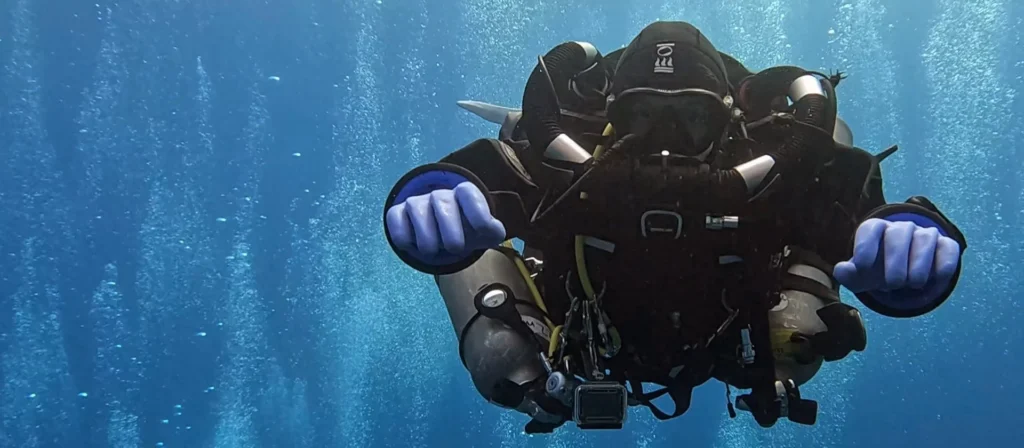

A regulatory grey area has claimed lives. The question now isn’t whether to legislate — it’s whether the Maldives has the courage to do it properly.
Six people are dead. Five Italian divers — among them University of Genoa marine ecologist Monica Montefalcone and her daughter — lost their lives in a deep cave system near Alimatha, in Vaavu Atoll, during what was reportedly a research dive that reached depths of 50 to 60 metres. A Maldivian rescue diver perished during the subsequent recovery operation. Rome prosecutors have opened an investigation. Finnish cave diving specialists were flown in to assist. And now, almost as predictably as the tide, a government has announced that legislation is coming.
This is how the dive industry too often changes: not through foresight, but through grief.
The Maldives government confirmed this week that it is drafting a legal framework to regulate and permit technical diving — a move its Chief Government Spokesperson Mohamed Hussain Shareef described as already in discussion. The proposed rules would introduce certification requirements, operational standards, permits, and safety oversight for technical and research divers. These are welcome words. But words written in the shadow of a tragedy carry a particular weight of obligation, and the dive community — operators, agencies, and divers alike — should watch closely to ensure that what follows is genuine structural change, not regulatory theatre designed to reassure tourists and close a difficult news cycle.
The Grey Zone Everyone Knew About
Here is the uncomfortable truth that no one in the Maldivian dive industry has been eager to discuss openly: technical diving has been happening in the Maldives for years. It simply hasn’t been happening legally.
Recreational diving in the Maldives is currently limited to 30 metres under existing regulations. Yet the Italian group reportedly descended to twice that depth inside an enclosed cave system. This wasn’t an aberration — it was a symptom of a gap that the industry has long exploited through ambiguity. Research permits, scientific exemptions, and the sheer remoteness of atoll environments have created conditions where the rules were never clearly enforced, and where the assumption of oversight substituted for actual oversight.
The Maldives is not alone in this. Destination-level regulatory frameworks for technical diving vary enormously across the world. Some countries — Malta, Egypt’s Red Sea, Mexico’s cenote systems — have developed reasonably mature structures for technical and cave diving operations, with certification prerequisites, operator licensing, and site-specific protocols. Others operate in the same grey zone the Maldives has inhabited: technically prohibitive on paper, functionally permissive in practice, and dangerously exposed the moment something goes wrong.
What happened in Vaavu Atoll was not the result of reckless amateurs ignoring all the rules. By accounts emerging from the investigation, this was an experienced Italian research team that appears to have made a fatal navigational error inside a complex cave system — possibly a wrong turn in low-visibility conditions that led them beyond a point of safe return. Cave diving kills experienced divers. It always has. The question was never whether accidents were possible in the Maldives. The question was what accountability structure existed if they happened.
The answer, as we now know, was: none worth speaking of.
What Legislation Must Actually Deliver
The Maldives government has an opportunity here that goes far beyond crisis management. Done correctly, a technical diving regulatory framework could position the archipelago as a world-class destination for a rapidly growing segment of the global dive market — one that tends to be older, higher-spending, and deeply committed to the destinations it chooses.
But the framework must be substantive. A few checkboxes on an application form will not do.
At minimum, any credible legislation needs to address the following:
Mandatory certification standards. Technical diving is not recreational diving with extra cylinders. Cave diving, in particular, is among the most demanding and unforgiving disciplines in the underwater world. Any framework must require verifiable, internationally recognised qualifications — and it must specify which agencies and certifications meet that bar. Blanket permits issued on the basis of general diver experience would be a dangerous half-measure.
Site-specific risk assessment and access management. Not all technical sites carry equal risk. The Maldives contains cave systems, deep pinnacles, wrecks, and blue-water environments that present very different hazard profiles. The legislation must create mechanisms for sites to be assessed, classified, and managed accordingly — with some restricted to higher certification levels and others closed outright until properly surveyed.
Operator accountability. Individual diver certification is necessary but not sufficient. The dive operators and liveaboard companies who organise technical expeditions must carry legal responsibility for verifying qualifications, conducting pre-dive briefings, ensuring emergency equipment is available, and maintaining communication protocols. The Italian tragedy occurred in waters overseen by operators whose regulatory obligations in this regard were essentially undefined.
Emergency response infrastructure. A Maldivian rescue diver died trying to reach depths he may not have been equipped to handle safely in an emergency scenario. This is not a criticism of that diver’s courage — it is a systems failure. Any technical diving framework must be accompanied by investment in hyperbaric facilities, trained technical rescue personnel, and clear protocols for who responds, how, and with what equipment when things go wrong in deep or overhead environments.
The Red Sea Parallel — And Its Lessons
From where we sit in the Red Sea diving world, this story carries a particular resonance. Egypt has navigated its own long, complicated history with technical diving regulation: from the informal growth of tec diving in the Sharm El Sheikh and Hurghada markets through the 1990s and 2000s, to the ongoing evolution of site access rules, liveaboard permitting, and decompression diving standards. It has not always been clean or consistent. But the infrastructure — the chambers, the tec operators, the training culture — developed in parallel with the activity, rather than being imposed reactively after a headline.
The Maldives is now being forced to compress that developmental arc under political pressure and international scrutiny. That is a harder environment in which to make good policy. Decisions made quickly to manage a crisis tend to be decisions optimised for the optics of action rather than the substance of safety.
The dive industry globally should apply pressure — constructive, collaborative, but firm — to ensure that the Maldivian government engages with international agencies, technical diving organisations such as IANTD, TDI, and GUE, and the broader community of technical dive operators before finalising any legislation. This is not a problem that can be solved by civil servants who have never planned a decompression dive.
A Turning Point — If the Will Is There
Tragedies do not automatically produce good policy. Sometimes they produce policy that looks decisive in the short term and creates new problems in the long term: frameworks that are too restrictive to be workable, or too porous to be meaningful.
The Maldives has a genuine decision to make. It can treat this moment as an administrative inconvenience to be managed — issue some new permits, add a few certification requirements, move on. Or it can use it as the catalyst for building a technical diving industry that is safe, professional, and globally respected; one that adds a new dimension to a destination that has, for too long, been content to offer recreational divers the same magnificent but relatively constrained experience.
The cave systems, deep walls, and underwater geography of the Maldives are extraordinary. Technical divers know this. Researchers know this. The potential is real.
But potential unrealised is just risk. And right now, six families are living with the cost of that risk being left unmanaged for too long.
The legislation is coming. The only question is whether it will be good enough.

Mohsen Nabil is the Founder and Editor-in-Chief of Diventures Magazine. A mechanical engineer and scuba diving instructor based in the Red Sea, he writes about diving safety, marine conservation, underwater exploration, and developments in the global dive industry. Through Diventures Magazine, he works to connect divers, scientists, and ocean advocates while promoting responsible diving and protection of the oceans.