

In the vibrant chaos of a coral reef, survival often depends on standing out. We are drawn to the electric blues of damsels, the striking patterns of angelfish, and the shimmering silver of schooling barracuda. But for some marine creatures, survival depends on the exact opposite: becoming invisible in plain sight.
If you are an avid diver in the Indo-Pacific, there is a very high probability that you have swum directly over one of the reef’s most patient killers without ever noticing it.
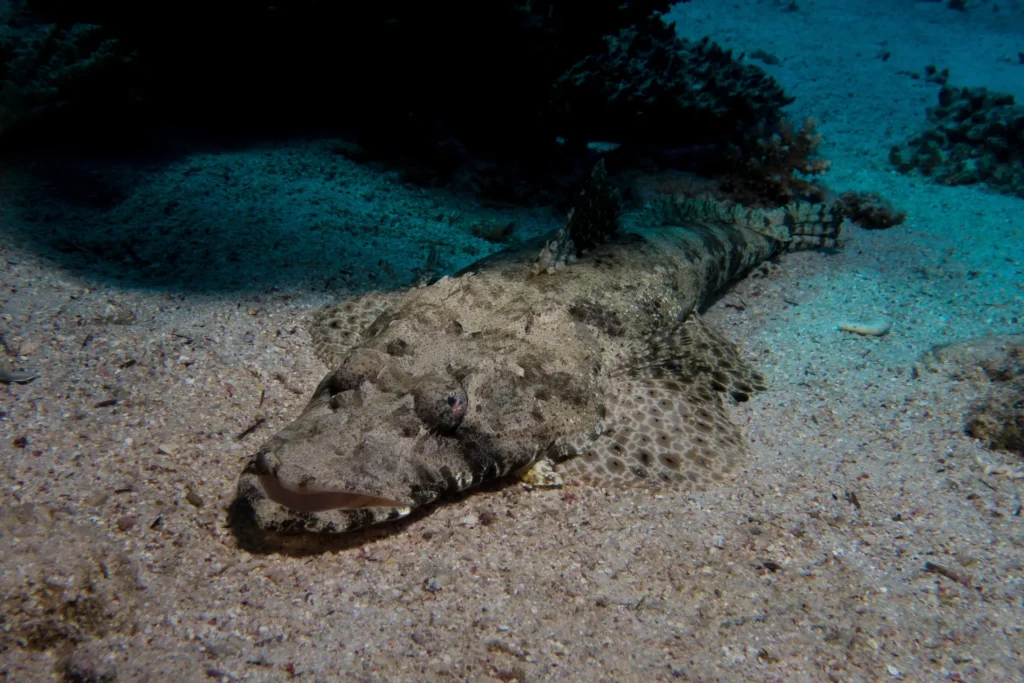
The crocodilefish (Cymbacephalus beauforti), also known as the tentacled flathead, is a masterclass in cryptic adaptation. It doesn’t hide in caves; it hides right out in the open, lying on sand patches or coral rubble, daring you to see it. Understanding how this unique creature achieves invisibility not only deepens our appreciation for marine evolution but also significantly improves your chances of actually spotting one on your next dive.
What is a Crocodilefish?
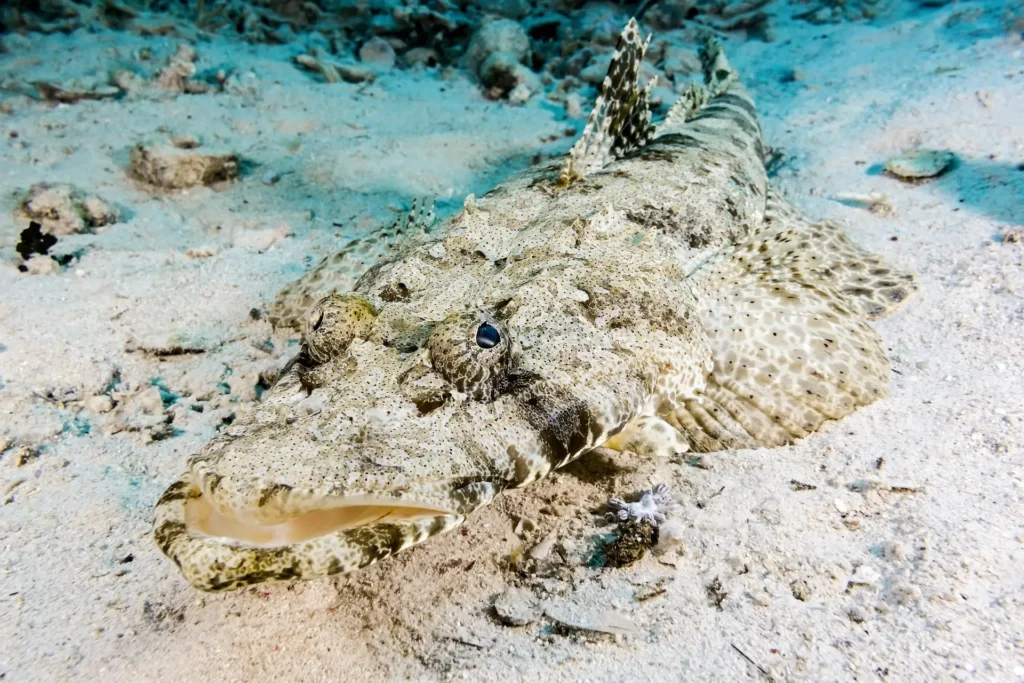
Before diving into their disappearing act, it’s helpful to understand what we are looking at. The crocodilefish gets its common name from its distinctively shaped head. Much like its reptilian namesake, it possesses a long, flattened snout and eyes situated on top of its head, offering an excellent upward vantage point to scan for passing prey.
They are part of the order Scorpaeniformes, making them distant cousins to scorpionfish, lionfish, and stonefish. Like many in that lineage, they are bottom-dwellers that rely on stealth rather than speed. While they possess spines, they are not notoriously venomous like their stonefish relatives, though care should always be taken not to touch marine life.
Growing up to 50 centimeters (about 20 inches) in length, they are not small fish. The fact that a two-foot-long predator can vanish on a barren patch of sand is a testament to the effectiveness of their disguise. They are primarily found in the shallow, tropical waters of the Western Pacific and the Indian Ocean. They are seen while diving in the Red Sea and while diving the Great Barrier Reef, favoring sandy bottoms near coral heads, seagrass beds, and rubble zones—the very areas many divers skip over quickly.
The Anatomy of Invisibility
The crocodilefish doesn’t rely on just one trick to remain hidden; it employs a suite of biological adaptations that work together to fool both predators and prey.
1. Disruptive Coloration and Patterning
The foundation of the crocodilefish’s camouflage is its complex dermal pigmentation. They don’t just match the color of the sand; they match the texture of the environment visually.
Their bodies are covered in a mottled pattern of irregular blotches, speckles, and bands in shades of beige, brown, cream, and grey. This is known as “disruptive coloration.” The eye of a potential predator or prey item naturally looks for outlines—the distinct shape of a fish. The crocodilefish’s patterns serve to break up its body outline, making it difficult for an observer to recognize where the fish ends and the seafloor begins. It dissolves the fish’s silhouette into the background noise of the substrate.
2. Dermal Flaps: The Importance of Being Shaggy
If you look closely at a high-resolution photograph of a crocodilefish, you’ll notice it isn’t smooth. Its body, particularly along the jawline and the flanks, is adorned with small, fleshy tassels of skin known as dermal flaps or cirri.
These flaps serve a crucial purpose in camouflage. In the underwater world, perfect straight lines or smooth curves rarely exist in nature. A smooth-bodied fish lying on rough coral rubble would stand out due to its texture alone. The dermal flaps break up the physical edges of the fish, casting tiny micro-shadows and mimicking the irregular textures of algae, sponges, or broken coral pieces that litter the seafloor. They soften the fish’s profile, ensuring there are no hard edges to give away its position.
3. The Iris Lappet: Hiding the Soul
Perhaps the most fascinating adaptation of the crocodilefish is found in its eyes. In the animal kingdom, eyes are often the hardest things to hide. They are usually round, highly reflective, and contain a dark pupil that stands out against natural backgrounds. Many predators instinctively look for eyes when scanning for prey.
The crocodilefish has solved this problem with a spectacular structure called an iris lappet.
If you manage to get a macro view of a crocodilefish eye, you will see a complex, lace-like curtain of skin draped over the upper half of the pupil. This intricate webbing serves two distinct functions:
- Camouflage: It breaks up the dark, telling circle of the pupil, making the eye look like just another patch of mottled sand or algae. It effectively masks the most recognizable feature on its face.
- Sunshade: Because crocodilefish lie in shallow, often bright water looking upward, the lappet acts like a built-in pair of sunglasses, reducing glare from the surface and allowing them to spot silhouetted prey more easily.
The Patience Game: The Ambush
All this elaborate camouflage is geared toward one singular goal: eating without expending energy on a chase. The crocodilefish is the ultimate energy conserver.
It will find a suitable spot near a reef edge where current might push small fish or crustaceans past its location. Once settled, it enters a state of near-total stillness. It may shuffle slightly to bury its lower edges into the sand, further blending its profile.
It waits. It doesn’t twitch. It barely seems to breathe. It relies entirely on the confidence that it cannot be seen.
When an unsuspecting damselfish or wrasse swims within striking distance above its head, the crocodilefish executes an explosive, upward snap of its jaws. The movement is so fast it’s almost impossible to track with the human eye. A vacuum is created, sucking the prey in, and within milliseconds, the crocodilefish settles back onto the sand, invisible once again, as if nothing happened.
How to Spot a Crocodilefish on a Dive
Knowing how well they hide, how do you find one? It requires a shift in how you scan the reef. Instead of looking for motion and color, you must look for patterns and symmetry.
- Slow Down in Rubble Zones: Don’t just kick quickly over the sandy patches between coral bommies. These transition zones are prime crocodilefish habitat. Glide slowly and scan the bottom about 5 to 10 feet ahead of you.
- Look for Symmetry: Nature is rarely perfectly symmetrical, but fish are. Scan the chaotic pattern of the rubble for the symmetrical shape of the crocodilefish’s broad head. Often, you will see the shape of the head before you resolve the actual fish.
- Find the Eyes: Despite their amazing iris lappets, the eyes are still the best giveaway. Look for two small, raised bumps on the sand that look suspiciously identical. If you see two symmetrical bumps, pause and let your eyes adjust. The rest of the fish will likely materialize around them.
- Watch Your Guide: Dive guides in the Indo-Pacific are masters at spotting these. If your guide stops over a patch of seemingly empty sand and points, don’t assume they are crazy. Get close, follow their finger, and look for the eyes.
Photography Tips
Crocodilefish are excellent subjects for underwater photographers, especially beginners, for one simple reason: they don’t move. You have plenty of time to compose your shot and adjust your settings.
- Get Low: A top-down shot usually just looks like a patch of sand. To capture the drama of the “crocodile” face, you need to get as low to the seafloor as possible (without damaging the reef, of course) and shoot at eye level.
- Macro the Eyes: If you have a macro lens, the intricate pattern of the iris lappet is a stunning subject.
- Side Lighting: Because their camouflage relies on texture and dermal flaps, using strobe lighting from the side (rather than head-on) can create small shadows that define their features and separate them from the background in the final image.
The next time you are diving a shallow reef in Asia or the Red Sea, take a moment to scan the “boring” sandy patches. You might just lock eyes with one of the ocean’s most impressive masters of disguise, patiently waiting for its next meal.

Jon lives in Nova Scotia, Canada and is the founder of ScubaDiveMarketing.com
. We work with dive shops from around the world to increase their online presence.