

A new overview published on September 30, 2025 brings fresh attention to Tahiti coral conservation organisations working across French Polynesia. The focus is on four groups and programmes linked to Tahiti and Mo’orea, with project sites also connected to Ahé, Taha’a, Bora Bora, and Tetiaroa Atoll.
This matters because coral reefs support marine life and coastal protection, and they are under pressure from warmer oceans, acidification, pollution, and overfishing. In 2025, the public discussion is no longer only about the problem. It is also about how local teams measure progress, restore reefs, and keep communities involved.
The update also shows a shift in how reef work is communicated. It is now more structured. There are clear project names, clear tools, and clear plans for education. For general readers, this is a useful way to understand what reef protection looks like in practice.
Reef restoration French Polynesia: what this update shows
The overview lists four efforts that represent different approaches to reef and marine protection:
- Coral Gardeners Tahiti (based on Mo’orea, with work linked to Ahé)
- Biorock Tahiti through the Coral Garden Restoration Biorock Programme (linked to Taha’a and Bora Bora)
- Te Mana o Te Moana (Tahiti-based, with a strong sea turtle focus)
- Tetiaroa Society (research and restoration programmes on Tetiaroa Atoll)
Some of these efforts are direct coral planting and monitoring. Others focus on animal care, education, and wider ecosystem work. Together, they show that reef protection is not one single method. It is a set of connected actions.
Coral Gardeners Tahiti: restoration, monitoring, and reef data
Coral planting milestones since 2017
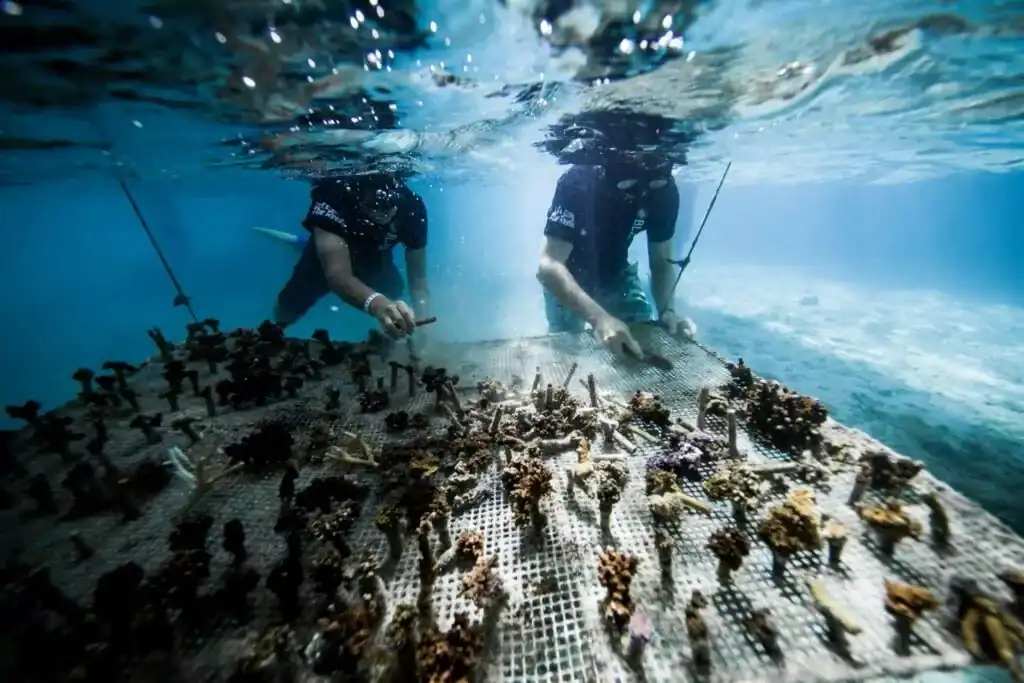
Coral Gardeners grew from a small start into a team of more than 30 members. The overview reports specific restoration numbers. In 2022, the team planted 15,225 nursery-grown corals from 20 species, and reached a total of 30,980 outplants since its founding in 2017.
These figures give a clear sense of scale. Coral restoration is often described as slow and limited. Here, the reported numbers show consistent planting and tracking over several years.
ReefAPP and underwater monitoring
One of the key points in the update is a monitoring tool called ReefAPP, described as a beta iOS app. The team uses it to track coral data on phones while still underwater. The stated goal is to reduce manual data intake and improve standard monitoring steps.
For readers who do not dive, this is important context. Reef restoration is not only about putting corals back. It is also about recording what is planted, where it is placed, and what happens over time.
Ahé and the problem of debris
In 2023, the overview says Coral Gardeners added a coral garden on Ahé. The aim was to work with the local community and to upcycle abandoned pearl farms to help protect the lagoon. The report describes debris left behind when some farms stopped operating, such as old fishing lines, nets, and sheet metal.
It also states that after cleaning damaged reef parts, the team replanted more than 2,000 healthy corals with help from islanders. This part of the story connects reef health to local livelihoods and local maintenance work, not only science.
Biorock Tahiti: Coral Garden Restoration Biorock Programme in Taha’a and Bora Bora
How the Biorock technique is described
The Coral Garden Restoration Biorock Programme is described as a partnership between Pearl Resorts of Tahiti and Espace Bleu, running at Le Taha’a Island Resort & Spa and Le Bora Bora Beach Resort & Spa.
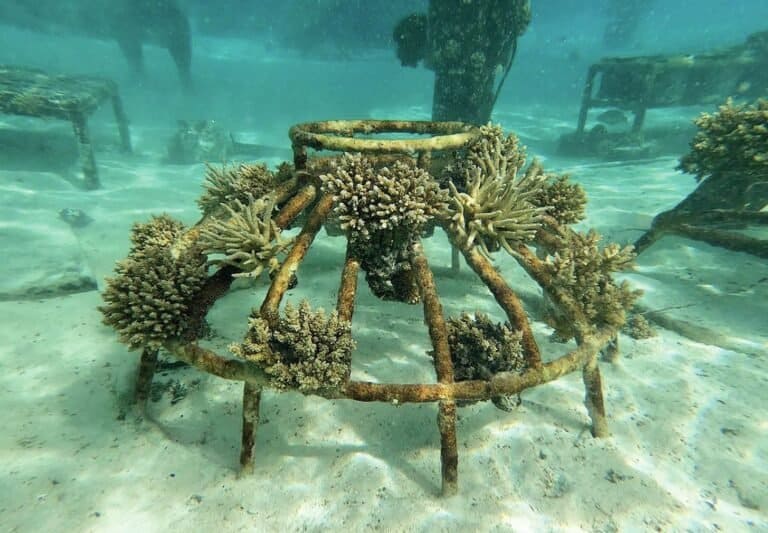
The overview explains the Biorock method in simple terms. It uses low-voltage electrical currents powered by solar energy to promote mineral accretion. Corals are grown on Biorock structures, and when mature, they are transplanted into damaged reef areas to rebuild coral gardens.
This is a different approach from coral nurseries alone. It is an engineered support method for coral growth, tied to a specific site and power system.
2024–2025 expansion and visitor education
The update states that in 2024–2025 the programme expanded restoration efforts to more reef zones in Bora Bora and Taha’a, with several hundred Biorock-grown coral fragments planted.
It also notes education programmes for resort visitors, including learning sessions about reef ecosystems and guided snorkelling tours over restored reef patches. This part is notable because it links restoration to public understanding, not only behind-the-scenes work.
P.R.O.T.E.C.T and wider environmental actions
The programme is described as supported by an environmental charter called P.R.O.T.E.C.T (Eco-Caring Together). The purpose is to link the coral work with waste reduction, biodiversity protection, and sustainable practices across properties.
This does not replace reef restoration. It places it inside a broader operational plan, which is often where long-term results are decided.
Te Mana o Te Moana: sea turtle rehabilitation Tahiti and public education
A move from Mo’orea to Tahiti
Te Mana o Te Moana is described as founded in 2004. The overview says it is now based at the Intercontinental Tahiti Resort & Spa in Faa’a, after moving in June 2023 following 19 years in Mo’orea.
This is a clear organisational update, and it helps readers understand where the work is currently centred.
Sea Turtle Care Centre and outreach
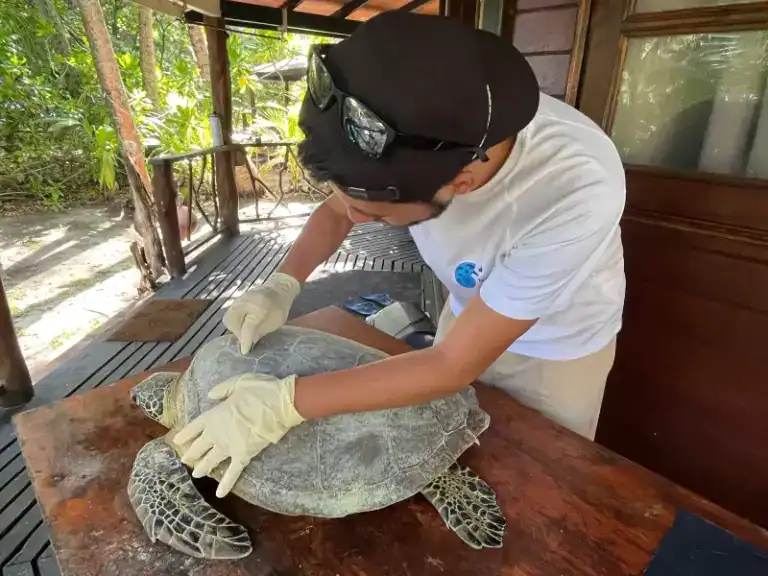
The organisation is described as running a Sea Turtle Care Centre, performing scientific research, and promoting education and awareness. The overview highlights public programmes, guided tours of rehabilitation lagoons, and outreach to schools. It also reports that more than 130,000 children have been educated about marine issues.
It also states that the centre cares for hundreds of injured or at-risk sea turtles each year. This is why “sea turtle rehabilitation Tahiti” is not a side topic here. It is a core part of how marine protection is delivered to the public.
Wider monitoring and clean-ups
The overview adds that the organisation monitors marine mammal presence, supports coral garden installations, and works on plastic waste clean-ups and habitat protection. This suggests a mixed model: animal care, education, and wider ecosystem attention.
Tetiaroa Society: research and restoration on Tetiaroa Atoll
TARP and ecosystem recovery
The Tetiaroa Society is described as active in research, conservation, and education, with the goal of restoring and safeguarding both land and marine ecosystems on Tetiaroa Atoll. It manages the Tetiaroa Atoll Restoration Program (TARP).
The overview lists TARP projects including invasive rat removal, fish and crustacean replenishment, and a Biocode Project aiming to inventory non-microbial species of reef ecosystems.
Programmes named in the update
The overview mentions marine coral reef health programmes, including one described as “Corals: Ecosystem of the Decade”. It also notes a newer effort called Restoring Balance and Building Climate Resilience, focused on restoring lagoon habitats, seabird populations, and using traditional knowledge alongside science.
Partnerships are mentioned, including The Brando Resort, local communities, and global collaborators. The framing is clear: Tetiaroa is being treated as a long-term model site for sustainability work.
Practical context for divers and travelers in Tahiti coral conservation organisations
If you snorkel or dive in Tahiti or Mo’orea, reef protection is not abstract. It can be seen in coral gardens, education sessions, and local clean-up work. The update also shows that many projects depend on careful monitoring, not only on planting.
A practical, safe approach for visitors is simple:
- Do not touch coral or stand on reef.
- Keep good buoyancy control and fin awareness.
- Avoid chasing wildlife, including turtles.
- Do not leave trash, and support clean habits on boats and beaches.
These are small actions, but they match the reality of reef work: reefs are damaged by repeated small impacts as well as large events.
FAQ
What are Tahiti coral conservation organisations in this 2025 update?
They are groups and programmes working on coral restoration, marine protection, monitoring, and education across Tahiti and nearby islands.
What is Coral Gardeners Tahiti known for?
The overview highlights coral nursery planting, tracking and monitoring work, and community-linked restoration, including work connected to Ahé.
What is Biorock Tahiti used for in reef restoration French Polynesia?
The overview describes the Biorock method as using low-voltage currents powered by solar energy to promote mineral accretion, growing corals on structures and then transplanting them to damaged reef areas.
What does Te Mana o Te Moana do for sea turtle rehabilitation Tahiti?
It runs a Sea Turtle Care Centre, supports research, and runs public and school education programmes, while caring for injured or at-risk turtles.
What is the Tetiaroa Society doing on Tetiaroa Atoll?
It manages TARP and other programmes including invasive species work, fish and crustacean replenishment, and reef ecosystem inventory and research projects.
Conclusion
This 2025 snapshot of Tahiti coral conservation organisations shows that reef protection in French Polynesia is being approached in several ways at the same time. Coral Gardeners focuses on planting and reef data. The Biorock Programme combines restoration with a specific growth technique and visitor learning. Te Mana o Te Moana links turtle care with education and public access. Tetiaroa Society runs longer-term research and restoration programmes with broad ecosystem goals.
For general readers, the key point is clear. Coral reefs face real pressure, but the response here is practical work, tracked over time, with community and education built into the process.
Diventures Team is a multidisciplinary team of scuba professionals, editors, and digital creators, producing accurate and experience-driven coverage of diving, marine life, and ocean culture.