

The suspension of SSI by the US Recreational Scuba Training Council has generated plenty of noise across diving forums and social media over the past week. For the vast majority of divers and instructors, though, the practical fallout is close to zero. Here’s a clear breakdown of what’s actually changed — and what hasn’t.
What is the US RSTC?
The US RSTC is a coalition of major training agencies operating in the United States, tasked with setting shared minimum training standards and representing the industry on standards matters. Its current listed members include PADI, IANTD, SEI, RAID, SDI, SNSI and NASE, with PSS as an associate member. Membership in the council is an administrative and governance function — it has no bearing on an agency’s ability to independently certify divers.
What is an ISO standard?
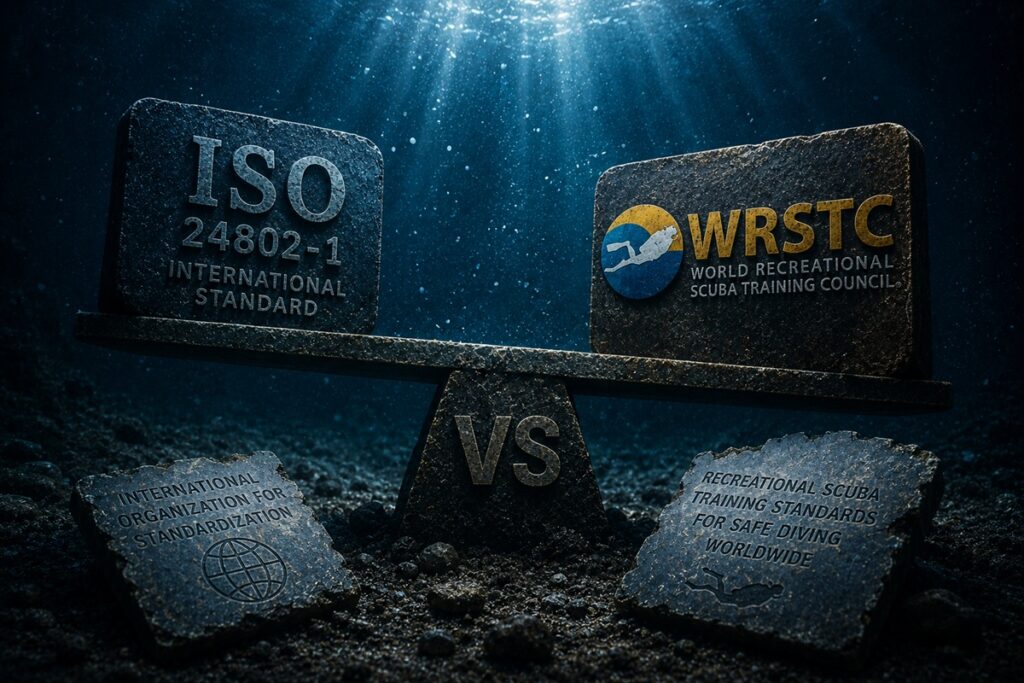
ISO standards are internationally recognised technical benchmarks, developed and maintained independently of the RSTC by the International Organization for Standardization. In diving, ISO standards cover things like instructor-level qualifications and training system requirements. Agencies aren’t required to hold ISO certification, but many major training organisations pursue it voluntarily to demonstrate their programmes meet internationally accepted requirements, alongside whatever regional council standards (like RSTC’s) they also comply with.
Are SSI certifications still valid?
Yes. Neither SSI nor the US RSTC has suggested that existing SSI certifications are affected in any way. Divers holding SSI credentials can continue diving exactly as before.
Can instructors keep teaching?
Yes. SSI has been explicit on this point in its most recent statement, confirming that Training Centres and Professionals can continue delivering all SSI programmes without interruption. SSI also reiterated that it remains fully ISO certified and independently audited, and that all its certifications stay internationally recognised regardless of its US RSTC status.
So what’s the dispute actually about?
According to SSI, the disagreement is narrowly focused on the training standard for the Assistant Instructor level. SSI has operated under ISO 24802-1 (second edition, issued 2014 and reconfirmed in 2024) rather than the RSTC’s own Assistant Instructor standard, which dates to 2002. SSI submitted a revision earlier this year asking both the US RSTC and RSTC Europe to update their standard to reflect the newer ISO benchmark. RSTC Europe accepted the change, with an updated release scheduled for October 1, 2026. The US RSTC did not respond to the submission — and shortly afterward, SSI’s listing disappeared from the council’s published membership page.
Suspension or removal — does it matter?
The two sides don’t even agree on the terminology. The US RSTC has since confirmed the action as a suspension, taken in line with its standard procedures after SSI’s status changed, and says it made no separate public announcement because none was required under those procedures. SSI’s own internal communication to its professionals had described the change as a removal carried out without prior notice. The US RSTC’s statement pushed back directly on that framing, while also noting it has worked with SSI on standards alignment before and remains open to further engagement.
Where does this leave things?
SSI’s CEO, Guido Wätzig, framed the company’s position as one of continued collaboration, stating that as a founding RSTC member, SSI intends to keep pursuing internationally recognised standards through dialogue rather than confrontation. Both organisations have left the door open to a resolution, whether that means reinstatement, a prolonged standoff, or an eventual formal split. Nothing announced so far points to any of those outcomes as more likely than another.
The bottom line
This remains a governance and standards dispute between two organisations — not a diver safety issue, and not a certification validity issue. SSI-trained divers, instructors, and the 4,000+ dive centres operating under the SSI system don’t need to do anything differently.

Mohsen Nabil is the Founder and Editor-in-Chief of Diventures Magazine. A mechanical engineer and scuba diving instructor based in the Red Sea, he writes about diving safety, marine conservation, underwater exploration, and developments in the global dive industry. Through Diventures Magazine, he works to connect divers, scientists, and ocean advocates while promoting responsible diving and protection of the oceans.