

Something is shifting in how the world thinks about diving safety — and Google is picking up the signal.
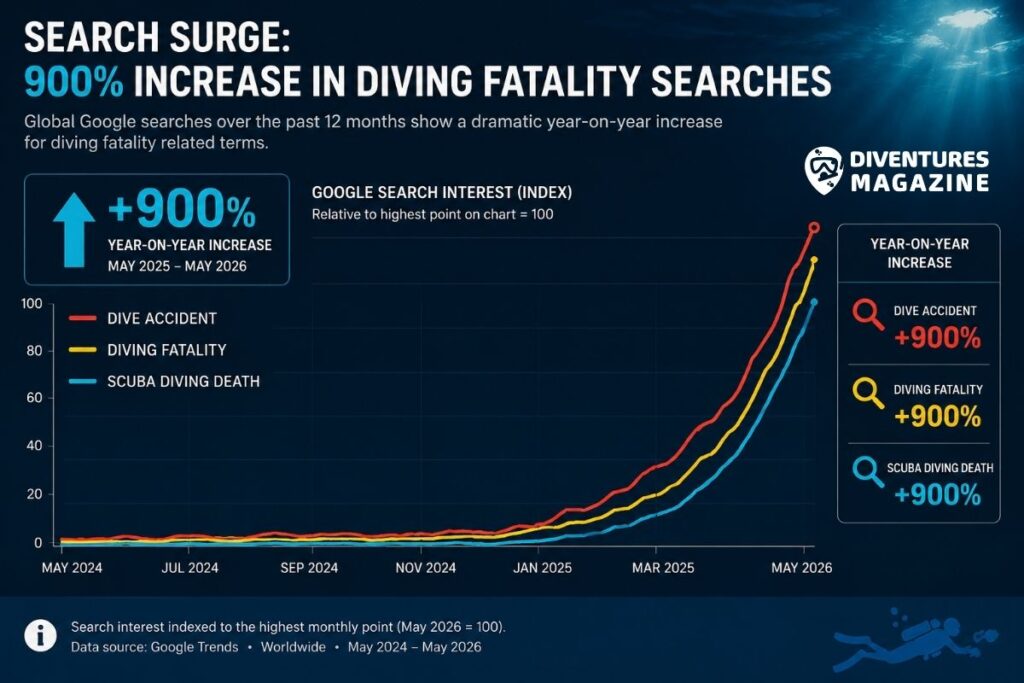
In the twelve months to May 2026, global searches for “dive accident” and “diving fatality” surged 900% year-on-year. “Scuba diving death” followed the same trajectory. These are not small numbers edging upward — they are terms that barely registered a year ago now attracting thousands of monthly searches, with no sign of slowing.
Search data does not lie about intent. When people type these terms into Google, they are not browsing. They are looking for something specific: information after a news event, reassurance before a dive trip, or answers after a loss. The question the data raises is not whether interest in diving fatalities has increased — it clearly has — but why, and what it means for an industry that has long preferred to discuss safety in controlled, institutional terms.
What the numbers actually show
Scuba diving is statistically safer than most people assume. The recreational scuba diving fatality rate has remained relatively steady at around two deaths per 100,000 dives, and DAN identifies over 1,000 diving-related injuries annually, with over 10% being fatal. That is a risk profile comparable to many common outdoor activities. NCBI
Fatality rates of around 16 deaths per 100,000 persons per year among DAN America members and 14 deaths per 100,000 among BSAC members did not change significantly during the period studied — comparable to jogging and motor vehicle accidents. The sport is not getting more dangerous in aggregate. The baseline has been broadly stable for decades.
What has changed is visibility. High-profile incidents in rapid succession — the Maldives cave tragedy that killed five Italian divers and one rescue diver in May 2026, a British couple who died following a diving incident in the Maldives over Christmas 2025, the Fort Pierce fatality, incidents off British Columbia — have created a concentrated media cycle that search engines are reflecting in real time. People are paying attention to diving deaths in a way they were not twelve months ago.
Why drowning is the wrong headline
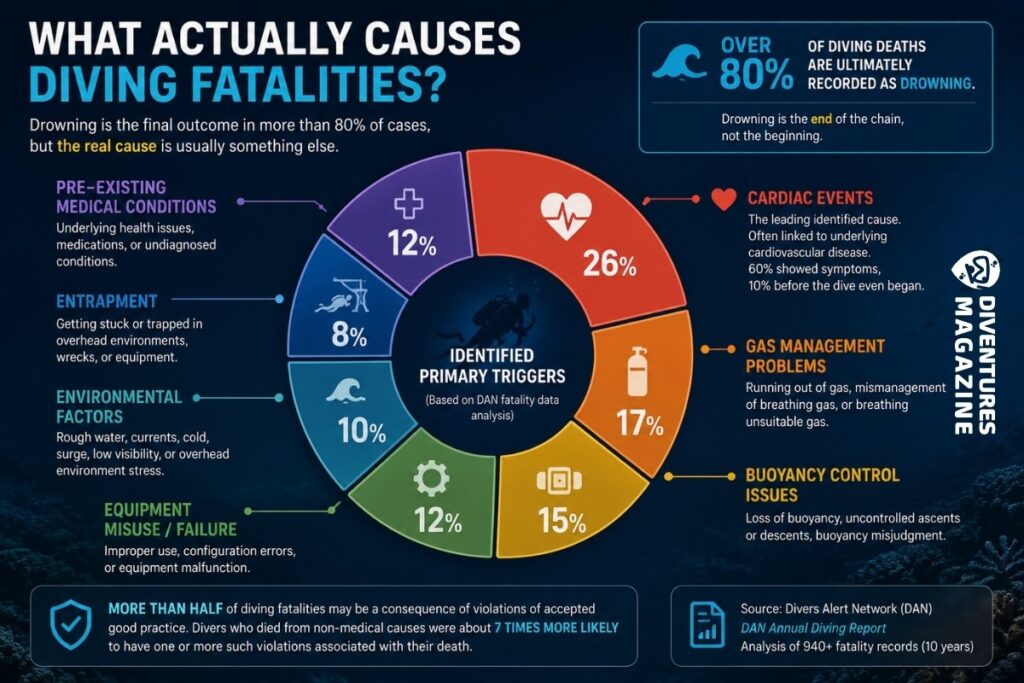
Over 80% of diving deaths are ultimately attributed to drowning on death certificates — but drowning is more a consequence of the medium than the actual cause of death. It usually obscures the real triggering event.
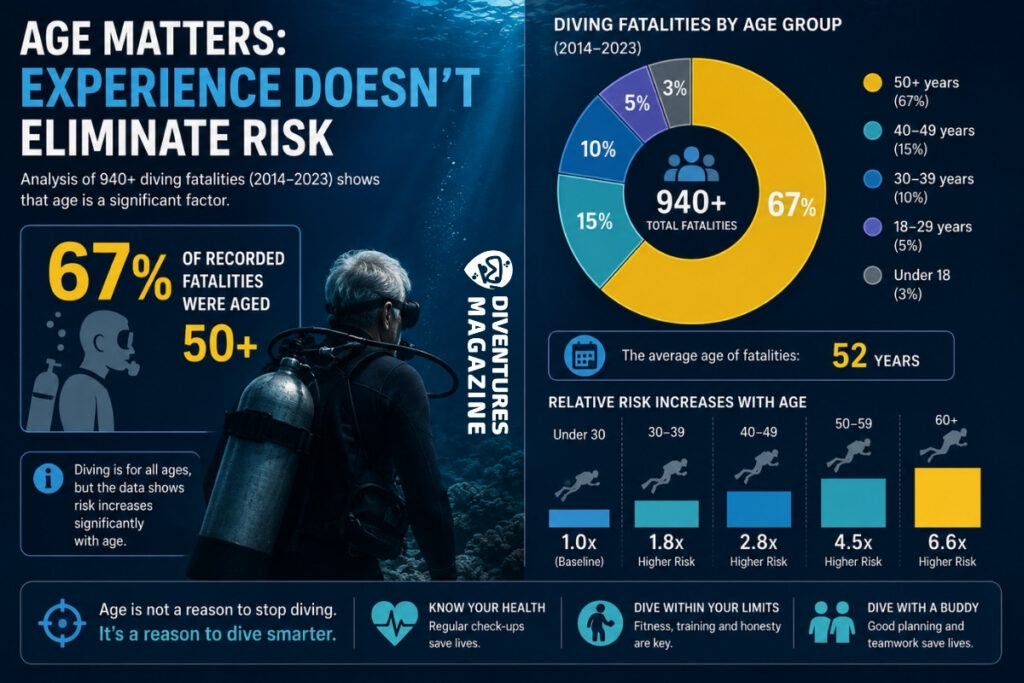
This distinction matters enormously, both for accurate reporting and for prevention. Death usually follows a sequence or combination of events, most of which may have been survivable in isolation. In more than 940 fatality records studied by DAN over ten years, only one-third of the triggers could be identified.
The most commonly identified triggers tell a clearer story. Cardiac incidents accounted for 26% of cases, with autopsy reports usually showing evidence of significant cardiovascular disease. About 60% of those who died from cardiac events displayed symptoms of fatigue, chest pain, or other distress — and in 10% of cases, those symptoms appeared before the dive even began.
Gas management problems, poor buoyancy control, equipment misuse, entrapment, rough water conditions, and pre-existing health problems account for the majority of identifiable causes. More than half of diving fatalities may be a consequence of violations of accepted good practice — and divers who died for non-medical reasons were about seven times more likely to have one or more such violations associated with their death.
The pattern that emerges is not one of a sport with a hidden danger problem. It is one of a sport where a small number of recurring, identifiable, preventable failures keep appearing in the record.
The age question
One of the clearest trends in the fatality data is age. Among recorded fatalities, 67% were aged 50 or older, with an average age of 54. This is not incidental. It reflects both the demographics of who is actually diving — an aging recreational diver population with more disposable income and time to dive — and the physiological reality that cardiac risk increases with age. Divers Alert Network
The industry has responded slowly to this shift. Certification standards were largely designed around younger, fitter bodies. Medical screening before diving varies enormously by operator and destination. In some markets, including parts of the Red Sea region, the gap between formal medical requirements and actual pre-dive screening practice is significant.
What the search surge actually signals
The 900% increase in fatality-related searches is not evidence that diving is becoming more deadly. It is evidence that public awareness of diving deaths has reached a threshold where people are actively seeking information the industry has historically kept largely internal.
When the manner of death is deemed accidental, the incident leading to death is seldom analysed sufficiently to be useful in determining the probable sequence of events — and therefore is not usually useful for improving diver safety. That institutional gap — between what the industry knows about how people die and what reaches the public — is exactly what search behavior is now trying to fill.
For operators, instructors, and training agencies, the surge presents both a responsibility and an opportunity. Divers are asking questions. The organizations best positioned to answer them accurately — with data, context, and practical guidance — will earn trust that advertising cannot buy. Those that stay silent, or respond with reassurance rather than information, will find that silence filled by less reliable sources.
DAN’s Annual Diving Report remains the most rigorous public dataset on recreational diving fatalities. If you are a diving professional concerned about a pattern you are seeing in your own operation, or a diver who wants to understand the risks clearly, it is the place to start.
Have you seen changes in how your dive center or operation handles safety briefings or medical screening in recent years? We want to hear from professionals on the ground. Write to us at in**@***********ag.com

Mohsen Nabil is the Founder and Editor-in-Chief of Diventures Magazine. A mechanical engineer and scuba diving instructor based in the Red Sea, he writes about diving safety, marine conservation, underwater exploration, and developments in the global dive industry. Through Diventures Magazine, he works to connect divers, scientists, and ocean advocates while promoting responsible diving and protection of the oceans.