

Climate scientists have long searched for ways to remove carbon dioxide from the atmosphere without causing further harm to the oceans. Now, a new field experiment involving “green sand” made from the mineral olivine is offering cautious optimism for the future of marine carbon removal.
Researchers behind one of the world’s first real-world marine enhanced rock weathering trials say the experiment showed no detectable harm to marine ecosystems, a key concern surrounding ocean-based geoengineering projects. The findings could mark an important step in the growing field of marine carbon dioxide removal (mCDR), which aims to use the ocean’s natural chemistry to lock away atmospheric carbon for thousands of years.
What Is “Green Sand” and How Does It Work?
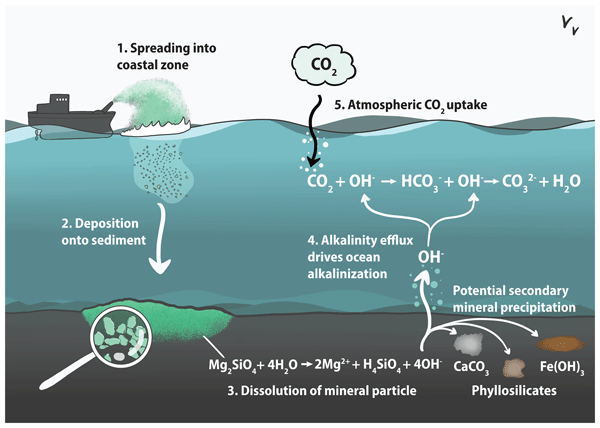
The “green sand” used in the trial is made from finely crushed olivine, a naturally occurring magnesium iron silicate mineral commonly found in Earth’s mantle. When olivine reacts with seawater, it gradually increases alkalinity, helping the ocean absorb more carbon dioxide from the atmosphere.
This process mimics natural geological weathering that normally takes place over millions of years. Scientists are attempting to accelerate that process to help counter rising global emissions and worsening ocean acidification.
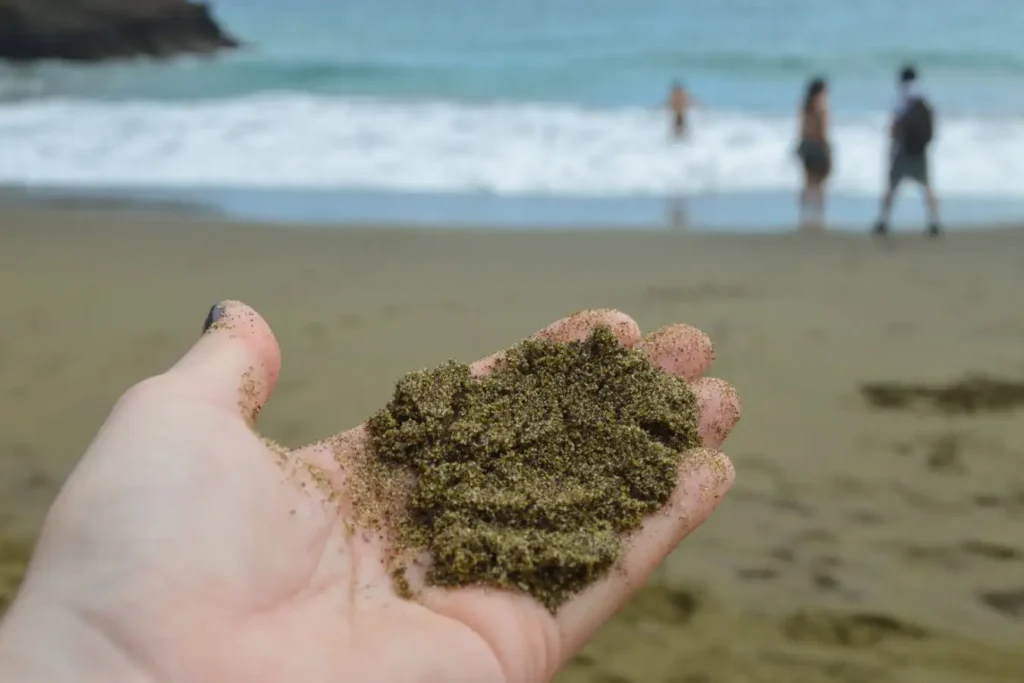
As oceans absorb increasing amounts of atmospheric CO2, seawater becomes more acidic. That chemical shift threatens coral reefs, shell-forming organisms, plankton communities, and broader marine food webs. By increasing ocean alkalinity, researchers hope to both remove carbon and reduce acidification stress.
The concept sounds promising on paper, but marine scientists and environmental groups have repeatedly warned that altering ocean chemistry at scale could produce unintended ecological consequences. Until recently, most evidence came from laboratory simulations rather than open-water testing.
The First Large-Scale Field Trial
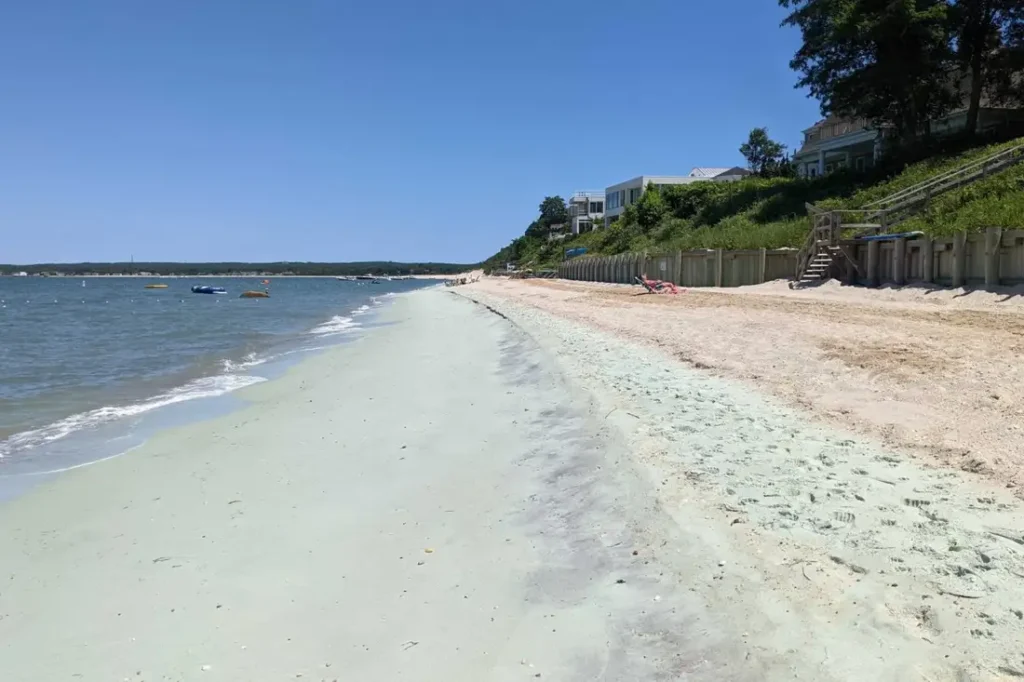
In 2022, scientists conducted a pioneering field trial on a beach in Southampton, New York, where olivine sand was added to a coastal environment to observe how benthic ecosystems responded over time. Researchers monitored marine organisms, sediment chemistry, and possible trace metal accumulation for nearly a year.
The study found that species abundance and biodiversity eventually returned to baseline levels within roughly two months after deployment. Researchers also reported no evidence of dangerous accumulation of metals such as nickel, chromium, cobalt, or manganese, which can naturally occur in olivine minerals.
According to the published findings, shifts observed in marine communities appeared consistent with normal environmental variability rather than direct olivine-related damage. The authors concluded that the trial produced “no detectable adverse effects” on benthic marine ecosystems over seasonal timescales.
Although scientists stress that larger and longer-term studies are still needed, the experiment represents one of the first real-world ecological datasets supporting the environmental viability of marine enhanced rock weathering.
A Parallel Ocean Alkalinity Experiment
At the same time, another major experiment has been testing ocean alkalinity enhancement offshore in the Gulf of Maine. In that project, scientists from the Woods Hole Oceanographic Institution released approximately 65,000 liters of alkaline sodium hydroxide into seawater while monitoring carbon uptake and marine biology.
The trial demonstrated measurable carbon absorption within days, with researchers estimating between 2 and 10 tonnes of CO2 removed initially and potentially up to 50 tonnes over time. Importantly, scientists reported no measurable impacts on plankton, microbes, fish larvae, or lobster larvae during the monitoring period.
Advanced monitoring systems, including autonomous underwater gliders, floating sensors, dye tracers, and satellite observations, helped researchers track the movement and dilution of the alkalinity plume in real time.
For marine researchers, the project demonstrated that carefully controlled ocean chemistry experiments can be monitored with far greater precision than critics initially feared.
Why Marine Scientists Remain Cautious
Despite the encouraging findings, ocean geoengineering remains highly controversial.
Critics argue that short-term field studies cannot fully predict what could happen if these techniques are scaled to industrial levels across entire coastlines or ocean regions. Environmental groups have raised concerns about cumulative ecological impacts, governance challenges, and the risk of relying too heavily on technological carbon removal instead of reducing fossil fuel emissions.
Scientists involved in the projects acknowledge these concerns.
Researchers also note that the full climate effectiveness of these methods depends on lifecycle emissions. Producing, grinding, and transporting alkaline materials requires energy, and those emissions must be accounted for before determining the net carbon removal benefit.
Still, many climate experts believe marine carbon removal research is becoming increasingly necessary as global climate targets drift further out of reach.
The oceans already store roughly 40 times more carbon than the atmosphere and absorb more than a quarter of human CO2 emissions annually. Enhancing that natural capacity could eventually become part of a broader climate mitigation strategy alongside emission reductions, renewable energy, and habitat restoration.
What This Means for Divers and the Marine Industry
For the diving community, the research highlights both the fragility and resilience of marine ecosystems.
Healthy reefs, shellfish habitats, and plankton populations are deeply vulnerable to ocean acidification. In regions such as the Red Sea, where coral reefs support biodiversity, tourism, and local economies, any technology capable of slowing acidification may attract growing attention in the years ahead.
However, divers and marine conservationists are also likely to remain among the strongest advocates for careful oversight. The ocean is not simply a carbon storage system — it is a living ecosystem whose complexity is still not fully understood.
The recent trials do not prove that marine geoengineering is ready for global deployment. What they do provide is something researchers have lacked for years: early field evidence that carefully managed ocean alkalinity experiments may be possible without immediate measurable ecological damage.
For now, the message from scientists is clear: more research, more transparency, and much more monitoring will be essential before green sand and ocean alkalinity enhancement move from experimental science into large-scale climate policy.

Mohsen Nabil is the Founder and Editor-in-Chief of Diventures Magazine. A mechanical engineer and scuba diving instructor based in the Red Sea, he writes about diving safety, marine conservation, underwater exploration, and developments in the global dive industry. Through Diventures Magazine, he works to connect divers, scientists, and ocean advocates while promoting responsible diving and protection of the oceans.