

Let’s be completely honest about what is happening in the diving industry right now: we are failing the consumer, undermining our own market sustainability, and choking out future growth — because too many professionals are behaving like religious zealots instead of business operators and educators.
One of the most frustrating — and frankly pathetic — trends I have watched develop over the decades is how quickly any conversation stops being about the actual mechanics of diving and starts being about the piece of plastic in your wallet.
Mention one training agency, and people affiliated with another react as if you just insulted their mother. Interview an instructor from one system, and someone immediately demands to know why their logo wasn’t featured. Try to have a serious, data-driven discussion about deteriorating standards, unsafe student-to-instructor ratios, or the systemic decline of the industry — and the response is rarely “Is this true?” Instead, it’s “What side are you on?” Some agencies even demand absolute loyalty and actively move to punish instructors who step out of line.
That’s not a diving problem. That’s a human defect.
To be fair, agencies didn’t build brand communities because they’re evil. They built them because belonging is one of the most powerful drivers of customer retention ever discovered. A diver who identifies with a tribe is more likely to continue training, attend events, travel, buy equipment, and remain active in the sport. The problem isn’t building communities. The problem begins when protecting the community becomes more important than pursuing the truth.
The Psychology of the Shortcut
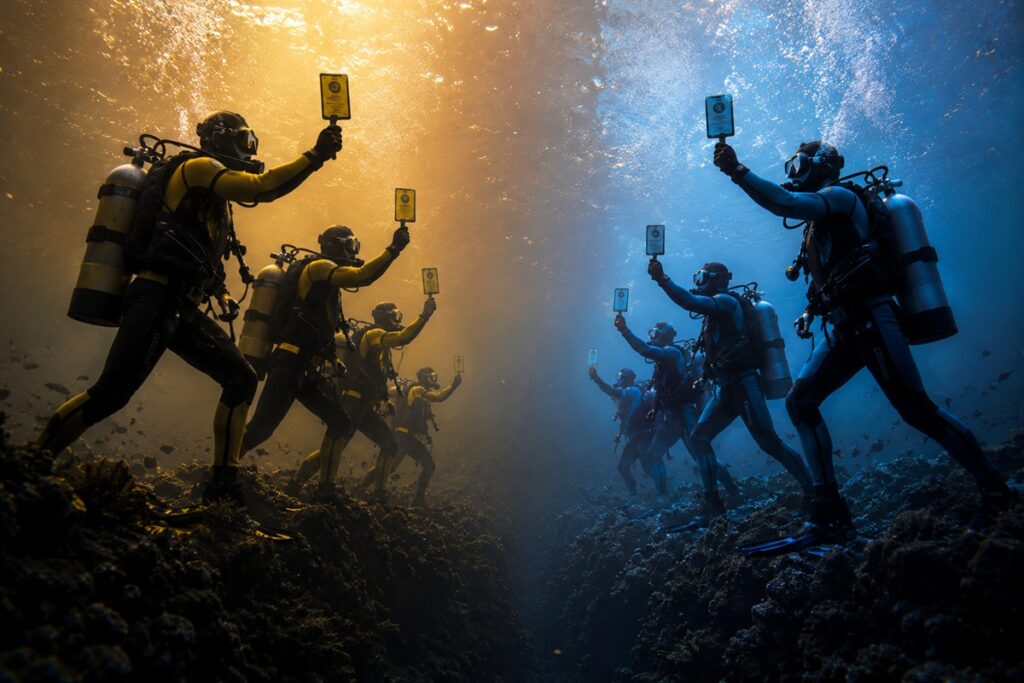
From a purely clinical marketing perspective, tribalism isn’t a bug — it’s a feature. For most of human history, belonging to a tribe wasn’t a lifestyle choice; it was survival. Step outside the tribe, and you died. Modern corporate marketing didn’t invent that primal instinct; it simply figured out how to monetize it.
A tier-one brand is nothing more than a psychological shortcut for identity. Harley-Davidson isn’t selling motorcycles; it’s selling the illusion of freedom to middle-aged accountants. Apple isn’t selling computers; it’s selling creative superiority wrapped inside a closed ecosystem engineered to manufacture belonging.
In our world, the major agencies are rarely viewed as what they actually are: administrative, publishing, and business service bodies. For a significant segment of divers and instructors, the agency logo becomes a proxy for self-worth.
When it works, it’s powerful. It builds community, drives customer acquisition, and makes a student feel they belong to something larger than a weekend pool session.
There is a concept from behavioral psychology that explains this with uncomfortable precision: identity-protective cognition. The theory holds that people don’t evaluate facts on their merits. Instead, they unconsciously filter evidence through the lens of their social identity. If accepting a fact threatens the group they belong to — or the identity they’ve built around that group — they become far more likely to dismiss, reinterpret, or rationalize the evidence away. The discussion is no longer about whether the information is accurate. It becomes about whether accepting it would feel like a betrayal of the tribe.
That is why two experienced instructors can read the exact same standards document and walk away with completely different conclusions. It isn’t always because one lacks the ability to understand what’s on the page. It may be because one interpretation reinforces their identity while the other challenges it. At that point, the debate stops being about standards and starts being about self-preservation. It also explains some of the more revealing reactions we’ve seen recently — responses to industry lawsuits, to agencies quietly dropping off RSTC rosters, and to much else besides.
The most dangerous thing about identity-protective cognition is that it doesn’t feel like bias. It feels like objectivity. People genuinely believe they are following the evidence when they are, in reality, protecting the identity they’ve invested in. They aren’t bad people. They simply cannot see what’s happening outside the cave their tribe is in.
But when that dynamic becomes dogmatic, it turns into absolute poison.
The moment a commercial brand replaces personal identity, any critique of the brand is processed as a personal assault. A cold-eyed business analysis of training quality becomes a betrayal. A comparative breakdown of standards becomes heresy. People stop defending safety, physics, and logic — and start defending flags.
Healthy Competition vs. Primal Tribalism
Let’s look at this through a strategic business lens. Healthy market competition is vital. Agencies should be competing against one another — ruthlessly, if necessary. But they should be competing on the quality of their educational materials, the rigor of their instructor development, customer service, business innovation, and above all, the safety and competence of their graduates. That kind of competition forces the entire market upward.
Tribalism does the exact opposite.
Competition says: We built a better system, and our metrics prove it.
Tribalism says: We are superior simply because of who we are, and everyone else is an idiot.
That distinction is costing us money. And it is costing us divers.
The industry is bleeding. Customer retention is abysmal. Retail margins have been cannibalized for decades. Instructors are chronically underpaid, treating a high-liability profession like a low-wage hobby. Yet instead of fixing the leaky bucket, the industry behaves as if the enemy is the shop across the street or the agency across the aisle.
It isn’t.
The real enemy is diver attrition. We have become extraordinarily efficient at factory-farming entry-level certifications — and completely inept at creating lifelong, active divers. We teach people to buy into a brand before they have accumulated enough water time to understand their own buoyancy characteristics.
If your agency’s business model or training standards cannot survive blunt questioning, rigorous comparison, and public scrutiny, then what you have isn’t a professional standard. It’s a cult. And this industry needs far less brand worship and a great deal more adult conversation.

Physics Doesn’t Care About Your Logo
Let’s strip away the corporate marketing veneer for a moment. No agency owns the ocean. No executive invented buoyancy, decompression theory, or gas management. Agencies package, standardize, market, and insure training systems. That is a legitimate and necessary business function. But let’s not confuse the distributor with the product.
The product is a competent diver.
We need to radically reorder where our loyalty sits in this industry. If this hierarchy offends your corporate sensibilities, then you are part of the problem:
- First loyalty: Diver safety and uncompromising competence.
- Second loyalty: The long-term health of the global diving community.
- Third loyalty: Professional and personal integrity.
- Fourth loyalty: The logo on your shirt — and only if it has earned the first three.
The best instructors I have ever worked with are intellectually independent. They can tell you exactly why they teach a specific skill a certain way, and the answer is grounded in physics and physiology — not because a manual told them to. To borrow a phrase I’ve heard Edd Sorenson use with his students more times than I can count: they teach the why behind the how.
They can look inward, or among a trusted circle of peers, and criticize their own agency when it drops the ball. They can openly adopt a better technique from a competitor without feeling personally threatened.
Instead of cultivating that kind of professionalism, the dive industry actively works to suppress it. Those in positions of power are deeply uncomfortable with robust conversations they cannot control. They weaponize “ethical standards” and “professional conduct” policies, deploying them as levers to silence open, critical discussion that might rattle the foundations of the corporate confidence game.
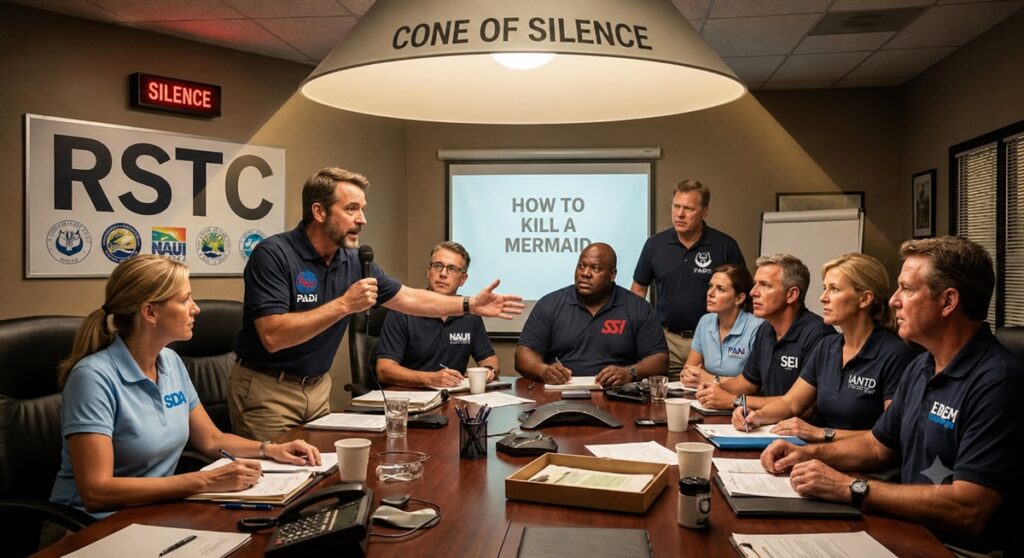
Ask yourself: why does the RSTC — whose core mission is supposed to be establishing baseline safety standards — weigh in on an industry-wide code of conduct designed to restrict freedom of expression? Most major agencies have installed their own version of exactly the same muzzle.
There is a nuance worth acknowledging here. Some instructors are too easily drawn toward weaponizing fear, uncertainty, and doubt — making unsupported, reckless claims about competing agencies or peers. That is genuinely wrong, and it is a legitimate problem. But the deeper truth is that the industry depends on blind consumer trust to sustain its current economic model. Anything that breaks the illusion is treated as an existential threat.
It’s too late for that. As the documentary How to Kill a Mermaid continues to gain traction, the confidence game is crumbling — and industry leadership knows it.
The weakest people in this industry hide behind logos. The strongest stand entirely on their own merit.
It is time for a collective reality check. We operate in an environment where human life depends entirely on equipment, discipline, and split-second judgment. The ocean is the ultimate equalizer, and it is entirely indifferent to marketing budgets.
Physics isn’t tribal. Gas planning isn’t tribal. Decompression stress doesn’t check your certification card. An out-of-air diver at ninety feet does not care about the logo on your rash guard.
It’s time to grow up, drop the tribal posturing, and focus on the only metric that actually matters: the diver.
Because the point was never the card. The point was always the dive.
If you genuinely want to look after this industry, start by looking after the diver. Are we doing that — or are we too busy fighting like a pack of wild dogs over the contents of a dumpster?
Yours in diving,

Founder, Deep 6 Gear | Training Director, SNSI
Chris Richardson is a diving industry leader, military veteran, and the founder of Deep 6 Gear. An elite Instructor Trainer and Course Director for SDI, TDI, ERDI, and NAUI, he specializes in technical, cave, and public safety diving. With an MBA and a history of shaping global standards on the NAUI and RSTC boards, Chris currently serves as the US/Canada Training Director for SNSI and is an SSI Platinum Pro 5000 recipient.