

For most divers, the sea is explored within clear limits. Depth stays within recreational ranges, dives happen in daylight, and a direct ascent to the surface is always possible. Equipment is simple, and gas planning is built around one cylinder of air or Nitrox.
Technical diving is different. It is diving that accepts planned complexity. It includes deeper dives, staged decompression, multiple gas mixes, and environments where you cannot go straight up. The aim is not only to go deeper. The aim is to go further, stay longer, and manage risks in a controlled way.
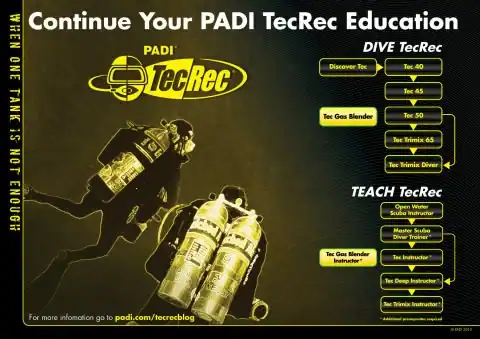
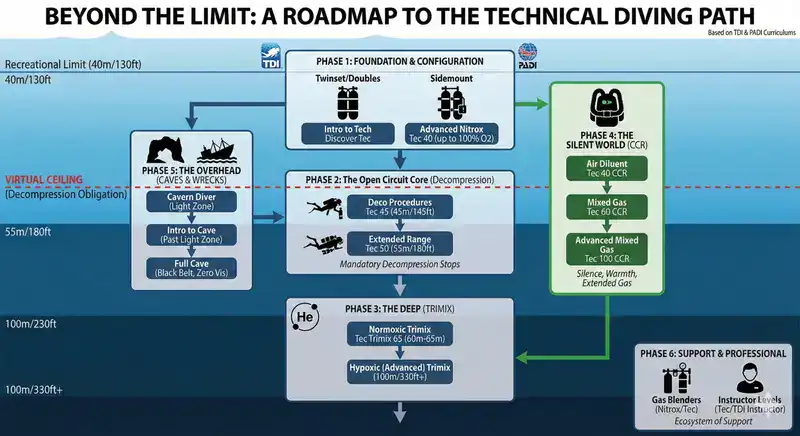
This transition is not about buying more equipment. It is a change in mindset. Technical training asks a diver to become precise, calm, and consistent. It requires strong foundational skills, clear teamwork, and careful planning. This article maps the learning path, using examples from the structured training routes of major agencies, including TDI and PADI.
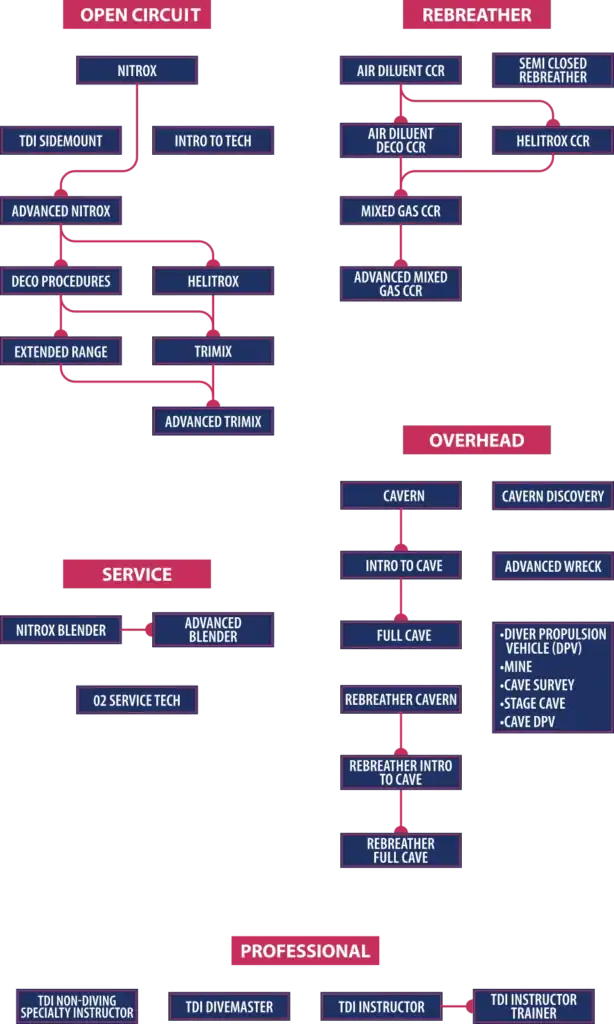
What “technical diving” means in practice
Technical diving is often defined by two conditions:
- A decompression obligation, where you must stop during ascent to reduce risk of decompression sickness.
- A ceiling, where you cannot make a direct ascent. This ceiling can be “virtual” (decompression stops) or physical (caves, wrecks, ice).
In technical diving, time, depth, gas, and equipment are planned as a system. The main question changes from “How long is my dive?” to “What is my plan if something fails at the worst moment?”
Phase 1: Foundation and equipment configuration
Buoyancy, trim, and control become non-negotiable
Many experienced recreational divers feel confident until they enter an entry-level technical course. Early technical training often feels like a fundamentals test. The goal is simple: stable buoyancy, clean trim, and controlled movement in the water.
In a wreck or cave, poor trim can stir silt and remove visibility. In any technical dive, poor control increases workload and stress. It can also increase breathing effort and raise carbon dioxide levels. This can affect judgment and increase risk.
The shift to redundancy
Recreational diving often relies on single solutions: one mask, one regulator system, one cylinder. Technical diving uses redundancy because the plan assumes that failures can happen.
Two common configurations are introduced early:
- Twinsets (doubles): two back-mounted tanks connected by an isolation manifold. A diver can isolate a leak and keep part of the gas supply.
- Sidemount: cylinders carried on the sides. It offers flexibility, easier valve access, and a lower profile in restricted spaces.
This phase also includes learning how to set equipment up in a consistent way. The goal is to reduce confusion when stress is high.
Task loading and problem management
A key training method is controlled overload. Students handle multiple problems at once, such as mask issues, regulator free-flow, and gas sharing. The purpose is not to make the diver panic. The purpose is to build a habit: pause, control breathing, think, then act.
This is where many divers learn the core difference between recreational and technical diving. Technical diving is not about reacting fast. It is about reacting correctly.
Phase 2: Open-circuit decompression and staged ascent
Crossing the “virtual ceiling”
In recreational diving, the surface is the default safety option. In decompression diving, it is not. Once a diver has a planned decompression obligation, a direct ascent is no longer safe. The diver must follow a schedule of stops to reduce risk.
This is sometimes described as a “virtual ceiling.” There is no rock above you, but the plan requires that you stay at depth levels for set times. The dive becomes a time-managed project, not a simple swim.
Stage bottles and gas switching
At this stage, divers often carry additional cylinders called stage bottles. These are not extra “bottom gas.” They are usually decompression gases, carried to make decompression more effective.
This introduces a serious hazard: breathing a high-oxygen mix too deep can cause oxygen toxicity and a convulsion. Training therefore focuses on a strict gas switch protocol. The diver verifies the correct cylinder, the correct gas, and the correct depth, and confirms with the team before switching.
In technical diving, “I think” is not acceptable. The diver must know.
Practical outcomes at the end of this phase
By the end of this stage, a diver is trained to plan decompression, manage more than one gas, and maintain control during ascents that may be long, cold, and exposed to currents. These dives require discipline, because small errors can accumulate.
Phase 3: Trimix and deeper technical diving
Why helium changes the dive
As depth increases, breathing air becomes a limiting factor. Nitrogen narcosis can reduce clear thinking, and gas density increases breathing effort. These effects can increase stress and reduce performance.
Trimix courses teach divers to replace part of the nitrogen with helium. Helium is less narcotic and can reduce gas density. The aim is to keep the diver functional and stable at greater depth.
Normoxic and hypoxic trimix
Trimix training is often discussed in two broad categories:
- Normoxic trimix: the mix has enough oxygen to be breathed at the surface. It supports deep dives with a clearer head than air.
- Hypoxic trimix: oxygen content is reduced to manage oxygen exposure at extreme depth. This creates a new risk at the surface: the bottom gas cannot support breathing in shallow water. Divers use travel gas and strict switching procedures.
At this phase, gas planning becomes a logistics system. Divers may manage several gas mixes, each with a defined purpose. Planning errors are not minor. They can be fatal.
Phase 4: Closed-circuit rebreathers (CCR)
How CCR diving works
Open-circuit scuba wastes most of each breath into the water. A closed-circuit rebreather recycles the diver’s gas. It removes carbon dioxide using a scrubber, then adds oxygen to maintain the desired oxygen level.
This changes the approach to gas supply and decompression. A rebreather can support long dives with smaller cylinders, which is one reason it is used for deep exploration and long-range projects.
Benefits and risks
CCR systems can offer practical advantages: longer duration and quieter operation. But the risk profile is different. A rebreather is a life-support machine that must be managed continuously.
Failures can be complex. Problems related to oxygen levels and carbon dioxide management can develop quickly and may not feel obvious at first. Training therefore places heavy emphasis on monitoring, checklists, and bailout planning.
A CCR diver is trained to assume that the machine can fail, and to carry a solution to get home safely.
Phase 5: Overhead environments: caves and wrecks
Technical diving is not always about depth
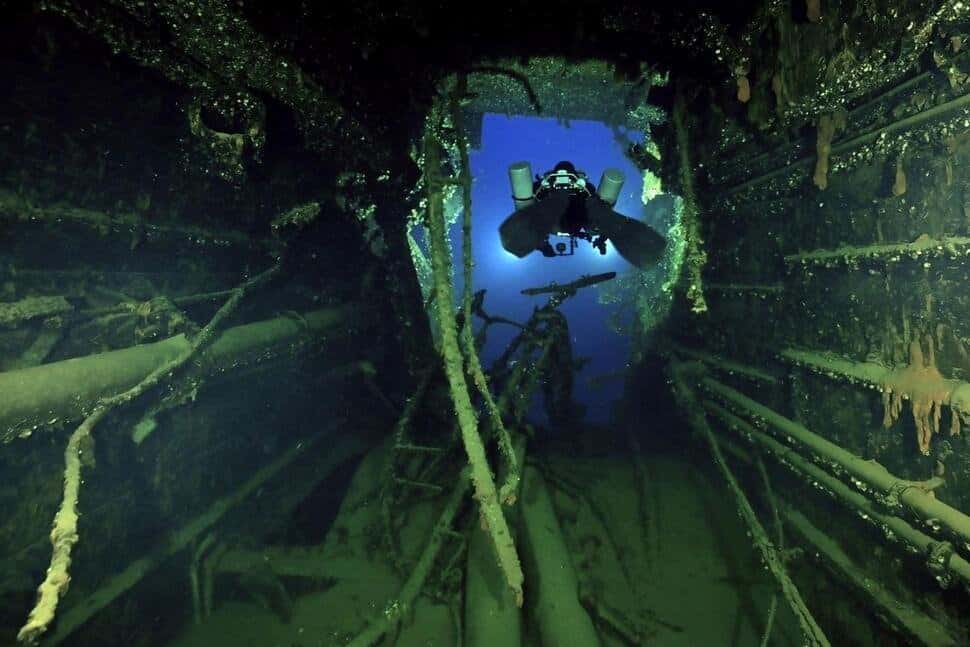
An overhead environment is a place where a direct ascent is impossible. The risk comes from distance to the exit, navigation complexity, and the need to manage gas with strict rules.
Training often progresses through stages:
- Cavern training: staying within the light zone and learning line work and anti-silt finning.
- Intro cave or basic overhead: moving beyond the light zone on a main line and using strict gas management, often described as the rule of thirds.
- Full cave or advanced overhead: complex navigation and problem solving in low or zero visibility, including lost line and entanglement drills.
The central skill here is stress control. In an overhead environment, panic turns small problems into major ones.
Phase 6: The support ecosystem: gas blending and instruction
Gas blending is part of technical safety
Technical diving depends on accurate gas mixing. A small error in oxygen content can create serious danger. This is why gas blender training exists. It focuses on precision, cleanliness, and correct handling of high-oxygen systems.
For many technical divers, learning the basics of gas theory and blending also improves their ability to check fills, ask better questions, and plan with more confidence.
Technical instructors as gatekeepers
Technical instructors have a different role from recreational instructors. The training environment includes higher consequences and more complex decision-making. Good instruction includes skill coaching, but also judgment about readiness.
A key part of technical culture is knowing when to stop and when to delay progression. A certification card is not the goal. Competence is the goal.
Practical context: how to plan your path without rushing
If you are considering technical diving, these steps keep the process realistic:
- Audit your fundamentals first: buoyancy, trim, propulsion, and calm problem-solving.
- Choose a structured progression: avoid jumping to deep training before you are stable in earlier steps.
- Treat equipment as a system: standardise setup and practise emergency drills until they are automatic.
- Build experience between courses: training is not the same as mastery.
- Stay conservative: technical diving rewards discipline, not boldness.
The best technical divers are not the ones who chase depth. They are the ones who plan well and keep control when conditions change.
FAQ
What is the main difference between recreational and technical diving?
Technical diving includes planned decompression, multiple gas mixes, and diving where a direct ascent may not be possible.
Do I need twinsets or sidemount to start technical training?
Many entry-level technical courses introduce twinsets or sidemount, because redundancy and valve management are key technical skills.
Why do technical divers carry stage bottles?
Stage bottles often carry decompression gases. They support safer and more effective decompression when used with strict gas switch procedures.
What is trimix used for?
Trimix adds helium to reduce narcosis and manage breathing effort at greater depth, depending on the training level and dive plan.
Is CCR safer than open circuit?
CCR can support longer dives with smaller gas supplies, but it introduces different risks. Safe CCR diving depends on strong training, strict monitoring, and reliable bailout planning.
Conclusion
Technical diving is a structured path built on control, planning, and discipline. The progression typically starts with precise fundamentals and redundant configurations. It moves into decompression diving and strict gas procedures, then into deeper diving with helium-based mixes. For some divers, it extends into CCR systems and overhead environments, where planning and stress control become even more important.
This path is not for everyone, and it should not be rushed. But for divers who enjoy precision and serious preparation, technical diving offers access to environments and projects that demand a higher standard of skill and teamwork.
Diventures Team is a multidisciplinary team of scuba professionals, editors, and digital creators, producing accurate and experience-driven coverage of diving, marine life, and ocean culture.