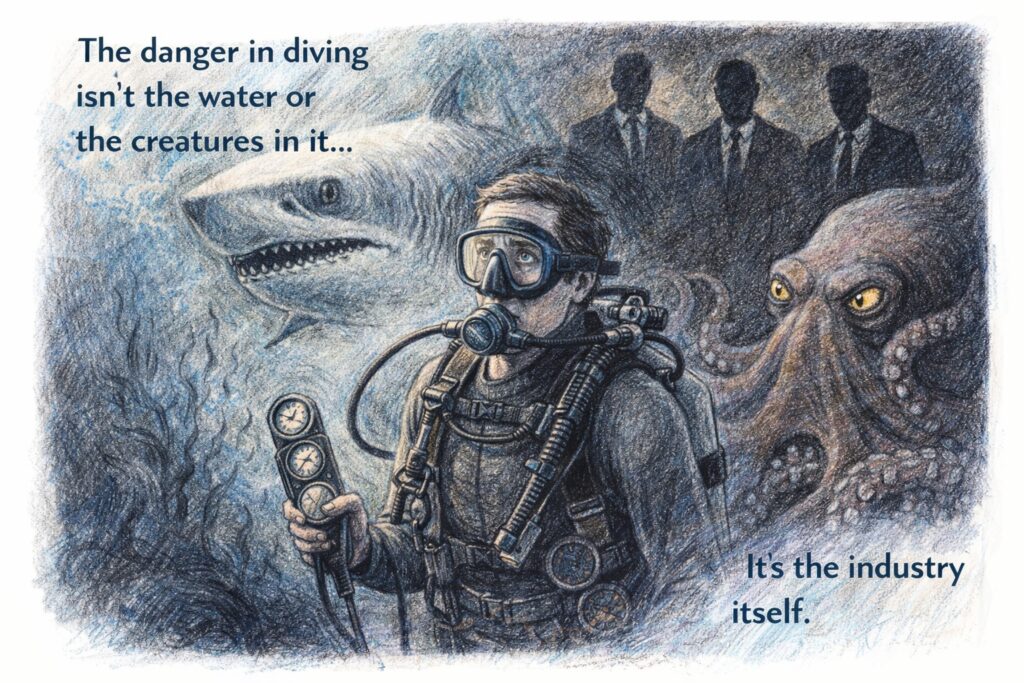

As 2025 comes to a close, I want to speak directly to people in the dive industry under 40.
I landed in Grand Cayman in 1995, the same month Rodale’s Scuba Diving ran the “Cayman Cowboys” article. Most of the people in that piece ended up being my friends and peers. And yes, I was one of them.
Not the cartoon version people later got offended by. The real version. A group of instructors who came up when becoming an instructor was hard, when you earned your place, when you were expected to actually know what you were doing before you were turned loose on students.
That matters, because the industry did not evolve away from that model.
It walked away from it.
Let’s Stop Pretending the Scuba Industry Business Model Is “Struggling”
It’s not struggling. It failed.
Aqualung proved it.
When the oldest, most globally penetrated scuba brand, one of the few that still held margin and credibility, gets bought out of bankruptcy, that is not normal consolidation. That should have been the moment where everyone stopped and said, “Okay… what are we doing?”
Instead, most people shrugged and said, “This happens.”
No. It doesn’t.
If Aqualung can’t survive under the current economics, then the conclusion is simple. The industry no longer supports the kind of companies it used to need to stay healthy. So new models must emerge, and yes, they will be attacked by the existing model.
If you know me, you will know that is my story in many ways, but truth is I was early, and early is a bad place to be. Now, it isn’t early. It’s a rapidly closing window for those in the industry under 40.
Anything else is denial.
Consolidation Isn’t a Fix, It’s Buying Time
Yes, Head owns Mares, SSI, and now Aqualung.
That stack can buy time. SSI throws off cash. Mares has steady lines. Aqualung still has brand weight.
But let’s be honest: this isn’t renewal. It’s survival. It’s last-man-standing stuff in a shrinking industry.
At best, it buys maybe twenty years. It does not rebuild the ecosystem.
And by pretending this is “business as usual,” it actually delays the reset that might have allowed something better to emerge.
I Became a Dive Instructor When You Were Built, Not Processed
When I became an instructor, you didn’t do a six-day course after clicking through slides online.
You spent real time as a Divemaster. You assisted real classes. You logged real dives. You went through long, demanding instructor programs. You didn’t teach much at first. You got mentored before you got trusted.
The guys in Cayman Cowboys were doing 800, 900 dives a year. They weren’t dangerous. They were experienced.
They weren’t cowboys because they were reckless. They were cowboys because they didn’t need a checklist to think.
That scared the hell out of institutions.
Cayman Didn’t Follow the Shift, It Led It
Cayman was ground zero for the push to make diving family-friendly, to bring kids in young, to funnel cruise ship volume into short, low-friction experiences, to reduce barriers, to sell the idea that “anyone can do this.”
CIWSA, tourism boards, agencies, trade groups, and the wider industry all pushed the same logic: if we make it easier and safer, more people will dive.
More people did dive.
But the meaning drained out.
And with it went instructor identity, career viability, pride, and aspiration.
We didn’t make diving better.
We made it ordinary.
Here’s the Part Nobody Likes Hearing: Safety Didn’t Improve
We have better gear. No argument. Computers, redundancy, gas analysis, better models.
And yet the outcome has not changed the way we tell ourselves it has.
That is not bad luck.
That is what happens when training gets shorter, mentorship disappears, and experience gets replaced by throughput.
Technology covered for declining competence, until it couldn’t.
Certification Agencies Took Volume, Everyone Else Took the Risk
Let’s stop dancing around this.
Certification agencies scaled by volume. Shorter courses. Lower barriers. Digital delivery. Margins protected.
Shops and instructors absorbed the liability, the student failure, the reputational damage, and the training debt.
That’s not an accident. That’s a gatekeeper model extracting value while pushing risk downstream.
Call it what you want.
It hollowed out the profession.
When Diving Tried to Be for Everyone, It Became Forgettable
You can’t market something as special and effortless at the same time.
When you tell people, “Anyone can do this… kids, grandparents, vacationers,” you get volume.
But you lose mystery. You lose aspiration. You lose identity.
People don’t dream about things presented as trivial.
And young, capable people stopped seeing diving as a career, not because it was hard, but because it was boring, underpaid, and stripped of meaning.
A Red Sea Note: Comfort, Confidence, and the Long-Term Diver
One regional note, from the Red Sea, helps show how these forces look in practice.
The Red Sea is a busy, international destination. Many guests arrive with strong excitement and limited time, and it is normal for people to want progress quickly. In that kind of market, the pressure always leans toward speed and simplicity.
The issue is not any one group of divers. It is what happens when experience does not have time to catch up with ambition. When training is compressed, some divers become certified but still feel uncertain underwater. They may do fine in calm conditions or with close supervision, yet they are not fully comfortable and confident on their own.
Comfort and confidence are not “nice extras.” They are safety tools. A calm diver makes better decisions, has better awareness, and manages surprises with less stress.
Comfort and confidence also build the business in a way that lasts. Divers who feel capable tend to continue. They take more training, invest in equipment, and stay connected to the community. Divers who feel stressed or “carried” often step away after the trip, even if they loved the destination.
The Red Sea also attracts divers who enjoy challenge and adventure, and that is part of diving’s nature. The key is to match adventure with solid education and mentoring, so confidence is built on skill, not luck.
To Those in Your 20s and 30s: This Industry Can Be Yours
If you’re in this industry at your age, you’re not stupid. Something about diving still grabbed you, even after we sanded the edges off it. So make it yours.
Hear this from someone who has been an instructor, sat on boards, built brands, and actually understands the business side.
This industry is yours if you’re willing to take it.
But not by following the rules we broke it with.
Compressed training sold as “accessibility” did not save diving. Volume dressed up as professionalism did not save diving. Box-checking instead of competence did not save diving. Instructors treated as disposable did not save diving.
Those things slowly killed it.
Demand excellence, even when it costs you.
There is no sustainable career at the bottom of a race to the bottom.
You don’t win by being cheaper.
You win by being worth it.
Find mentors, not gatekeepers. Find people who help you manage risk, not pretend it doesn’t exist. Avoid anyone who insists you fit into the narrow box they built while the industry was already dying.
And understand this clearly: the old business model is dead. Gear margins are gone. Volume doesn’t save you. Consolidation doesn’t create opportunity.
Your value is mastery, judgment, trust, and experience.
Price those in, or don’t bother.
Make Diving Hard Again, in the Right Way
Not unsafe. Not reckless.
Meaningfully hard.
Hard enough that finishing means something. Hard enough that people are proud of it. Hard enough that it changes who they are.
People don’t commit their lives to easy things.
They commit to things that matter.
Final Thought: The Scuba Industry Doesn’t Need Saving. It Needs Honesty.
Aqualung wasn’t a fluke. It was proof.
Until we admit the old model is dead, not struggling, the industry will keep managing decline instead of building something new.
Diving doesn’t need more people.
It needs meaning back.
And yeah, we probably need the Cayman Cowboys again.

Christopher E. Richardson
Fundador, Deep 6 Gear | Director de Formación, SNSI
Chris Richardson es un líder de la industria del buceo, veterano militar y fundador de Deep 6 Gear. Formador de Instructores de élite y Director de Cursos para SDI, TDI, ERDI y NAUI, está especializado en buceo técnico, en cuevas y de seguridad pública. Con un MBA y un historial de formación de normas globales en los consejos de NAUI y RSTC, Chris es actualmente Director de Formación para EE.UU. y Canadá de SNSI y ha recibido el SSI Platinum Pro 5000.