
Divers have recovered artifacts from the wreck of the Britannic, the sister ship of the Titanic, for the first time since it sank in 1916. The recovery was announced by Greece’s Culture Ministry in mid-September 2025, after a weeklong deep-diving operation carried out in May.
For general readers, this is not only a ship story. It is also a story about how underwater heritage is handled today. The Britannic lies deep, in difficult conditions, and the objects brought up need careful conservation before the public can see them.
The items recovered include the ship’s bell and a port-side navigation light, plus smaller objects linked to both the ship’s hospital role and its original passenger design. They are now being conserved in Athens and are expected to become a key part of a new Museum of Underwater Antiquities planned for the port of Piraeus.
What happened in May 2025
A weeklong recovery operation
Greece’s Culture Ministry said an 11-member deep-sea diving team worked on the wreck for one week in May. The team recovered objects from inside and around the ship, then brought them to the surface for transport to Athens.
The Ministry also noted that the work was not easy. Currents and low visibility made access and handling more challenging than many people imagine when they think of a shipwreck.
The role of technical diving
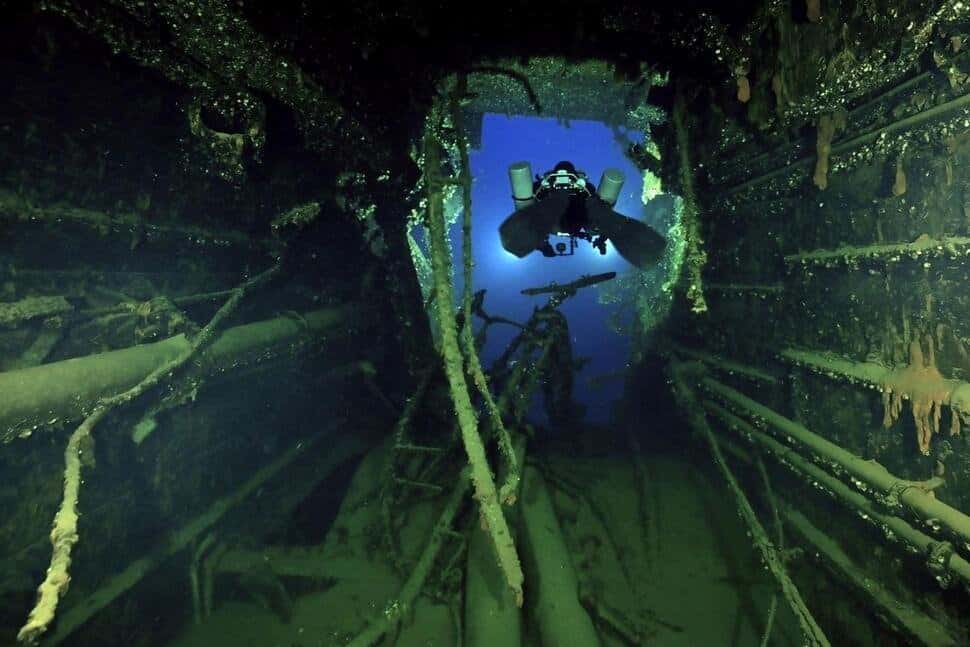
The wreck lies at about 120 meters (nearly 400 feet). At that depth, normal recreational scuba does not apply. The recovery required technical divers using closed-circuit rebreathers, which allow long and controlled bottom time and staged decompression.
According to the Ministry statement, the recovery operation was organized by British historian Simon Mills, founder of the Britannic Foundation.
What artifacts were recovered
Key items: bell and navigation light
Among the main objects raised were the ship’s lookout bell and the port-side navigation light. These are iconic items because they are direct, physical identifiers of the ship and its working systems.
Objects that show two “lives” of the ship
The Britannic was designed as a luxury liner, but it was later used as a hospital ship during World War I. The recovered items reflect both parts of its story. The Ministry statement listed objects such as:
- Silver-plated first-class trays
- Ceramic tiles from a Turkish bath
- A pair of passenger binoculars
- A porcelain sink from second-class cabins
These details matter because shipwreck stories often become simple: “a wreck, a dive, a few objects.” Here, the selection shows daily life, ship design, and how different areas of the vessel were fitted out.
Why the Britannic matters
A Titanic connection, but a different story
The Britannic was part of the White Star Line fleet and was launched in 1914. It was built as a luxury ship, but war changed its purpose. It was requisitioned and operated as a hospital ship during World War I.
On Nov. 21, 1916, the ship struck a mine and sank off the island of Kea, about 75 kilometers (45 miles) southeast of Athens, while heading toward the island of Lemnos, according to the report.
The sinking and the human cost
The ship sank in less than an hour. The report says 30 of the more than 1,060 people onboard died, after lifeboats were pulled into the ship’s still-turning propellers.
This detail is one reason the Britannic remains central to World War I maritime history. The tragedy was not only the mine strike itself, but also what happened during evacuation.
Practical context for divers and travelers
For divers: depth changes everything
At 120 meters, even a “simple” task becomes complex. Visibility can drop quickly, currents can move a diver off position, and any object handling must be slow and controlled.
This is why most people will never dive this wreck, and why professional teams plan work carefully. It is also why recovery missions often have clear priorities. You do not “grab and go.” You document, assess, and only move what can be moved safely and without damage.
For travelers: why conservation takes time
Recovering an item is only the beginning. Once an object is brought up, it can degrade fast if it is not treated correctly. That is why the artifacts are being conserved in Athens before they go on display in the future museum in Piraeus.
In practical terms, this is how underwater archaeology and heritage protection works today: recovery, conservation, and then public display with context.
What happens next: a museum display in Piraeus
Greece’s Culture Ministry said the recovered items will enter the permanent collection of a new Museum of Underwater Antiquities being developed at the port of Piraeus. The museum is expected to include a World War I section, with Britannic artifacts as a major feature.
For the public, this matters because it moves the story from a specialist diving topic into a wider historical record. It also gives the objects a stable future, rather than keeping them in private hands or in storage without context.
Conclusion
This recovery is a rare moment in shipwreck history: the Britannic has been known and dived for years, yet artifacts have now been raised for the first time since its sinking in 1916, under an operation backed by Greece’s Culture Ministry.
The story is not only about Titanic’s sister ship. It is also about modern technical diving, careful recovery work, and the long path from a seabed object to a museum display. For readers who want to understand why wrecks still matter, the Britannic recovery is a clear example: history is still there, but it is not easy to reach, and it must be handled with care.

Diventures Team is a multidisciplinary team of scuba professionals, editors, and digital creators, producing accurate and experience-driven coverage of diving, marine life, and ocean culture.