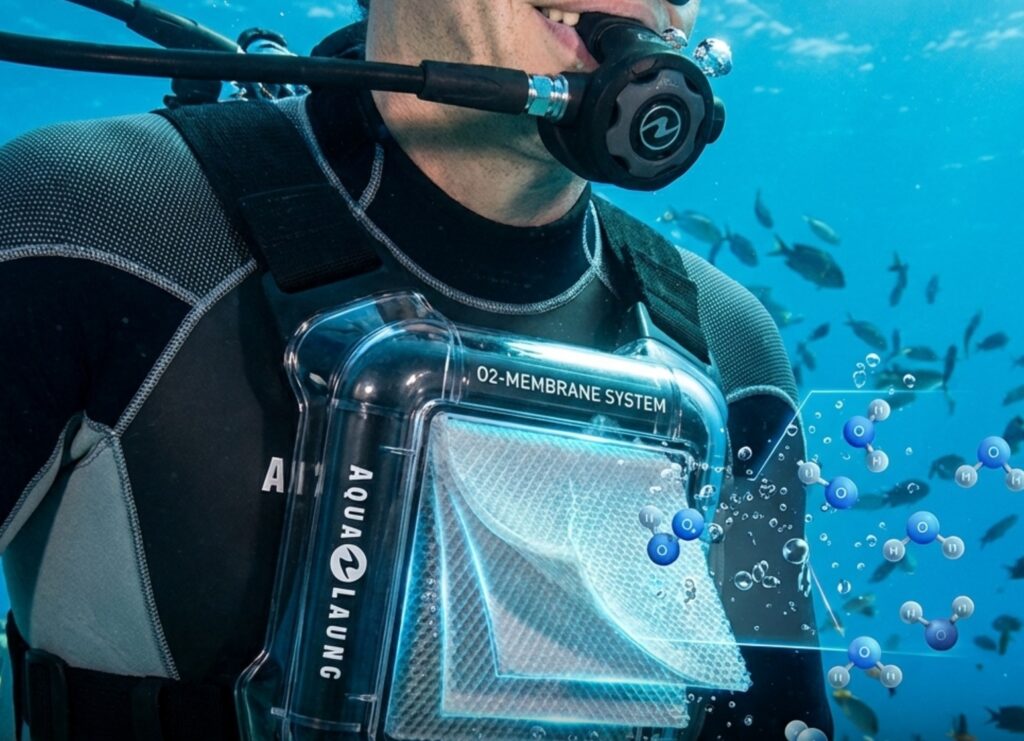

From time to time, sensational claims resurface online suggesting that humans are on the verge of breathing underwater like fish — no tanks, no bubbles, no limits. According to these narratives, advanced membrane technology has already enabled divers to extract oxygen directly from seawater, rendering scuba cylinders and even decompression sickness obsolete.
It sounds revolutionary.
It also isn’t true.
So where does reality stand when it comes to artificial gills and underwater respiration?
The Origin of the “Artificial Gills” Idea
The idea of artificial gills is not new. For decades, scientists and engineers have explored whether it might be possible to mimic fish gills using hydrophobic membranes — materials that allow gases to pass through while blocking liquid water.
In laboratory conditions, such membranes can separate gases from liquids. This principle is real and used in industrial and medical applications. However, translating it into a human life-support system underwater is where theory collides with biology and physics.
The Oxygen Problem No One Can Ignore
The core limitation is brutally simple:
Water contains very little oxygen.
Seawater typically holds only 6–8 milligrams of dissolved oxygen per liter. A resting human requires roughly 250 milliliters of oxygen per minute, and far more when swimming, stressed, or cold.
To meet that demand, a diver would need to process thousands of liters of water every minute — continuously — through a device small enough to wear on the chest. Passive water flow, no matter how cleverly engineered, simply cannot deliver that volume.
Fish solve this problem with:
- Massive gill surface area
- Ultra-thin membranes
- Continuous blood flow
- Extremely low metabolic oxygen demand
Humans have none of those advantages.
Why Depth Makes the Idea Even Less Plausible
Claims that test divers have “breathed normally” at depths of 60 meters using artificial gills raise even more red flags.
At such depths:
- Gas density increases breathing resistance
- Nitrogen narcosis becomes significant
- Oxygen partial pressure must be precisely controlled
- Thermal stress and workload skyrocket
Any system capable of supporting a human at 60 meters would need active pumping, compression control, gas regulation, redundancy, and monitoring — effectively turning it into a rebreather. At that point, extracting oxygen from water offers no advantage.
The Myth of Eliminating Decompression Sickness
One of the most dangerous claims circulating is that artificial gills would eliminate decompression sickness.
This is categorically false.
Decompression sickness occurs due to inert gas absorption, primarily nitrogen, dissolving into body tissues under pressure. Whether oxygen comes from a tank or from water makes no difference — nitrogen exposure remains.
As long as humans breathe a gas mixture underwater, decompression physiology still applies.
Military and Commercial Reality
While navies around the world invest heavily in:
- Closed-circuit rebreathers
- Oxygen rebreathers for shallow operations
- Advanced gas-management systems
There is no confirmed military use of artificial gill technology for human respiration. Submarine escape systems, special forces diving, and covert operations all still rely on conventional breathing gases — not oxygen extracted from water.
No verified field trials, operational deployments, or peer-reviewed data support the claims currently circulating online.
So Why Does the Myth Persist?
Because it’s compelling.
Artificial gills appeal to our imagination, blur the line between biology and technology, and promise freedom from tanks, bubbles, and limits. But when extraordinary claims appear without:
- Scientific publications
- Medical oversight
- Military confirmation
- Independent verification
They belong to science fiction, not diving reality.
What the Future Actually Holds
The future of diving innovation is real — just not magical.
Progress continues in:
- Safer and smarter rebreathers
- Better decompression modeling
- Improved materials and sensors
- Lower-profile life-support systems
- Enhanced diver monitoring and AI-assisted safety
Breathing water, however, remains beyond human capability.
Conclusion: Curiosity Is Healthy — Misinformation Is Not
Artificial gills are a fascinating concept and a valid subject for academic research. But as of today, no human can breathe underwater without a gas supply, and no technology has changed that fundamental truth.
In diving, respecting physics and physiology isn’t conservative — it’s what keeps us alive.

Diventures Team is a multidisciplinary team of scuba professionals, editors, and digital creators, producing accurate and experience-driven coverage of diving, marine life, and ocean culture.