
Rocky Island
Unverified
Overview
Rocky Island is one of Egypt’s most remote and exposed offshore dive sites. Situated in the Deep South, around five kilometres southeast of Zabargad Island, it is reached almost exclusively as part of a liveaboard itinerary.
The small island rises from deep open water and is surrounded by steep coral walls. These walls are densely covered with soft corals, hard corals, coral trees and overhanging formations, while the current brings nutrients that support large populations of reef fish.
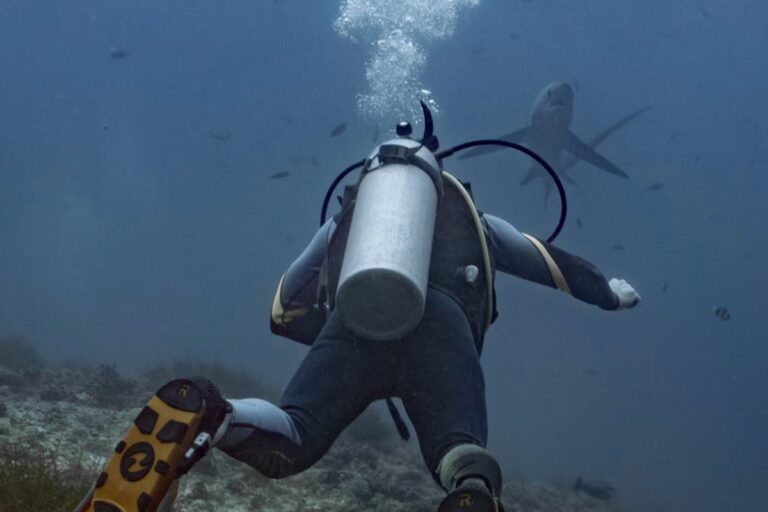
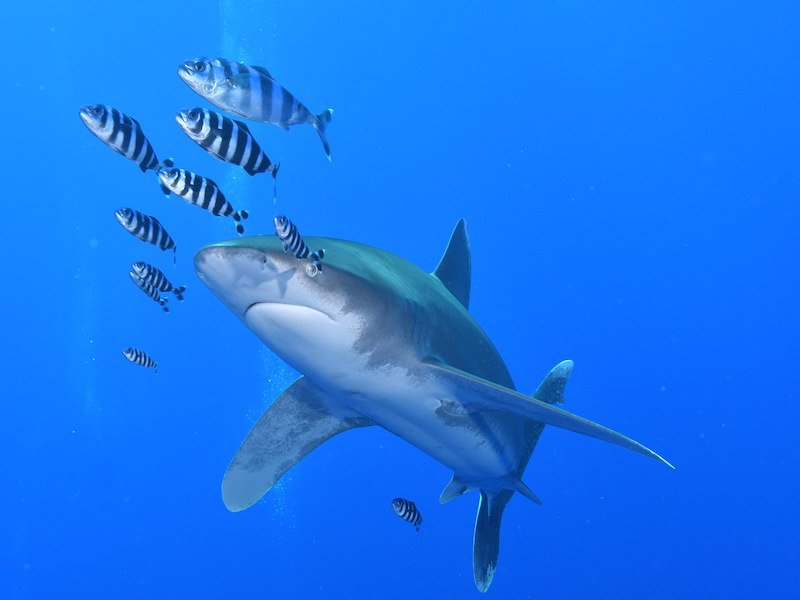
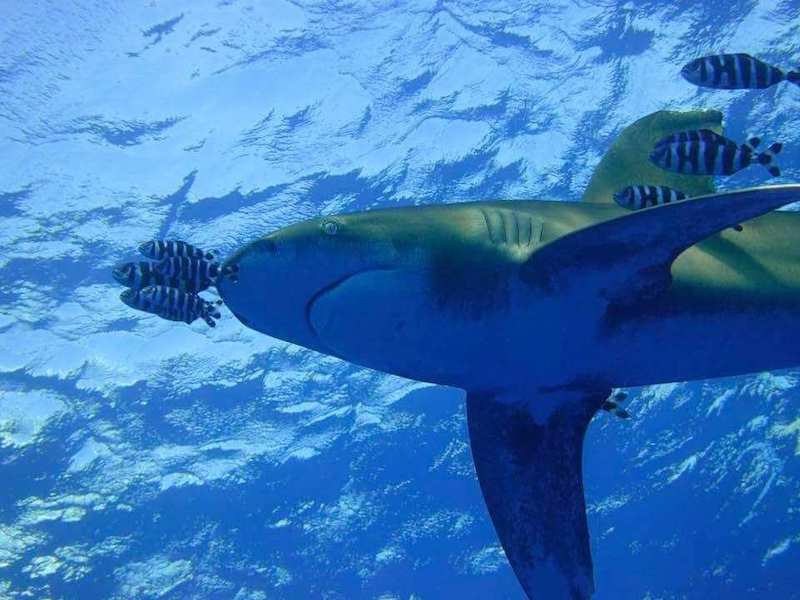
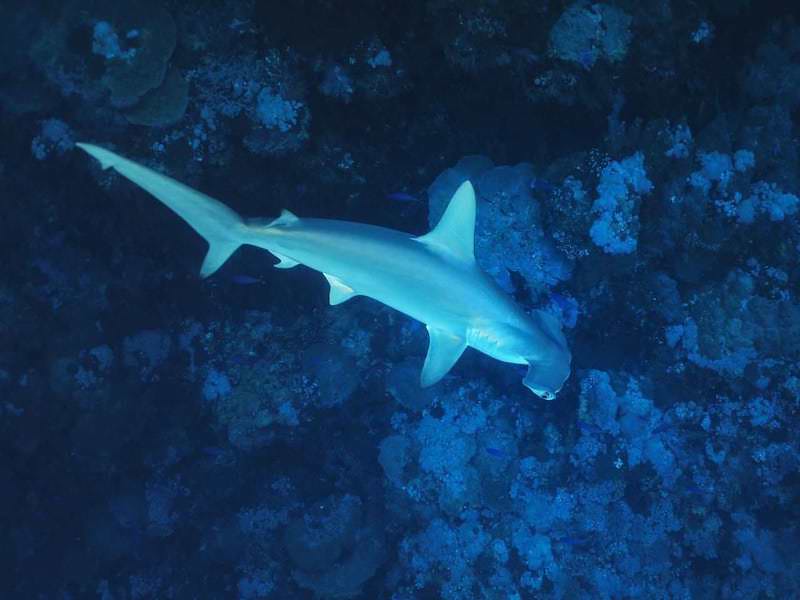
Rocky Island is especially known for pelagic encounters. Schools of barracuda and giant trevally patrol the reef, while grey reef sharks and silky sharks may appear along the walls. Oceanic whitetips, hammerheads, manta rays and tiger sharks are also possible, but these encounters are seasonal or uncommon and should never be expected as guaranteed sightings.
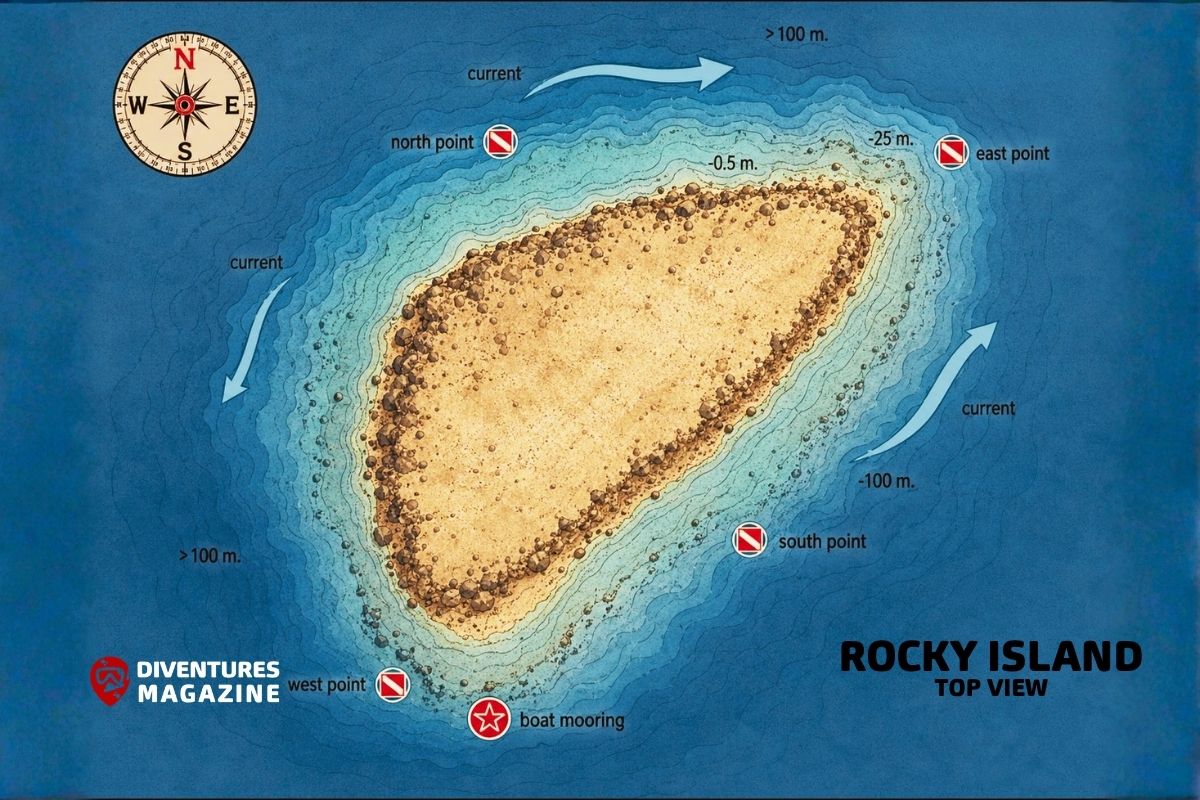
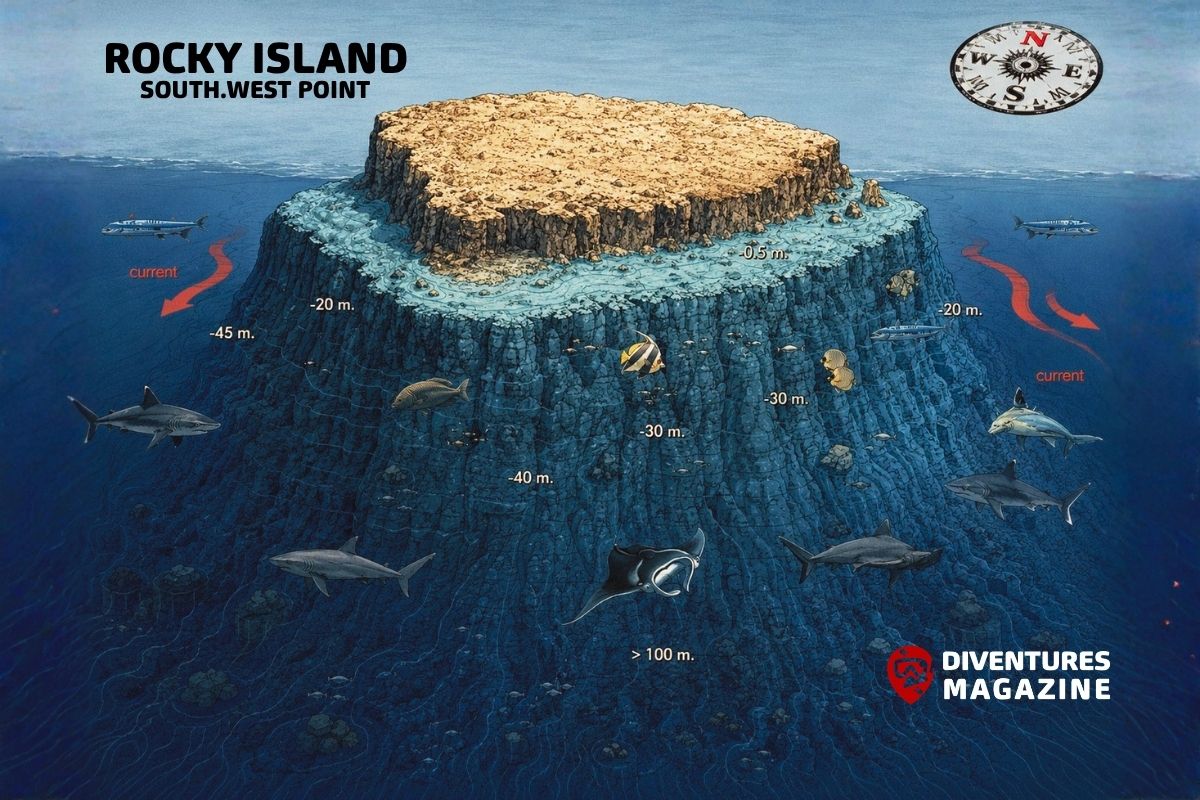
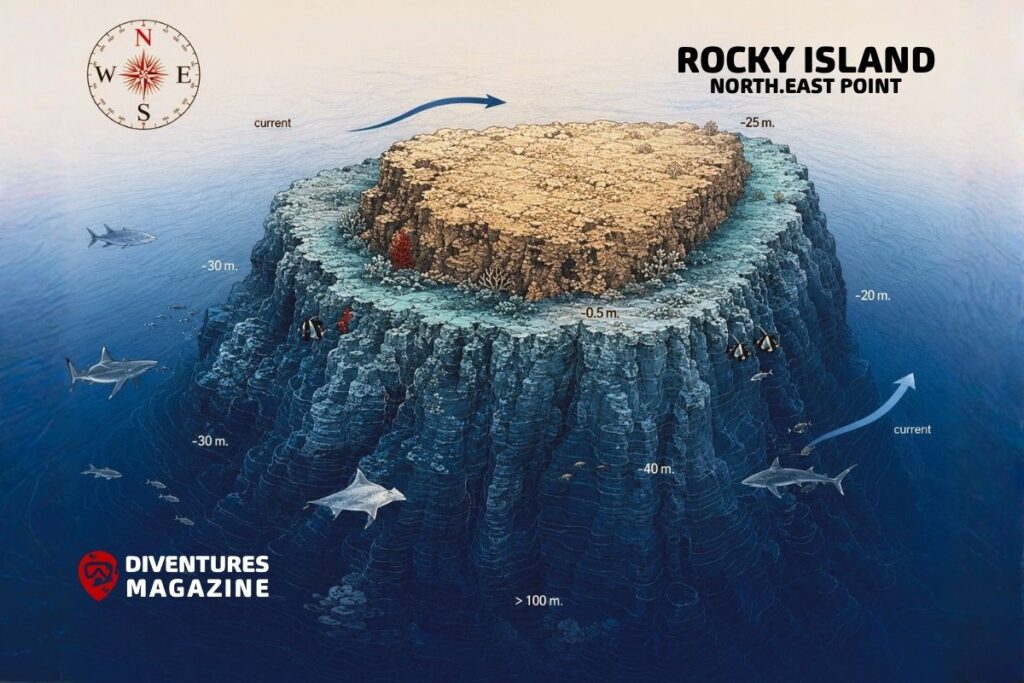
Most dives are conducted as drifts, with the entry point selected according to the current. The eastern and western sides can experience particularly strong water movement, and currents may change direction or carry divers away from the island into open water.
Because the walls offer few natural depth references, divers must monitor depth, gas supply and no-decompression time carefully. Blue-water ascents and RIB pickups are common, making delayed surface marker buoy skills essential.
Rocky Island is best suited to advanced divers who are comfortable with strong currents, deep walls, negative or rapid entries and open-ocean ascents. Its dramatic topography, healthy coral growth and potential pelagic encounters make it one of the most rewarding dives in Egypt’s southern Red Sea.
Main Attractions
Rocky Island is an exposed, remote site with steep walls, strong currents and no nearby shore-based support. Advanced certification and substantial experience with drift diving and blue-water ascents are strongly recommended.
Near-vertical walls surrounding an isolated offshore island
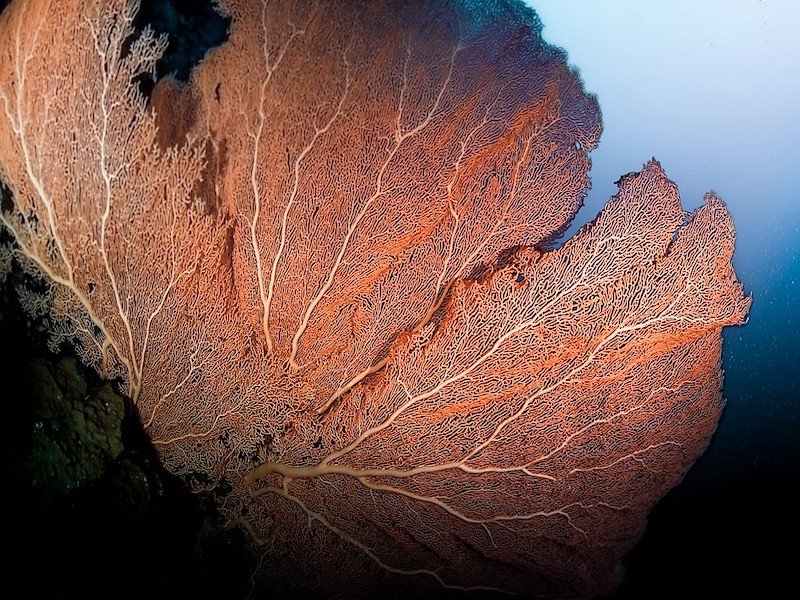
Dense soft-coral growth and coral-covered overhangs
Strong, nutrient-rich currents
Large schools of barracuda and giant trevally
Grey reef and silky shark encounters
Possible oceanic whitetip and hammerhead sightings
Rare possible tiger shark encounters
Open-ocean drift diving
The deep SS Maidan wreck for qualified technical divers
Exceptionally remote and uncrowded diving
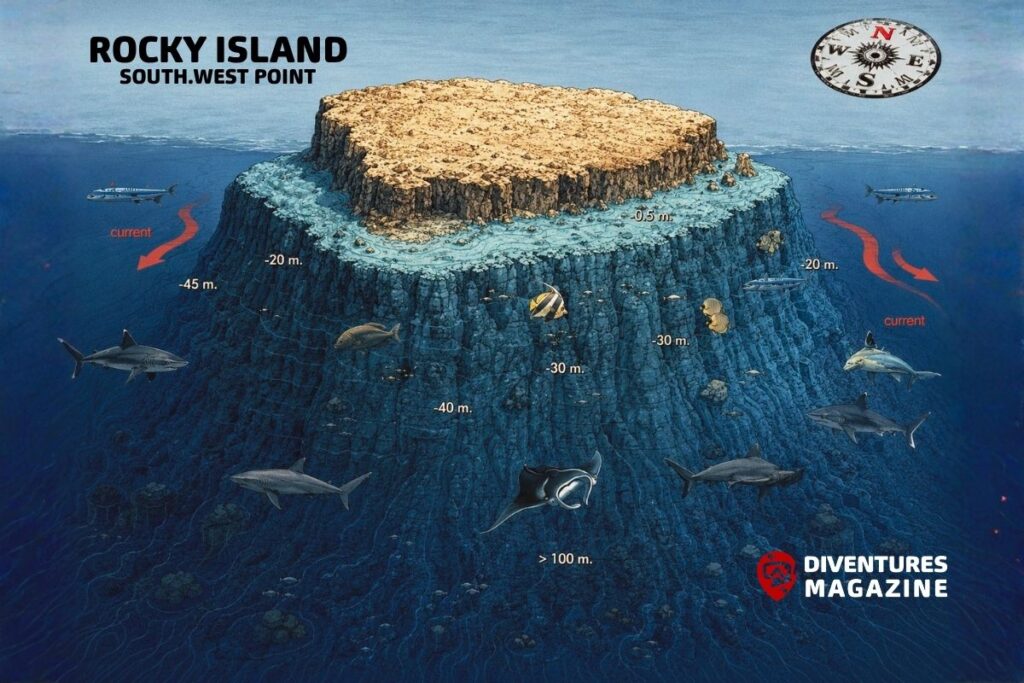
Rocky Island’s defining feature is its exposed seamount topography. Its walls fall rapidly into deep water, creating upwellings and current channels that attract schooling fish and pelagic predators.
Marine Life
Grey reef sharks, silky sharks, oceanic whitetip sharks, giant trevally, barracuda, tuna, Napoleon wrasse, blue-spotted rays, surgeonfish, anthias, moray eels and occasional spinner dolphins.
Scalloped hammerheads, manta rays and tiger sharks are possible but uncommon encounters. They should always be presented as possible sightings, never as guaranteed attractions.
Coral & Habitat
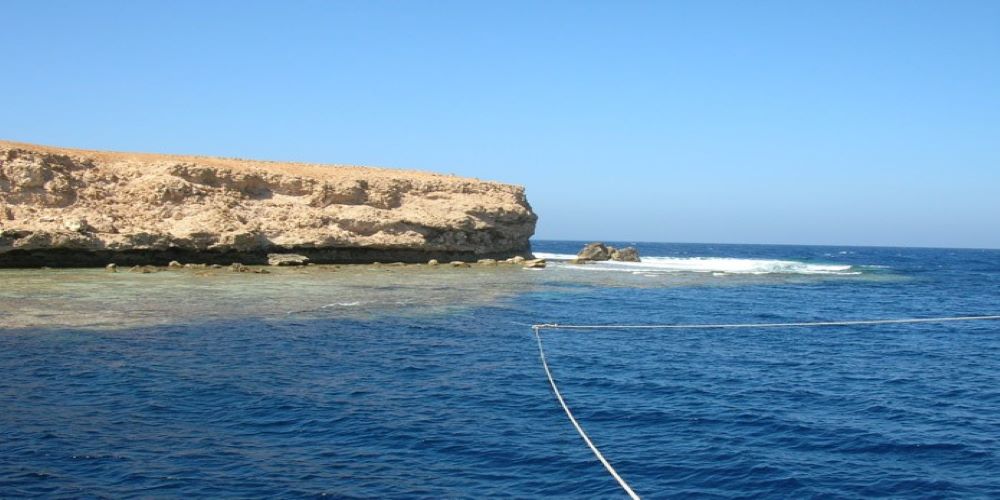
Rocky Island is a small, isolated offshore island surrounded by a fringing reef. Although the island measures only around 540 metres at its longest point, the underwater formation is much larger, with steep walls descending into deep open water on every side.
The walls are densely covered with soft corals, hard corals, coral trees, sponges and overhanging formations. Cracks, recesses and small cave-like openings provide shelter for reef fish, while schools of anthias and surgeonfish gather close to the coral-covered faces.
The island’s exposed position allows nutrient-rich currents to move around the reef, supporting dense marine life and attracting larger pelagic species into the surrounding blue water.
Wreck Information
The SS Maidan lies on the southern side of Rocky Island at depths of approximately 80–120 metres. The wreck is reported to be largely complete and relatively undisturbed because only a small number of technical divers have visited it.
The SS Maidan is far outside recreational diving limits and should not be presented as part of the standard Rocky Island dive. It is accessible only to appropriately trained and equipped technical diving teams with specialised planning and support.
Suggested Route
Southern wall drift
The guide should first assess the current before selecting the entry point. Enter from the RIB or liveaboard on the up-current side of the southern wall and descend close to the reef.
Continue along the coral-covered wall at approximately 20–30 metres, moving with the current while watching the open water for barracuda, giant trevally, tuna and possible sharks.
Gradually reduce depth as the dive progresses. Complete the safety stop close to the wall when conditions allow or beneath a delayed surface marker buoy before the RIB pickup.
Eastern-tip drift
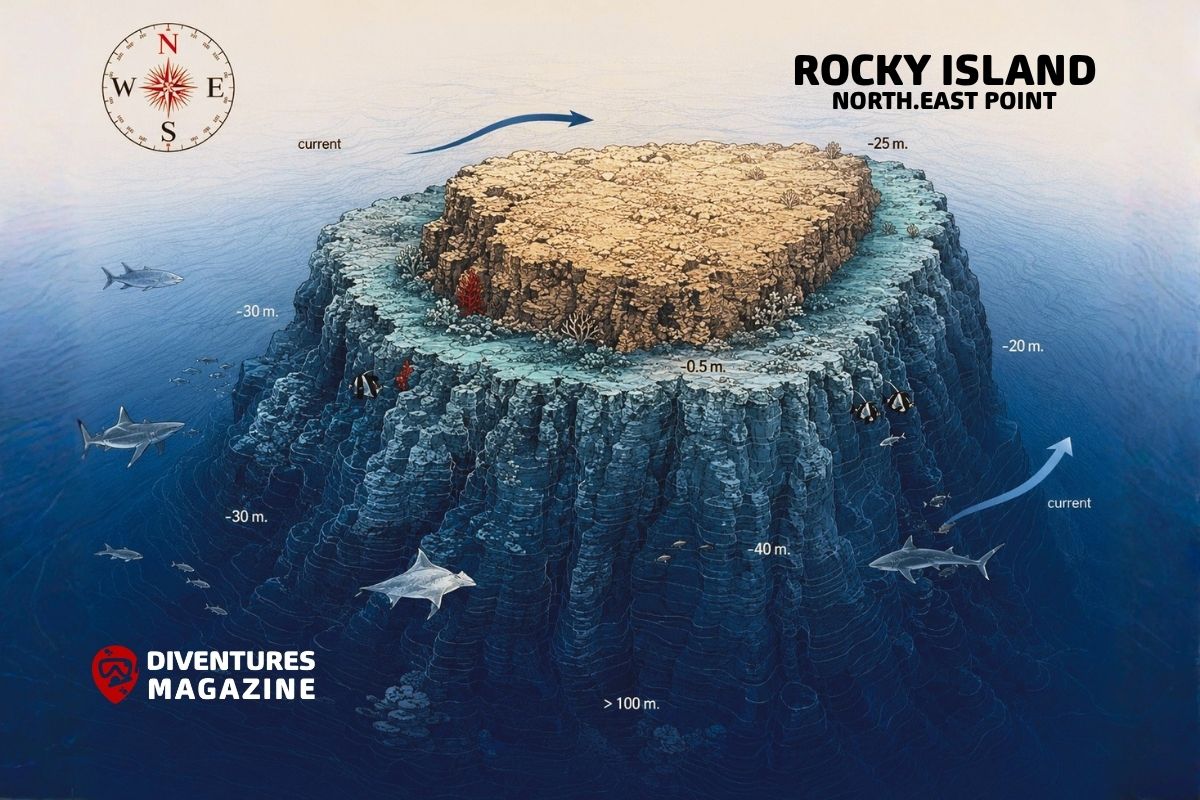
Experienced divers may begin near the eastern side and descend to approximately 25–30 metres. Follow the wall toward the exposed eastern corner, where stronger current and upwelling water can attract large fish.
Remain close to the reef and avoid following pelagic animals away from the wall or below the planned maximum depth. Finish on the northern side and ascend beneath a delayed surface marker buoy for collection by the RIB.
The final route, entry point and direction must always be chosen by an experienced local guide according to the actual current, waves and boat-pickup plan.
Photography Notes
Rocky Island is primarily a wide-angle photography destination. The coral-covered walls, large schools of barracuda, giant trevally and possible shark encounters provide the site’s strongest photographic opportunities.
The eastern tip and other exposed corners may concentrate pelagic activity where currents meet the wall. Photographers should prepare exposure, focus and strobe settings before reaching these areas because the current may make it difficult to stop or reposition.
The reef walls also provide opportunities for close-focus wide-angle images featuring soft corals, anthias and divers against the open blue. Photographers must avoid touching the reef or separating from the group while concentrating on a subject.
A delayed surface marker buoy should be readily accessible because blue-water ascents and RIB pickups are common at the site.
History
Rocky Island itself has no well-documented history of permanent settlement, mining or lighthouse activity. It is a small, uninhabited island whose main historical significance comes from the loss of the SS Maidan on its southern reef. The ancient peridot-mining history often associated with this area belongs to nearby Zabargad Island, not Rocky Island.
The SS Maidan was a British steel steam cargo ship built in Glasgow in 1912 for T. & J. Brocklebank. During the First World War, it was requisitioned as a troop transport and carried British infantry units from Southampton to Le Havre in November 1914.
On its final voyage in 1923, the vessel was travelling from Calcutta toward Europe with approximately 10,000 tonnes of cargo. After stopping at Port Sudan, it continued north toward Suez. Navigational errors and a failure to account properly for the Red Sea’s variable currents placed the ship dangerously close to Rocky Island. At 1:39 a.m. on 10 June 1923, the Maidan struck the reef.
Most of the ship’s 100 crew members and seven passengers were transferred to nearby St John’s Island, now known as Zabargad Island, and later rescued by the SS Warwickshire. The Maidan eventually slipped from the reef at 7:10 p.m. and sank into deep water south of Rocky Island. A subsequent Board of Trade inquiry criticised the captain’s navigation and failure to change course sufficiently after the island was sighted.
The wreck was rediscovered in 2003 by technical divers Grant Searancke and Kimmo Hagman. It now lies at approximately 80–120 metres, largely intact and accessible only to highly qualified technical diving teams.
Best Season
January, February, March, April, May, October, November, December
Underwater Map
Site Diagram